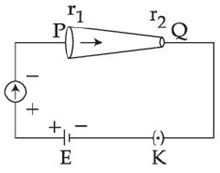
A current of \( 5 \, \text{A} \) is passing through a non-linear magnesium wire of cross-section \( 0.04 \, \text{m}^2 \). At every point the direction of current density is at an angle of \( 60^\circ \) with the unit vector of area of cross-section. The magnitude of electric field at every point of the conductor is: [Resistivity of magnesium \( \rho = 44 \times 10^{-8} \, \Omega \text{m} \) ]
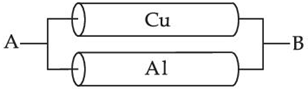
A copper (Cu) rod of length \( 25 \, \mathrm{cm} \) and cross-sectional area \( 3 \, \mathrm{mm^2} \) is joined with a similar Aluminium (Al) rod as shown in figure. Find the resistance of the combination between the ends A and B.
(Take Resistivity of Copper \( = 1.7 \times 10^{-8} \, \Omega \,\mathrm{m} \) , Resistivity of Aluminium \( = 2.6 \times 10^{-8} \, \Omega \,\mathrm{m} \) )