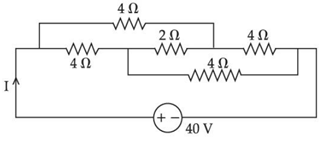
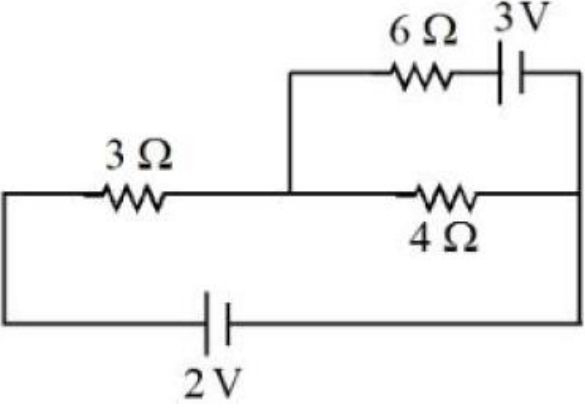
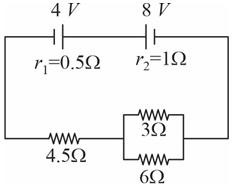
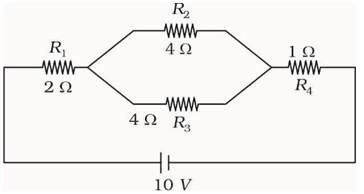
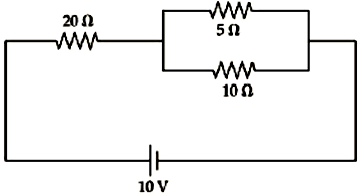
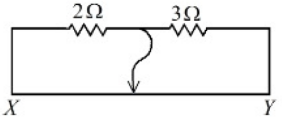
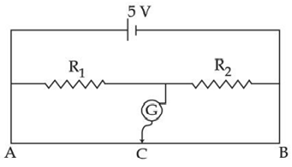
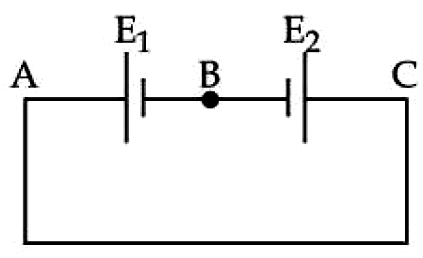
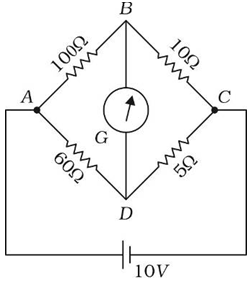
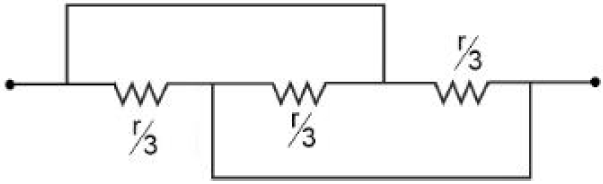
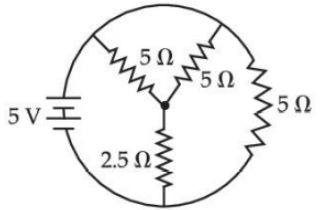
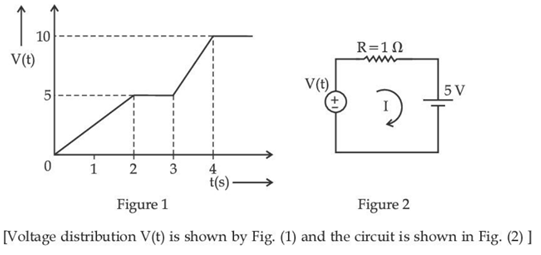
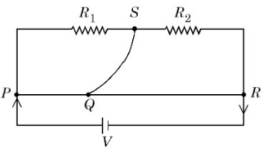
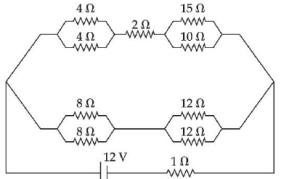
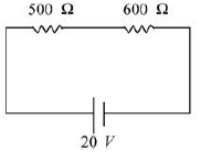
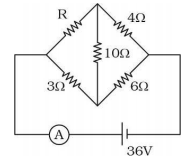
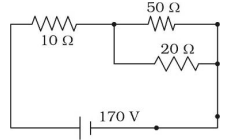
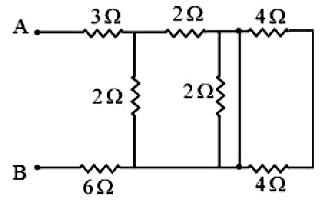
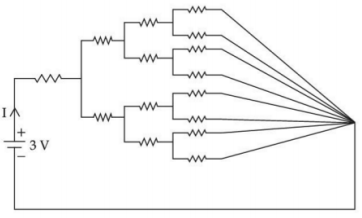
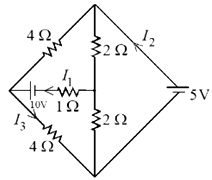
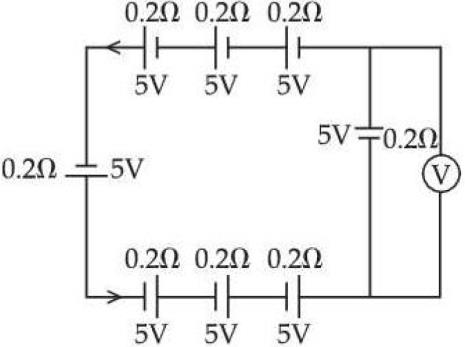
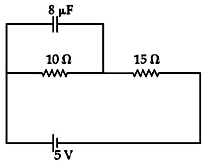
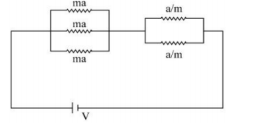
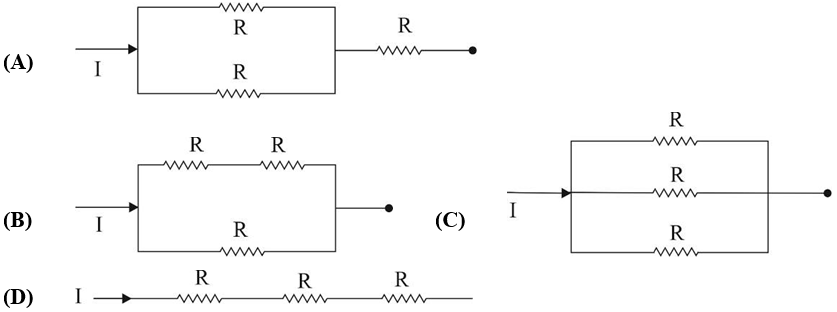
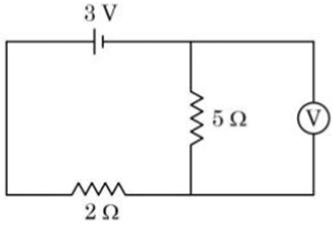
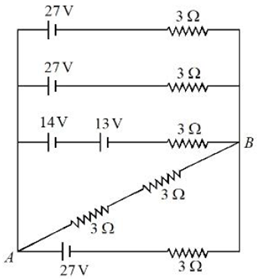
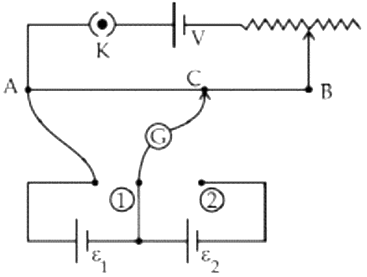
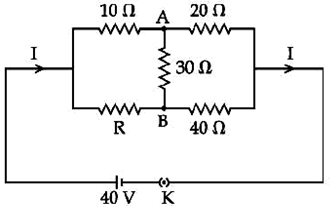
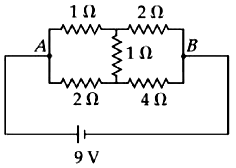
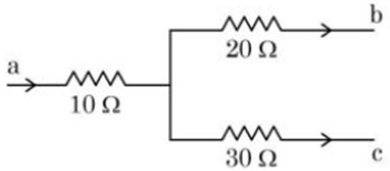
The current \( I \) in the given circuit will be:
\( 10 \, \text{A} \)
\( 20 \, \text{A} \)
\( 4 \, \text{A} \)
\( 40 \, \text{A} \)
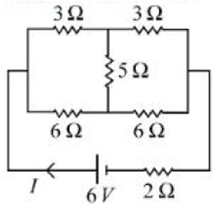
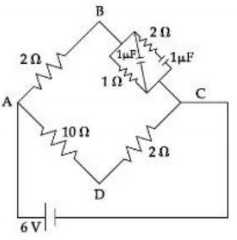
A battery of \( 6\,\text{V} \) is connected to the circuit as shown below. The current \( I \) drawn from the battery is:
An electric bulb rated \( 50 \, \text{W} \) – \( 200 \, \text{V} \) is connected across a \( 100 \, \text{V} \) supply. The power dissipation of the bulb is:
The current flowing through a conductor connected across a source is \( 2\,\text{A} \) and \( 1.2\,\text{A} \) at \( 0^{\circ}\text{C} \) and \( 100^{\circ}\text{C} \) respectively. The current flowing through the conductor at \( 50^{\circ}\text{C} \) will be _____ \( \times 10^{2} \,\text{mA} \).
What will be the most suitable combination of three resistors \( A = 2\Omega \), \( B = 4\Omega \), \( C = 6\Omega \) so that \( \left(\frac{22}{3}\right)\Omega \) is equivalent resistance of combination?
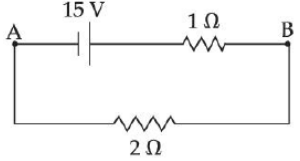
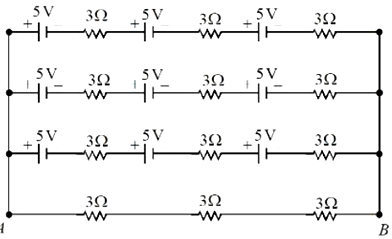
For the network shown below, the value of \( V_B - V_A \) is __________ \( \text{V} \).
An electric bulb rated as \( 100 \, \text{W} - 220 \, \text{V} \) is connected to an ac source of rms voltage \( 220 \, \text{V} \). The peak value of current through the bulb is:
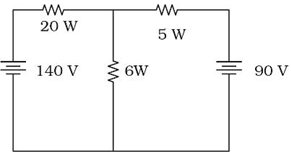
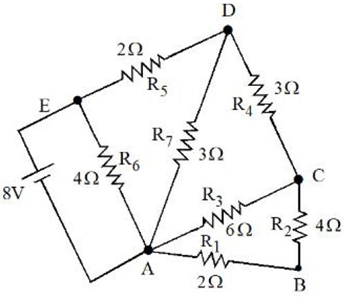
The value of current in the \( 6 \, \Omega \) resistance is:
At room temperature \( (27^\circ \text{C}) \), the resistance of a heating element is \( 50 \, \Omega \). The temperature coefficient of the material is \( 2.4 \times 10^{-4} \, ^\circ \text{C}^{-1} \). The temperature of the element, when its resistance is \( 62 \, \Omega \) is ......\( ^\circ \text{C} \).
A teacher in his physics laboratory allotted an experiment to determine the resistance \( (G) \) of a galvanometer. Students took the observations for \( \frac{1}{3} \) deflection in the galvanometer. Which of the below is true for measuring value of \( G \)?
For the two cells having same EMF \( E \) and internal resistance \( r \), the current passing through the external resistor \( 6\,\Omega \) is same when both the cells are connected either in parallel or in series. The value of internal resistance \( r \) is __________ \( \Omega \).
Five identical cells each of internal resistance \( 1\,\Omega \) and emf \( 5\,\text{V} \) are connected in series and in parallel with an external resistance \( R \). For what value of \( R \), current in series and parallel combination will remain the same?
In an ammeter, \( 5\% \) of the main current passes through the galvanometer. If resistance of the galvanometer is \( G \), the resistance of ammeter will be:
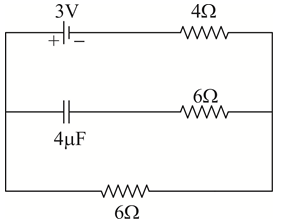
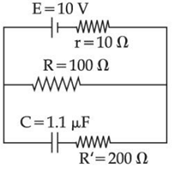
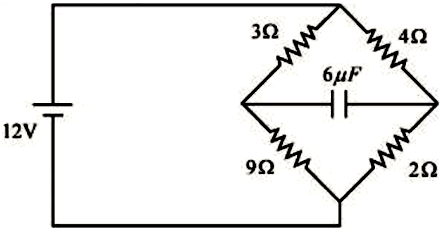
In the network shown below, the charge accumulated in the capacitor in steady state will be:
A current of \( 10 \, \text{A} \) exists in a wire of crossectional area of \( 5 \, \text{mm}^{2} \) with a drift velocity of \( 2 \times 10^{-3} \, \text{m s}^{-1} \). The number of free electrons in each cubic meter of the wire is ________.
If a copper wire is stretched to increase its length by \( 20\% \). The percentage increase in resistance of the wire is ________ \( \% \).
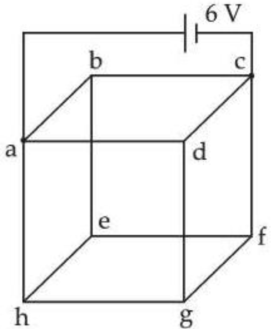
Twelve wires each having resistance \( 2\,\Omega \) are joined to form a cube. A battery of \( 6 \,\text{V} \) emf is joined across point \( a \) and \( c \). The voltage difference between \( e \) and \( f \) is _______ \( \text{V} \).
In the given figure an ammeter \( A \) consists of a \( 240 \, \Omega \) coil connected in parallel to a \( 10 \, \Omega \) shunt. The reading of the ammeter is ________ \( \text{mA} \).
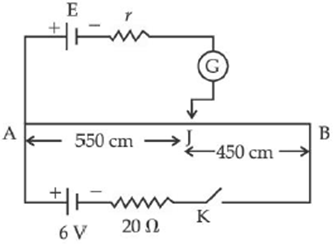
In the given figure, there is a circuit of potentiometer of length \( AB = 10 \, \text{m} \). The resistance per unit length is \( 0.1 \, \Omega / \text{cm} \). Across \( AB \), a battery of emf \( E \) and internal resistance '\( r \)' is connected. The maximum value of emf measured by this potentiometer is:
A wire of resistance \( R \) and radius \( r \) is stretched till its radius became \( \frac{r}{2} \). If new resistance of the stretched wire is \( xR \), then value of \( x \) is ________.
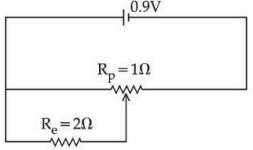
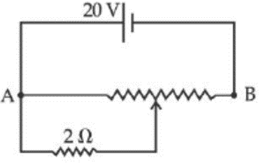
Sliding contact of a potentiometer is in the middle of the potentiometer wire having resistance \( R_p = 1 \, \Omega \) as shown in the figure. An external resistance of \( R_e = 2 \, \Omega \) is connected via the sliding contact. The electric current in the circuit is:
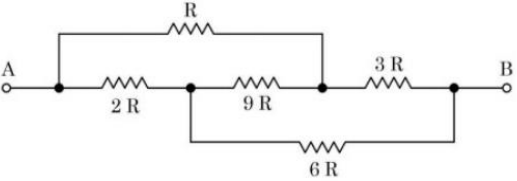
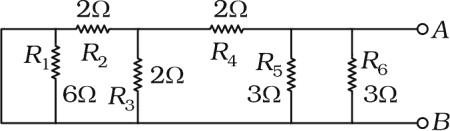
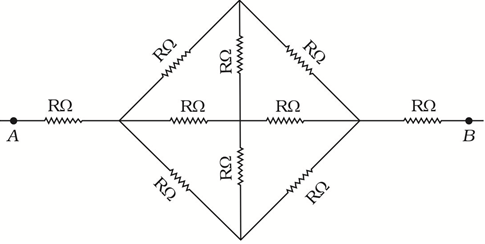
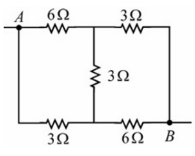
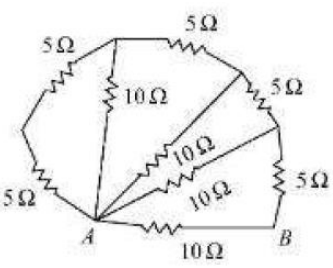
The equivalent resistance between \( A \) and \( B \) of the network shown in figure:
The charge flowing in a conductor changes with time as \( Q(t) = \alpha t - \beta t^{2} + \gamma t^{3} \). Where \( \alpha \), \( \beta \) and \( \gamma \) are constants. Minimum value of current is:
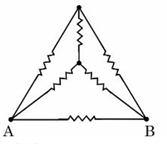
A wire of resistance \( R \) is bent into a triangular pyramid as shown in figure with each segment having same length. The resistance between points \( A \) and \( B \) is \( \frac{R}{n} \). The value of \( n \) is:
Which of the following resistivity \( (\rho) \) v/s temperature \( (T) \) curves is most suitable to be used in wire bound standard resistors?
A galvanometer has a resistance of \( 50\,\Omega \) and it allows maximum current of \( 5\,\mathrm{mA} \). It can be converted into voltmeter to measure upto \( 100\,\mathrm{V} \) by connecting in series a resistor of resistance:
Refer to the circuit diagram given below. The heat generated across the \( 6\Omega \) resistance in \( 100 \) second is \( \dfrac{\alpha}{100} \, \text{J} \). The value of \( \alpha \) is ______. (Nearest integer)
A cell of emf \( 90 \, \text{V} \) is connected across series combination of two resistors each of \( 100 \, \Omega \) resistance. A voltmeter of resistance \( 400 \, \Omega \) is used to measure the potential difference across each resistor. The reading of the voltmeter will be:
A galvanometer having coil resistance \( 10\,\Omega \) shows a full scale deflection for a current of \( 3 \,\text{mA} \). For it to measure a current of \( 8 \,\text{A} \), the value of the shunt should be:
The electric current through a wire varies with time as \( I = I_0 + \beta t \), where \( I_0 = 20 \, \text{A} \) and \( \beta = 3 \, \text{A/s} \). The amount of electric charge crossed through a section of the wire in \( 20 \, \text{s} \) is:
Two wires A and B are made up of the same material and have the same mass. Wire A has radius of \( 2.0 \, \text{mm} \) and wire B has radius of \( 4.0 \, \text{mm} \). The resistance of wire B is \( 2 \, \Omega \). The resistance of wire A is ____________ \( \Omega \).
In a meter bridge experiment the balance point is obtained if the gaps are closed by \( 2\Omega \) and \( 3\Omega \). A shunt of \( X\Omega \) is added to \( 3\Omega \) resistor to shift the balancing point by \( 22.5 \, \text{cm} \). The value of \( X \) is ____.
The equivalent resistance between \( A \) and \( B \) is ___________.
A wire of length \( 10 \, \text{cm} \) and radius \( \sqrt{7} \times 10^{-4} \, \text{m} \) connected across the right gap of a meter bridge. When a resistance of \( 4.5 \, \Omega \) is connected on the left gap by using a resistance box, the balance length is found to be at \( 60 \, \text{cm} \) from the left end. If the resistivity of the wire is \( R \times 10^{-7} \, \Omega \, \text{m} \), then value of \( R \) is :
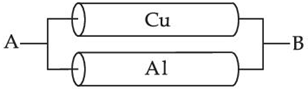
A copper (Cu) rod of length \( 25 \, \mathrm{cm} \) and cross-sectional area \( 3 \, \mathrm{mm^2} \) is joined with a similar Aluminium (Al) rod as shown in figure. Find the resistance of the combination between the ends A and B.(Take Resistivity of Copper \( = 1.7 \times 10^{-8} \, \Omega \,\mathrm{m} \) , Resistivity of Aluminium \( = 2.6 \times 10^{-8} \, \Omega \,\mathrm{m} \) )
A uniform metallic wire carries a current \( 2 \, \text{A} \), when \( 3.4 \, \text{V} \) battery is connected across it. The mass of uniform metallic wire is \( 8.92 \times 10^{-3} \, \text{kg} \), density is \( 8.92 \times 10^{3} \, \text{kg}/\text{m}^{3} \) and resistivity is \( 1.7 \times 10^{-8} \, \Omega\text{-m} \). The length of wire is:
The resistance of a conductor \( 15^\circ \text{C} \) is \( 16 \, \Omega \) and at \( 100^\circ \text{C} \) is \( 20 \, \Omega \). What will be the temperature coefficient of resistance of the conductor?
Seawater at a frequency \( f = 9 \times 10^2\,Hz \), has permittivity \( \varepsilon = 80\,\varepsilon_0 \) and resistivity \( \rho = 0.25\,\Omega m \). Imagine a parallel plate capacitor is immersed in seawater and is driven by an alternating voltage source \( V(t) = V_0 \sin(2 \pi ft) \). Then the conduction current density becomes \( 10^x \) times the displacement current density after time \( t = \dfrac{1}{800}\,s \). The value of \( x \) is ________. (Given: \( \dfrac{1}{4\pi \varepsilon_0} = 9 \times 10^9\, N m^2 C^{-2} \))
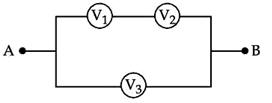
Three voltmeters, all having different internal resistances are joined as shown in figure. When some potential difference is applied across \( A \) and \( B \), their readings are \( V_1, V_2 \) and \( V_3 \). Choose the correct option.
Two resistance of \( 100\,\Omega \) and \( 200\,\Omega \) are connected in series with a battery of \( 4\,\text{V} \) and negligible internal resistance. A voltmeter is used to measure voltage across \( 100\,\Omega \) resistance, which give reading as \( 1\,\text{V} \). The resistance of voltmeter must be ______ \( \Omega \).
Two sources of equal emfs are connected in series. This combination is connected to an external resistance \( R \). The internal resistances of the two sources are \( r_1 \) and \( r_2 \) (\( r_1 > r_2 \)). If the potential difference across the source of internal resistance \( r_1 \) is zero, then the value of \( R \) will be:
A potential \( V_{0} \) is applied across a uniform wire of resistance \( R \). The power dissipation is \( P_{1} \). The wire is then cut into two equal halves and a potential of \( V_{0} \) is applied across the length of each half. The total power dissipation across two wires is \( P_{2} \). The ratio \( P_{2} : P_{1} \) is \( \sqrt{x} : 1 \). The value of \( x \) is ________.
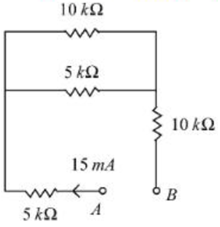
A current of \( 15 \,\text{mA} \) flows in the circuit as shown in figure. The value of potential difference between the points \( A \) and \( B \) will be:
Two identical cells each of emf \( 1.5 \, \text{V} \) are connected in series across a \( 10 \, \Omega \) resistance. An ideal voltmeter connected across \( 10 \, \Omega \) resistance reads \( 1.5 \, \text{V} \). The internal resistance of each cell is _______ \( \Omega \).
The equivalent resistance of series combination of two resistor is ‘\( s \)’. When they are connected in parallel, the equivalent resistance is ‘\( p \)’. If \( s = n p \), then the minimum value for \( n \) is ______. (Round off to the Nearest Integer)
A moving coil galvanometer of resistance \( 100 \, \Omega \) shows a full scale deflection for a current of \( 1 \, \text{mA} \). The value of resistance required to convert this galvanometer into an ammeter, showing full scale deflection for a current of \( 5 \, \text{mA} \), is ____________ \( \Omega \).
Two wires of same length and thickness having specific resistances \( 6 \, \Omega \, \text{cm} \) and \( 3 \, \Omega \, \text{cm} \) respectively are connected in parallel. The effective resistivity is \( \rho \, \Omega \, \text{cm} \). The value of \( \rho \), to the nearest integer is:
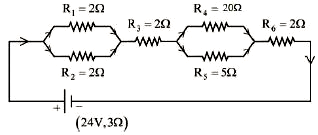
As shown in the figure, a network of resistors is connected to a battery of \( 24 \, \text{V} \) with an internal resistance of \( 3 \, \Omega \). The currents through the resistors \( R_4 \) & \( R_5 \) are \( I_4 \) & \( I_5 \) respectively. The values of \( I_4 \) & \( I_5 \) are :
Resistance of the wire is measured as \( 2 \, \Omega \) and \( 3 \, \Omega \) at \( 10^{\circ}\text{C} \) and \( 30^{\circ}\text{C} \) respectively. Temperature co-efficient of resistance of the material of the wire is:
A \( 16\,\Omega \) wire is bend to form a square loop. A \( 9 \, \text{V} \) supply having internal resistance of \( 1\,\Omega \) is connected across one of its sides. The potential drop across the diagonals of the square loop is ______ \( \times 10^{-1} \, \text{V} \).
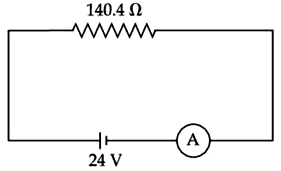
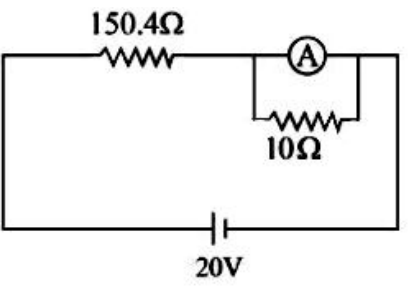
In the figure shown below, a resistance of \( 150.4 \, \Omega \) is connected in series to an ammeter A of resistance \( 240 \, \Omega \). A shunt resistance of \( 10 \, \Omega \) is connected in parallel with the ammeter. The reading of the ammeter is ________ \( \text{mA} \).
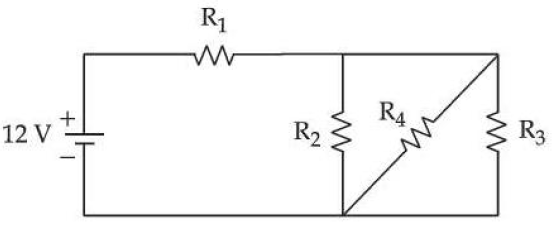
In the given figure \( R_1 = 10 \, \Omega \), \( R_2 = 8 \, \Omega \), \( R_3 = 4 \, \Omega \) and \( R_4 = 8 \, \Omega \). Battery is ideal with emf \( 12 \, \text{V} \). Equivalent resistant of the circuit and current supplied by battery are respectively:
An aluminium wire is stretched to make its length, \( 0.4\% \) larger. The percentage change in resistance is:
In the circuit diagram shown in figure given below, the current flowing through resistance \( 3\Omega \) is \( \dfrac{x}{3} \, \text{A} \). The value of \( x \) is _________.
Two metallic wires of identical dimensions are connected in series. If \( \sigma_1 \) and \( \sigma_2 \) are the conductivities of the these wires respectively, the effective conductivity of the combination is:
The equivalent resistance of the given circuit between the terminals A and B is:
As shown in the figure, in steady state, the charge stored in the capacitor is ________ \( \times 10^{-6} \, \text{C} \).
In the given circuit, the current in resistance \( R_{3} \) is:
In a potentiometer arrangement, a cell of emf \( 1.20 \, \text{V} \) gives a balance point at \( 36 \, \text{cm} \) length of wire. This cell is now replaced by another cell of emf \( 1.80 \, \text{V} \). The difference in balancing length of potentiometer wire in above conditions will be __________ \( \text{cm} \).
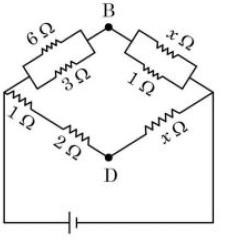
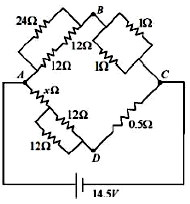
If the potential difference between \( B \) and \( D \) is zero, the value of \( x \) is \( \frac{1}{n} \, \Omega \). The value of \( n \) is _______.
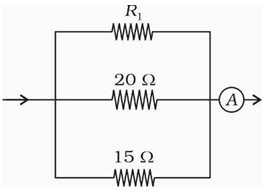
In the given circuit, the current flowing through the resistance \( 20 \, \Omega \) is \( 0.3 \, \text{A} \), while the ammeter reads \( 0.9 \, \text{A} \). The value of \( R_1 \) is ________ \( \Omega \).
Two cells of emfs \( 1 \, \text{V} \) and \( 2 \, \text{V} \) and internal resistances \( 2 \, \Omega \) and \( 1 \, \Omega \), respectively, are connected in series with an external resistance of \( 6 \, \Omega \). The total current in the circuit is \( I_{1} \). Now the same two cells in parallel configuration are connected to same external resistance. In this case, the total current drawn is \( I_{2} \). The value of \( \left( \dfrac{I_{1}}{I_{2}} \right) \) is \( \dfrac{x}{3} \). The value of \( x \) is ____________.
The value of unknown resistance \( (x) \) for which the potential difference between \( B \) and \( D \) will be zero in the arrangement shown, is:
Given below are two statements:Statement I: The equivalent resistance of resistors in a series combination is smaller than least resistance used in the combination.Statement II: The resistivity of the material is independent of temperature.In the light of the above statements, choose the correct answer from the options given below:
The ratio of heat dissipated per second through the resistance \( 5 \, \Omega \) and \( 10 \, \Omega \) in the circuit given below is:
Given below are two statements:
In the light of the above statements, choose the most appropriate answer from the option given below:
Two resistors \( 2\,\Omega \) and \( 3\,\Omega \) are connected in the gaps of bridge as shown in figure. The null point is obtained with the contact of jockey at some point on wire \( XY \). When an unknown resistor is connected in parallel with \( 3\,\Omega \) resistor, the null point is shifted by \( 22.5 \,\text{cm} \) toward \( Y \). The resistance of unknown resistor is ______ \( \Omega \).
In an experiment to find emf of a cell using potentiometer, the length of null point for a cell of emf \( 1.5\,\text{V} \) is found to be \( 60\,\text{cm} \). If this cell is replaced by another cell of emf \( E \), the length of null point increases by \( 40\,\text{cm} \). The value of \( E \) is \( \frac{x}{10}\,\text{V} \). The value of \( x \) is ________.
A resistor dissipates \( 192 \, \text{J} \) energy in \( 1 \, \text{s} \) when a current of \( 4 \, \text{A} \) is passed through it. Now, when the current is doubled, the amount of thermal energy dissipated in \( 5 \, \text{s} \) is ______ J.
When two resistances \( R_1 \) and \( R_2 \) connected in series and introduction into the left gap of a meter bridge and a resistance of \( 10 \, \Omega \) is introduced into the right gap, a null point is found at \( 60 \, \text{cm} \) from left side. When \( R_1 \) and \( R_2 \) are connected in parallel and introduced into the left gap, a resistance of \( 3 \, \Omega \) is introduced into the right-gap to get null point at \( 40 \, \text{cm} \) from left end. The product of \( R_1 R_2 \) is _____ \( \Omega^2 \).
If \( n \) represents the actual number of deflections in a converted galvanometer of resistance \( G \) and shunt resistance \( S \). Then the total current \( I \) when its figure of merit is \( K \) will be:
Eight copper wire of length \( l \) and diameter \( d \) are joined in parallel to form a single composite conductor of resistance \( R \). If a single copper wire of length \( 2l \) have the same resistance \( (R) \) then its diameter will be ________ \( d \).
Two cells of emfs \( 1 \, \text{V} \) and \( 2 \, \text{V} \) and internal resistance \( 2 \, \Omega \) and \( 1 \, \Omega \), respectively connected in parallel, gave a current of \( 1 \, \text{A} \) through an external resistance. If the polarity of one cell is reversed, then value of current through the external resistance will be \( \dfrac{\alpha}{5} \, \text{A} \). The value of \( \alpha \) is __________.
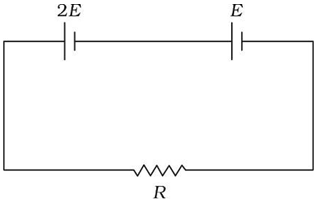
Two cells of emf \( 2E \) and \( E \) with internal resistance \( r_1 \) and \( r_2 \) respectively are connected in series to an external resistor \( R \) (see figure). The value of \( R \), at which the potential difference across the terminals of the first cell becomes zero is:
From the combination of resistors with resistances values \( R_1=R_2=R_3=5\,\Omega \) and \( R_4=10\,\Omega \), which of the following combination is the best circuit to get an equivalent \( 6\,\Omega \)?
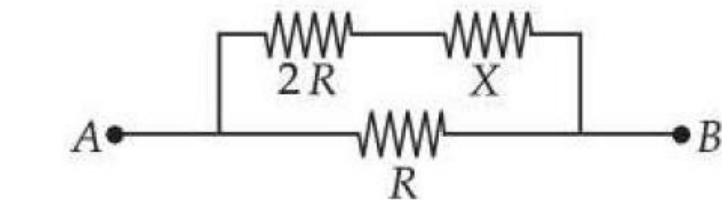
Two known resistances of \( R\,\Omega \) and \( 2R\,\Omega \) and one unknown resistance \( x\,\Omega \) are connected in a circuit as shown in the figure. If the equivalent resistance between points \( A \) and \( B \) in the circuit is \( x\,\Omega \), then the value of \( x \) is _______ \( \Omega \).
\( (A) \) The drift velocity of electrons decreases with the increase in the temperature of conductor.\( (B) \) The drift velocity is inversely proportional to the area of cross-section of given conductor.\( (C) \) The drift velocity does not depend on the applied potential difference to the conductor.\( (D) \) The drift velocity of electron is inversely proportional to the length of the conductor.\( (E) \) The drift velocity increases with the increase in the temperature of conductor.Choose the correct answer from the options given below:
The number of turns of the coil of a moving coil galvanometer is increased in order to increase current sensitivity by \( 50\% \). The percentage change in voltage sensitivity of the galvanometer will be:
The current in a conductor is expressed as \( I = 3t^{2} + 4t^{3} \), where \( I \) is in Ampere and \( t \) is in second. The amount of electric charge that flows through a section of the conductor during \( t = 1 \, \text{s} \) to \( t = 2 \, \text{s} \) is _____ \( \text{C} \).
A student is provided with a variable voltage source \( V \), a test resistor \( R_T = 10 \, \Omega \), two identical galvanometers \( G_1 \) and \( G_2 \) and two additional resistors, \( R_1 = 10 \, \text{M}\Omega \) and \( R_2 = 0.001 \, \Omega \). For conducting an experiment to verify ohm’s law, the most suitable circuit is:
When an external resistance of \( 5 \, \Omega \) is connected across terminals of a cell, a current of \( 0.25 \, \text{A} \) flows through it. When the \( 5 \, \Omega \) resistor is replaced by a \( 2 \, \Omega \) resistor, a current of \( 0.5 \, \text{A} \) flows through it. The internal resistance of the cell is ___________ \( \Omega \).
What equal length of an iron wire and a copper-nickel alloy wire, each of \( 2 \text{mm} \) diameter connected parallel to give an equivalent resistance of \( 3 \Omega \)? (Given resistivities of iron and copper-nickel alloy wire are \( 12 \mu\Omega \text{cm} \) and \( 51 \mu\Omega \text{cm} \) respectively).
A current of \( 2 \, \text{A} \) flows through a wire of cross-sectional area \( 25.0 \, \text{mm}^{2} \). The number of free electrons in a cube meter are \( 2.0 \times 10^{28} \). The drift velocity of the electrons is ________ \( \times 10^{-6} \, \text{m}\,\text{s}^{-1} \). (Given, charge on electron \( = 1.6 \times 10^{-19} \, \text{C} \))
The battery of a mobile phone is rated as \( 4.2 \, \mathrm{V} \), \( 5800 \, \mathrm{mAh} \). How much energy is stored in it when fully charged?
In the given figure of meter bridge experiment, the balancing length \( AC \) corresponding to null deflection of the galvanometer is \( 40 \, \text{cm} \). the balancing length, if the radius of the wire \( AB \) is doubled, will be _____ \( \text{cm} \).
In the given figure switches \( S_{1} \) and \( S_{2} \) are in open condition. The resistance across \( ab \) when the switches \( S_{1} \) and \( S_{2} \) are closed is __________ \( \Omega \).
Two cells are connected in opposition as shown. Cell \( E_1 \) is of \( 8 \, \text{V} \) emf and \( 2 \, \Omega \) internal resistance; the cell \( E_2 \) is of \( 2 \, \text{V} \) emf and \( 4 \, \Omega \) internal resistance. The terminal potential difference of cell \( E_2 \) is ____ \( \text{V} \).
The four arms of a Wheatstone bridge have resistances as shown in the figure. A galvanometer of \( 15\,\Omega \) resistance is connected across \( BD \). Calculate the current through the galvanometer when a potential difference of \( 10\,\text{V} \) is maintained across \( AC \).
A wire of resistance \( 20 \, \Omega \) is divided into \( 10 \) equal parts, resulting pairs. A combination of two parts are connected in parallel and so on. Now resulting pairs of parallel combination are connected in series. The equivalent resistance of final combination is _____ \( \Omega \).
The \( H \) amount of thermal energy is developed by a resistor in \( 10 \, \text{s} \) when a current of \( 4 \, \text{A} \) is passed through it. If the current is increased to \( 16 \, \text{A} \), the thermal energy developed by the resistor in \( 10 \, \text{s} \) will be:
The energy dissipated by a resistor is \( 10 \ \text{mJ} \) in \( 1 \ \text{s} \) when an electric current of \( 2 \ \text{mA} \) flows through it. The resistance is __________ \( \Omega \). (Round off to the Nearest Integer)
Find the equivalent resistance between two ends of the following circuit:
A wire of resistance \( R_1 \) is drawn out so that its length is increased by twice of its original length. The ratio of new resistance to original resistance is:
A uniform heating wire of resistance \( 36\,\Omega \) is connected across a potential difference of \( 240\,\text{V} \). The wire is then cut into half and a potential difference of \( 240\,\text{V} \) is applied across each half separately. The ratio of power dissipation in first case to the total power dissipation in the second case would be \( 1:x \), where \( x \) is:
Two identical cells each of emf \( 1.5 \, \text{V} \) are connected in parallel across a parallel combination of two resistors each of resistance \( 20 \, \Omega \). A voltmeter connected in the circuit measures \( 1.2 \, \text{V} \). The internal resistance of each cell is:
The total current supplied to the circuit as shown in figure by the \( 5 \, \text{V} \) battery is ______ \( \text{A} \).
For the circuit shown, the value of current at time \( t = 3.2 \, \text{s} \) will be _____ \( \text{A} \).
Equivalent resistance of the following network is ________ \( \Omega \).
A rectangular parallelepiped is measured as \( 1 \, \text{cm} \times 1 \, \text{cm} \times 100 \, \text{cm} \). If its specific resistance is \( 3 \times 10^{-7} \, \Omega \, \text{m} \), then the resistance between its two opposite rectangular faces will be ______ \( \times 10^{-7} \, \Omega \).
A meter bridge with two resistances \( R_1 \) and \( R_2 \) as shown in figure was balanced (null point) at \( 40 \) cm from the point \( P \). The null point changed to \( 50 \) cm from the point \( P \), when \( 16\,\Omega \) resistance is connected in parallel to \( R_2 \). The Q. values of resistances \( R_1 \) and \( R_2 \) are __________.
Two identical cells, when connected either in parallel or in series gives same current in an external resistance \( 5 \, \Omega \). The internal resistance of each cell will be ____ \( \Omega \).
The voltage drop across \( 15 \, \Omega \) resistance in the given figure will be ________ \( \text{V} \).
The effective resistance between \( A \) and \( B \), if resistance of each resistor is \( R \), will be
An electrical bulb rated \( 220 \, \text{V} \), \( 100 \, \text{W} \), is connected in series with another bulb rated \( 220 \, \text{V} \), \( 60 \, \text{W} \). If the voltage across combination is \( 220 \, \text{V} \), the power consumed by the \( 100 \, \text{W} \) bulb will be about ______ \( \text{W} \).
A potentiometer wire of length \( 10 \, \text{m} \) and resistance \( 20 \, \Omega \) is connected in series with a \( 25 \, \text{V} \) battery and an external resistance \( 30 \, \Omega \). A cell of emf \( E \) in secondary circuit is balanced by \( 250 \, \text{cm} \) long potentiometer wire. The value of \( E \) (in volt) is \( \frac{x}{10} \). The value of \( x \) is ________.
In an electric circuit, a cell of certain emf provides a potential difference of \( 1.25 \, \text{V} \) across a load resistance of \( 5 \, \Omega \). However, it provides a potential difference of \( 1 \, \text{V} \) across a load resistance of \( 2 \, \Omega \). The emf of the cell is given by \( \dfrac{x}{10} \, \text{V} \). Then the value of \( x \) is _______.
Consider a moving coil galvanometer (MCG):A. The torsional constant in moving coil galvanometer has dimentions \( [ML^{2}T^{-2}] \).B. Increasing the current sensitivity may not necessarily increase the voltage sensitivity.C. If we increase number of turns \( (N) \) to its double \( (2N) \), then the voltage sensitivity doubles.D. MCG can be converted into an ammeter by introducing a shunt resistance of large value in parallel with galvanometer.E. Current sensitivity of MCG depends inversely on number of turns of coil.Choose the correct answer from the options given below:
Two cells of same emf but different internal resistance \( r_1 \) and \( r_2 \) are connected in series with a resistance \( R \). The value of resistance \( R \), for which the potential difference across second cell is zero, is:
The current flowing through \( R_{2} \) is:
Resistance of a wire at \( 0^\circ \text{C} \), \( 100^\circ \text{C} \) and \( t^\circ \text{C} \) is found to be \( 10 \, \Omega \), \( 10.2 \, \Omega \) and \( 10.95 \, \Omega \) respectively. The temperature \( t \) in Kelvin scale is ______.
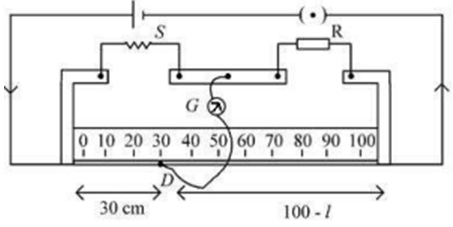
In a meter bridge experiment, for measuring unknown resistance ‘\( S \)’, the null point is obtained at a distance \( 30 \, \text{cm} \) from the left side as shown at point \( D \). If \( R \) is \( 5.6 \, \text{k}\Omega \), then the value of unknown resistance ‘\( S \)’ will be ______ \( \Omega \).
Two resistors are connected in series across a battery as shown in figure. If a voltmeter of resistance \( 2000 \, \Omega \) is used to measure the potential difference across \( 500 \, \Omega \) resistor, the reading of the voltmeter will be ______ \( \text{V} \).
Current measured by the ammeter \( A \) in the reported circuit when no current flows through \( 10 \, \Omega \) resistance, will be ________ \( \text{A} \).
The voltage across the \( 10 \, \Omega \) resistor in the given circuit is \( x \) volt.The value of \( x \) to the nearest integer is _______________.
In the given circuit, the equivalent resistance between the terminal \( A \) and \( B \) is ____________ \( \Omega \).
A wire of resistance \( R \) is bent into an equilateral triangle and an identical wire is bent into a square. The ratio of resistance between the two end points of an edge of the triangle to that of the square is:
In the given circuit, the value of \( \left|\frac{I_{1}+I_{3}}{I_{2}}\right| \) is _______.
All resistances in figure are \( 1\,\Omega \) each. The value of current 'I' is \( \frac{a}{5} \) \( \text{A} \). The value of \( a \) is ____________.
A \( 1\,\text{m} \) long wire is broken into two unequal parts \( X \) and \( Y \). The \( X \) part of the wire is stretched into another wire \( W \). Length of \( W \) is twice the length of \( X \) and the resistance of \( W \) is twice that of \( Y \). Find the ratio of length of \( X \) and \( Y \).
The equivalent resistance between \( A \) and \( B \) as shown in figure is:
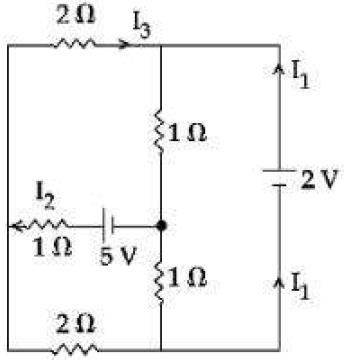
Refer to the figure given blow. The values of \( I_1, I_2 \) and \( I_3 \) are ______.
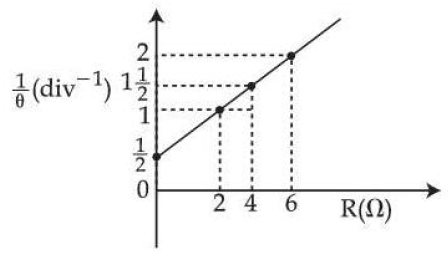
In the experiment to determine the galvanometer resistance by half-deflection method, the plot of \( \frac{1}{\theta} \) vs the resistance \( (R) \) of the resistance box is shown in the figure. The figure of merit of the galvanometer is __________ \( \times 10^{-1} \, \text{A/division} \). [The source has emf \( 2 \, \text{V} \)]
First, a set of \( n \) equal resistors of \( 10 \, \Omega \) each are connected in series to a battery of emf \( 20 \, \text{V} \) and internal resistance \( 10 \, \Omega \). A current \( I \) is observed to flow. Then, the \( n \) resistors are connected in parallel to the same battery. It is observed that the current is increased \( 20 \) times, then the value of \( n \) is ______.
The number of electrons flowing per second in the filament of a \( 110 \, \text{W} \) bulb operating at \( 220 \, \text{V} \) is:(Given \( e = 1.6 \times 10^{-19} \, \text{C} \))
The current sensitivity of moving coil galvanometer is increased by \( 25\% \). This increase is achieved only by changing in the number of terms of coils and area of cross section of the wire while keeping the resistance of galvanometer coil constant. The percentage change in the voltage sensitivity will be:
In a meter bridge experiment to determine the value of unknown resistance, first the resistance \( 2 \, \Omega \) and \( 3 \, \Omega \) are connected in the left and right gaps of the bridge and the null point is obtained at a distance \( l \) cm from the left. Now when an unknown resistance \( x \, \Omega \) is connected in parallel to \( 3 \, \Omega \) resistance, the null point is shifter by \( 10 \, \text{cm} \) to the right of wire. The value of unknown resistance \( x \) is ________________ \( \Omega \).
The difference of temperature in a material can convert heat energy into electrical energy. To harvest the heat energy, the material should have
The resistances of the platinum wire of a platinum resistance thermometer at the ice point and steam point are \( 8 \, \Omega \) and \( 10 \, \Omega \) respectively. After inserting in a hot bath of temperature \( 400^\circ \text{C} \), the resistance of platinum wire is:
The reading in the ideal voltmeter \( V \) shown in the given circuit diagram is:
At steady state the charge on the capacitor, as shown in the circuit below, is __________ \( \mu\text{C} \).
A square shaped wire with resistance of each side \( 3\,\Omega \) is bent to form a complete circle. The resistance between two diametrically opposite points of the circle in unit of \( \Omega \) will be ____________.
A wire of resistance \( R \) and length \( L \) is cut into \( 5 \) equal parts. If these parts are joined parallely, then resultant resistance will be :
A wire of resistance \( 160 \, \Omega \) is melted and drawn in a wire of one-fourth of its length. The new resistance of the wire will be:
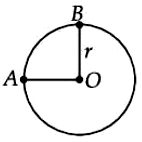
A wire of uniform resistance \( \lambda \, \Omega / \text{m} \) is bent into a circle of radius \( r \) and another piece of wire with length \( 2r \) is connected between points A and B (AOB) as shown in figure. The equivalent resistance between points A and B is ______ \( \Omega \).
Refer of the figure given below, current between terminals \( A \) and \( B \) is ______ \( \text{A} \).
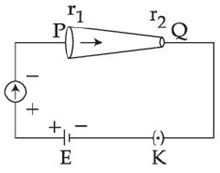
In the given figure, a battery of emf \( E \) is connected across a conductor \( PQ \) of length '\( l \)' and different area of cross-sections having radii \( r_{1} \) and \( r_{2} \) \( (r_{2} < r_{1}) \).
A voltmeter with internal resistance of \( x \, \Omega \) can be used to measure upto \( 20 \, \text{V} \). In order to increase its measuring range to \( 30 \, \text{V} \), the required modification is to ________.
An electric toaster has resistance of \( 60 \, \Omega \) at room temperature \( (27^\circ \, \text{C} \)). The toaster is connected to a \( 220 \, \text{V} \) supply. If the current flowing through it reaches \( 2.75 \, \text{A} \), the temperature attained by toaster is around: \( \big( \text{if } \alpha = 2 \times 10^{-4} / ^\circ \text{C} \big) \)
Given below are two statements: One is labelled as Assertion A and the other is labelled as Reason R. Assertion A: For measuring the potential difference across a resistance of \( 600 \, \Omega \), the voltmeter with resistance \( 1000 \, \Omega \) will be preferred over voltmeter with resistance \( 4000 \, \Omega \). Reason R: Voltmeter with higher resistance will draw smaller current than voltmeter with lower resistance. In the light of the above statements, choose the most appropriate answer from the options given below:
A galvanometer of resistance \( 100\,\Omega \) when connected in series with \( 400\,\Omega \) measures a voltage of up to \( 10\,\text{V} \). The value of resistance required to convert the galvanometer into ammeter to read up to \( 10\,\text{A} \) is \( x \times 10^{-2}\,\Omega \). The value of \( x \) is:
For the given circuit, in the steady state, \( |V_{B}-V_{D}| = \) ______ V.
Two coils require \( 20 \) minutes and \( 60 \) minutes respectively to produce same amount of heat energy when connected separately to the same source. If they are connected in parallel arrangement to the same source; the time required to produce same amount of heat by the combination of coils, will be ________ min.
\( 10 \) resistors each of resistance \( 10 \, \Omega \) can be connected in such as to get maximum and minimum equivalent resistance. The ratio of maximum and minimum equivalent resistance will be _______.
A resistor develops \( 300 \, \text{J} \) of thermal energy in \( 15 \, \text{s} \), when a current of \( 2 \, \text{A} \) is passed through it. If the current increases to \( 3 \, \text{A} \), the energy developed in \( 10 \, \text{s} \) is __________ \( \text{J} \).
The combination of two identical cells, whether connected in series or parallel combination provides the same current through an external resistance of \( 2 \, \Omega \). The value of internal resistance of each cell is:
A regular hexagon is formed by six wires each of resistance \( r \, \Omega \) and the corners are joined to the center by wires of same resistance. If the current enters at one corner and leaves at the opposite corner, the equivalent resistance of the hexagon between the two opposite corners will be:
A cell, shunted by a \( 8 \, \Omega \) resistance, is balanced across a potentiometer wire of length \( 3 \, \text{m} \). The balancing length is \( 2 \, \text{m} \) when the cell is shunted by \( 4 \, \Omega \) resistance. The value of internal resistance of the cell will be ____ \( \Omega \).
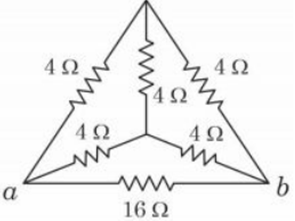
The equivalent resistance of the circuit shown below between points a and b is:
A cylindrical conductor of length \( 2 \, \text{m} \) and area of cross-section \( 0.2 \, \text{mm}^{2} \) carries an electric current of \( 1.6 \, \text{A} \) when its ends are connected to a \( 2 \, \text{V} \) battery. Mobility of electrons in the conductor is \( \alpha \times 10^{-3} \, \text{m}^{2}/(\text{V s}) \). The value of \( \alpha \) is: (electron concentration \( = 5 \times 10^{28} \, \text{m}^{3} \) and electron charge \( = 1.6 \times 10^{-19} \, \text{C} \))
The current flowing through the \( 1 \, \Omega \) resistor is \( \frac{n}{10} \, \text{A} \). The value of \( n \) is __________.
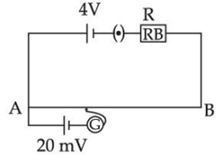
As shown in the figure, a potentiometer wire of resistance \( 20 \, \Omega \) and length \( 300 \, \text{cm} \) is connected with resistance box \( (\text{R.B.}) \) and a standard cell of emf \( 4 \, \text{V} \). For a resistance '\( R \)' of resistance box introduced into the circuit, the null point for a cell of \( 20 \, \text{mV} \) is found to be \( 60 \, \text{cm} \). The value of 'R' is _______ \( \Omega \).
If you are provided a set of resistances \( 2 \, \Omega \), \( 4 \, \Omega \), \( 6 \, \Omega \) and \( 8 \, \Omega \). Connect these resistances so as to obtain an equivalent resistance of \( \frac{46}{3} \, \Omega \).
The resistance of a wire is \( 5\,\Omega \). It’s new resistance in ohm if stretched to \( 5 \) times of it’s original length will be:
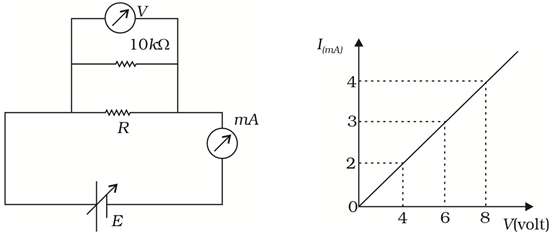
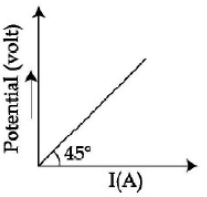
To determine the resistance \( (R) \) of a wire, a circuit is designed below. the V–I characteristic curve for this circuit is plotted for the voltmeter and the ammeter readings as shown in figure. The value of \( R \) is ..... \( \Omega \).
Given below are two statements:Statement-I: The equivalent emf of two nonideal batteries connected in parallel is smaller than either of the two emfs.Statement-II: The equivalent internal resistance of two nonideal batteries connected in parallel is smaller than the internal resistance of either of the two batteries.In the light of the above statements, choose the correct answer from the options given below.
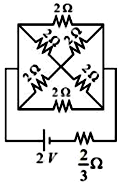
In the following circuit, the battery has an emf \( 2 \, \text{V} \) and an internal resistance of \( \dfrac{2}{3} \, \Omega \). The power consumption in the entire circuit is _______ \( \text{W} \).
The equivalent resistance between the points \( A \) and \( B \) in the following circuit is \( \frac{x}{5} \, \Omega \). The value of \( x \) is ________.
In the potentiometer, when the cell in the secondary circuit is shunted with \( 4\Omega \) resistance, the balance is obtained at the length \( 120 \, \text{cm} \) of wire. Now when the same cell is shunted with \( 12\Omega \) resistance, the balance is shifted to a length of \( 180 \, \text{cm} \). The internal resistance of cell is ________ \( \Omega \).
The drift velocity of electrons for conductor connected in an electrical circuit is \( V_d \). The conductor in now replaced by another conductor with same material and same length but double the area of cross section. The applied voltage remains same. The new drift velocity of electrons will be:
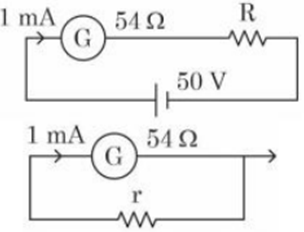
For designing a voltmeter of range \( 50 \, \text{V} \) and an ammeter of range \( 10 \, \text{mA} \) using a galvanometer which has a coil of resistance \( 54 \, \Omega \) showing a full scale deflection for \( 1 \, \text{mA} \) as in figure.(A) for voltmeter \( R \approx 50 \, \text{k}\Omega \) (B) for ammeter \( r \approx 0.2 \, \Omega \)(C) for ammeter \( r = 6 \, \Omega \) (D) for voltmeter \( R \approx 5 \, \text{k}\Omega \)(E) for voltmeter \( R \approx 500 \, \Omega \)Choose the correct answer from the options given below:
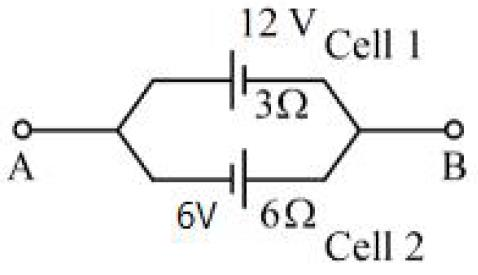
Two cells are connected between points \( A \) and \( B \) as shown. Cell \( 1 \) has emf of \( 12 \, \text{V} \) and internal resistance of \( 3 \, \Omega \). Cell \( 2 \) has emf of \( 6 \, \text{V} \) and internal resistance of \( 6 \, \Omega \). An external resistor \( R \) of \( 4 \, \Omega \) is connected across \( A \) and \( B \). The current flowing through \( R \) will be ______ \( \text{A} \).
The equivalent resistance between points \( A \) and \( B \) in the given network is:
A resistor develops \( 500 \, \text{J} \) of thermal energy in \( 20 \, \text{s} \) when a current of \( 1.5 \, \text{A} \) is passed through it. If the current is increased from \( 1.5 \, \text{A} \) to \( 3 \, \text{A} \), what will be the energy developed in \( 20 \, \text{s} \).
The current density in a cylindrical wire of radius \( r = 4.0 \,\text{mm} \) is \( 1.0 \times 10^{6} \,\text{A}/\text{m}^{2} \). The current through the outer portion of the wire between radial distances \( \frac{r}{2} \) and \( r \) is \( x \pi \,\text{A} \); where \( x \) is ________.
Equivalent resistance between the adjacent corners of a regular \( n \)-sided polygon of uniform wire of resistance \( R \) would be:
A motor operating on \( 100 \, \text{V} \) draws a current of \( 1 \, \text{A} \). If the efficiency of the motor is \( 91.6\% \), then the loss of power in units of cal/s is:
In the circuit shown, the energy stored in the capacitor is \( n \, \mu \text{J} \). The value of \( n \) is __________.
There are '\( n \)' number of identical electric bulbs, each is designed to draw a power \( p \) independently from the mains supply. They are now joined in series across the mains supply. The total power drawn by the combination is:
A hollow cylindrical conductor has length of \( 3.14 \, \mathrm{m} \), while its inner and outer diameters are \( 4 \, \mathrm{mm} \) and \( 8 \, \mathrm{mm} \) respectively. The resistance of the conductor is \( n \times 10^{-3} \, \Omega \). If the resistivity of the material is \( 2.4 \times 10^{-8} \, \Omega \, \mathrm{m} \). The value of \( n \) is ______.
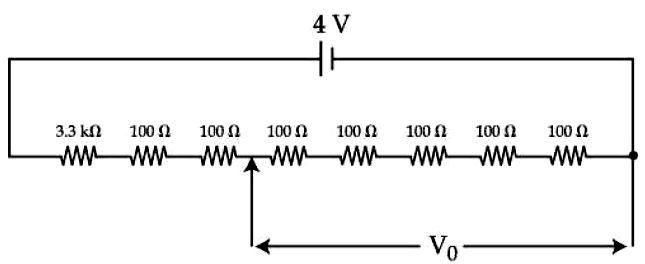
A potential divider circuit is shown in figure. The output voltage \( V_0 \) is:
Given below are two statements:Statement I : If the number of turns in the coil of a moving coil galvanometer is doubled then the current sensitivity becomes double.Statement II : Increasing current sensitivity of a moving coil galvanometer by only increasing the number of turns in the coil will also increase its voltage sensitivity in the same ratioIn the light of the above statements, choose the correct answer from the options given below:
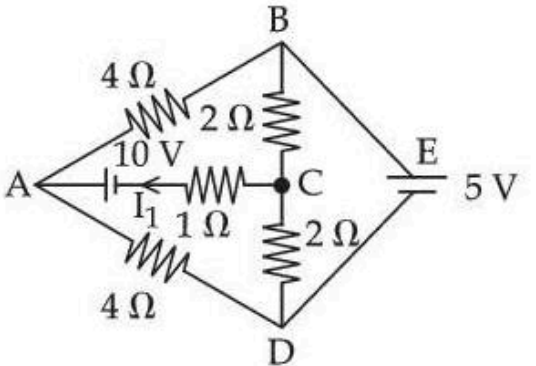
In the following circuit, the magnitude of current \( I_{1} \) is _______ \( \text{A} \).
The current \( I \) flowing through the given circuit will be __________ \( \text{A} \).
The given potentiometer has its wire of resistance \( 10\,\Omega \). When the sliding contact is in the middle of the potentiometer wire, the potential drop across \( 2\,\Omega \) resistor is:
In a metre-bridge when a resistance in the left gap is \( 2\,\Omega \) and unknown resistance in the right gap, the balance length is found to be \( 40 \, \text{cm} \). On shunting the unknown resistance with \( 2\,\Omega \), the balance length changes by:
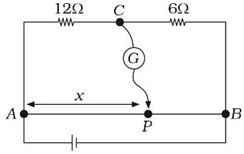
Consider a \( 72 \, \text{cm} \) long wire \( AB \) as shown in the figure. The galvanometer jockey is placed at \( P \) on \( AB \) at a distance \( x \, \text{cm} \) from \( A \). The galvanometer shows zero deflection. The value of \( x \), to the nearest integer, is:
When a potential difference \( V \) is applied across a wire of resistance \( R \), it dissipate energy at a rate \( W \). If the wire is cut into two halve and these halve are connected mutually parallel across the same supply, the energy dissipation rate will become:
A wire of resistance \( 9 \, \Omega \) is bent to form an equilateral triangle. Then the equivalent resistance across any two vertices will be _______ ohm.
The variation of applied potential and current flowing through a given wire is shown in figure. The length of wire is \( 31.4 \, \text{cm} \). The diameter of wire is measured as \( 2.4 \, \text{cm} \). The resistivity of the given wire is measured as \( x \times 10^{-3} \, \Omega \, \text{cm} \). The value of \( x \) is __________. [Take \( \pi = 3.14 \)].
In the given circuit ‘\( a \)’ is an arbitrary constant. The value of \( m \) for which the equivalent circuit resistance is minimum, will be \( \sqrt{\frac{x}{2}} \). The value of \( x \) is _______.
When a resistance of \( 5 \, \Omega \) is shunted with a moving coil galvanometer, it shows as full scale deflection for a current of \( 250 \, \text{mA} \), however when \( 1050 \, \Omega \) resistance is connected with it in series, it gives full scale deflection for \( 25 \, \text{volt} \). The resistance of galvanometer is ______ \( \Omega \).
To measure the internal resistance of a battery, potentiometer is used. For \( R = 10 \, \Omega \), the balance point is observed at \( l = 500 \, \text{cm} \) and for \( R = 1 \, \Omega \) the balance point is observed at \( l = 400 \, \text{cm} \). The internal resistance of the battery is approximately:
In a potentiometer arrangement, a cell gives a balancing point at \( 75 \, \text{cm} \) length of wire. This cell is now replaced by another cell of unknown emf. If the ratio of the emf's of two cells respectively is \( 3:2 \), the difference in the balancing length of the potentiometer wire in above two cases will be ________ \( \text{cm} \).
Different combination of \( 3 \) resistors of equal resistance \( R \) are shown in the figures. The increasing order for power dissipation is:
A meter bridge setup is shown in the figure. It is used to determine an unknown resistance \( R \) using a given resistor of \( 15 \, \Omega \). The galvanometer (\( G \)) shows null deflection when tapping key is at \( 43 \, \text{cm} \) mark from end A. If the end correction for end A is \( 2 \, \text{cm} \), then the determined value of \( R \) will be ________ \( \Omega \).
The length of a given cylindrical wire is increased to double of its original length. The percentage increase in the resistance of the wire will be ________________\( \% \).
Current passing through a wire as function of time is given as \( I(t)=0.02t+0.01\,\text{A} \). The charge that will flow through the wire from \( t=1\,\text{s} \) to \( t=2\,\text{s} \) is:
In the given circuit, the terminal potential difference of the cell is:
The number density of free electrons in copper is nearly \( 8 \times 10^{28} \, \text{m}^{-3} \). A copper wire has its area of cross section \( = 2 \times 10^{-6} \, \text{m}^2 \) and is carrying a current of \( 3.2 \, \text{A} \). A drift speed of the electrons is ______ \( \times 10^{-6} \, \text{ms}^{-1} \).
As shown in the figure, the voltmeter reads \( 2 \, \text{V} \) across \( 5 \, \Omega \) resistor. The resistance of the voltmeter is _________ \( \Omega \).
The voltage and the current between \( A \) and \( B \) points shown in the circuit are ______.
In the given potentiometer circuit arrangement, the balancing length \( AC \) is measured to be \( 250 \, \text{cm} \). When the galvanometer connection is shifted from point \( (1) \) to point \( (2) \) in the given diagram, the balancing length becomes \( 400 \, \text{cm} \). The ratio of the emf of two cells, \( \dfrac{\varepsilon_1}{\varepsilon_2} \) is :
Two identical heater filaments are connected first in parallel and then in series. At the same applied voltage, the ratio of heat produced in same time for parallel to series will be:
The value of current \( I \) in the electrical circuit as given below, when potential at \( A \) is equal to the potential at \( B \), will be _________ \( \text{A} \).
The deflection in moving coil galvanometer falls from \( 25 \) divisions to \( 5 \) division when a shunt of \( 24 \, \Omega \) is applied. The resistance of galvanometer coil will be:
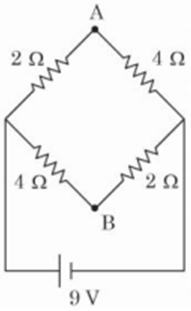
A network of four resistances is connected to \( 9 \, \text{V} \) battery, as shown in figure. The magnitude of voltage difference between the points \( A \) and \( B \) is __________ \( \text{V} \).
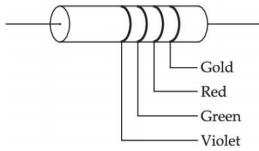
The colour coding on a carbon resistor is shown in the given figure. The resistance value of the given resistor is:
An electric bulb rated as \( 200 \, \text{W} \) at \( 100 \, \text{V} \) is used in a circuit having \( 200 \, \text{V} \) supply. The resistance ‘\( R \)’ that must be put in series with the bulb so that the bulb delivers the same power is ____________ \( \Omega \).
An inductor of \( 10 \, \text{mH} \) is connected to a \( 20 \, \text{V} \) battery through a resistor of \( 10 \, \text{k}\Omega \) and a switch. After a long time, when maximum current is set up in the circuit, the current is switched off. The current in the circuit after \( 1 \, \mu \text{s} \) is \( \dfrac{x}{100} \, \text{mA} \). Then \( x \) is equal to __________________ .(Take \( e^{-1} = 0.37 \) )
The current density in a cylindrical wire of radius \( 4 \, \text{mm} \) is \( 4 \times 10^{6} \, \text{A m}^{-2} \). The current through the outer portion of the wire between radial distances \( \frac{R}{2} \) and \( R \) is __________ \( \pi \, \text{A} \).
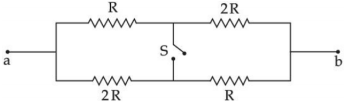
The ratio of the equivalent resistance of the network (shown in figure) between the points \( a \) and \( b \) when switch is closed is \( x : 8 \). The value of \( x \) is _______.
Water falls from a \( 40 \, \text{m} \) high dam at the rate of \( 9 \times 10^4 \, \text{kg} \) per hour. Fifty percentage of gravitational potential energy can be converted into electrical energy. Using this hydro electric energy number of \( 100 \, \text{W} \) lamps, that can be lit, is: (Take \( g = 10 \, \text{m s}^{-2} \))
A cylindrical wire of radius \( 0.5 \, \text{mm} \) and conductivity \( 5 \times 10^{7} \, \text{S/m} \) is subjected to an electric field of \( 10 \, \text{mV/m} \). The expected value of current in the wire will be \( x^{3}\pi \, \text{mA} \). The value of \( x \) is ________.
In a metallic conductor, under the effect of applied electric field the free electrons of the conductor.
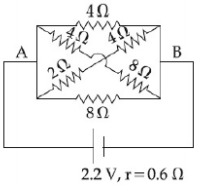
In the given figure, the emf of the cell is \( 2.2 \, \text{V} \) and if internal resistance is \( 0.6 \, \Omega \). Calculate the power dissipated in the whole circuit:
Two resistors of \( 200\,\Omega \) and \( 400\,\Omega \) are connected in series with a battery of \( 100 \, \text{V} \). A bulb rated at \( 200 \, \text{V}, 100 \, \text{W} \) is connected across the \( 400\,\Omega \) resistance. The potential drop across the bulb is _______ \( \text{V} \).
The heat generated in \( 1 \, \text{minute} \) between points \( A \) and \( B \) in the given circuit, when a battery of \( 9 \, \text{V} \) with internal resistance of \( 1 \, \Omega \) is connected across these points is __________________\( \text{J} \).
Figure shows a part of an electric circuit. The potentials at points \( a \), \( b \) and \( c \) are \( 30 \, \text{V} \), \( 12 \, \text{V} \) and \( 2 \, \text{V} \) respectively. The current through the \( 20 \, \Omega \) resistor will be:
A current of \( 5 \, \text{A} \) is passing through a non-linear magnesium wire of cross-section \( 0.04 \, \text{m}^2 \). At every point the direction of current density is at an angle of \( 60^\circ \) with the unit vector of area of cross-section. The magnitude of electric field at every point of the conductor is: [Resistivity of magnesium \( \rho = 44 \times 10^{-8} \, \Omega \text{m} \) ]
A potentiometer wire of length \( 300 \, \text{cm} \) is connected in series with a resistance \( 780 \, \Omega \) and a standard cell of emf \( 4 \, \text{V} \). A constant current flows through potentiometer wire. The length of the null point for cell of emf \( 20 \, \text{mV} \) is found to be \( 60 \, \text{cm} \). The resistance of the potentiometer wire is __________ \( \Omega \).
By what percentage will the illumination of the lamp decrease if the current drops by \( 20\% \)?
Wheatstone bridge principle is used to measure the specific resistance \(( S_1) \) of given wire, having length \( L \), radius \( r \). If \( X \) is the resistance of wire, then specific resistance is; \( S_1 = X \left(\displaystyle \frac{\pi r^{2}}{L} \right) \). If the length of the wire gets doubled then the value of specific resistance will be:
Two resistors of \( 100 \, \Omega \) each are connected in series with a \( 9 \, \text{V} \) battery. A voltmeter of \( 400 \, \Omega \) resistance is connected to measure the voltage drop across one of the resistors. The voltmeter reading is ______ \( \text{V} \).