The internal energy of air in \( 4 \, \text{m} \times 4 \, \text{m} \times 3 \, \text{m} \) sized room at \( 1 \) atmospheric pressure will be __________ \( \times 10^{6} \, \text{J} \). (Consider air as diatomic molecule)
A gas is kept in a container having walls which are thermally non-conducting. Initially the gas has a volume of \( 800 \ \text{cm}^3 \) and temperature \( 27^\circ \text{C} \). The change in temperature when the gas is adiabatically compressed to \( 200 \ \text{cm}^3 \) is: (Take \( \gamma = 1.5 \); \( \gamma \) is the ratio of specific heats at constant pressure and at constant volume)
Given are statements for certain thermodynamic variables,(A) Internal energy, volume \( (V) \) and mass \( (M) \) are extensive variables.(B) Pressure \( (P) \), temperature \( (T) \) and density \( (\rho) \) are intensive variables.(C) Volume \( (V) \), temperature \( (T) \) and density \( (\rho) \) are intensive variables.(D) Mass \( (M) \), temperature \( (T) \) and internal energy are extensive variables.Choose the correct answer from the options given below:
Water of mass \( m \) gram is slowly heated to increase the temperature from \( T_1 \) to \( T_2 \). The change in entropy of the water, given specific heat of water is \( 1 \,\mathrm{J\,kg^{-1}\,K^{-1}} \), is:
An ideal gas exists in a state with pressure \( P_{0} \), volume \( V_{0} \). It is isothermally expanded to \( 4 \) times of its initial volume \( (V_{0}) \), then isobarically compressed to its original volume. Finally the system is heated isochorically to bring it to its initial state. The amount of heat exchanged in this process is:
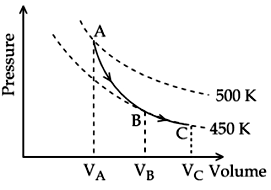
Given below are two statements. One is labelled as Assertion (A) and the other is labelled as Reason (R). Assertion (A): With the increase in the pressure of an ideal gas, the volume falls off more rapidly in an isothermal process in comparison to the adiabatic process. Reason (R): In isothermal process, \( PV = \) constant, while in adiabatic process \( PV^{\gamma} = \) constant. Here \( \gamma \) is the ratio of specific heats, \( P \) is the pressure and \( V \) is the volume of the ideal gas. In the light of the above statements, choose the correct answer from the options given below:
Match List I with List - II.
\( \Delta Q = \text{Heat supplied} \)\( \Delta W = \text{Work done by the system} \)\( \Delta U = \text{Change in internal energy} \)\( P = \text{Pressure of the system} \)\( \Delta V = \text{Change in volume of the system} \)Choose the correct answer from the options given below :
A poly-atomic molecule \( (C_{V} = 3R, \, C_{P} = 4R, \) where \( R \) is gas constant) goes from phase space point \( A \, (P_{A} = 10^{5} \, \text{Pa}, \, V_{A} = 4 \times 10^{-6} \, \text{m}^{3}) \) to point \( B \, (P_{B} = 5 \times 10^{4} \, \text{Pa}, \, V_{B} = 6 \times 10^{-6} \, \text{m}^{3}) \) to point \( C \, (P_{C} = 10^{4} \, \text{Pa}, \, V_{C} = 8 \times 10^{-6} \, \text{m}^{3}) \). A to B is an adiabatic path and B to C is an isothermal path. The net heat absorbed per unit mole by the system is:
Match the LIST-I with LIST-II:
Choose the correct answer from the options given below:
Identify the characteristics of an adiabatic process in a monoatomic gas.(A) Internal energy is constant.(B) Work done in the process is equal to the change in internal energy.(C) The product of temperature and volume is a constant.(D) The product of pressure and volume is a constant.(E) The work done to change the temperature from \( T_1 \) to \( T_2 \) is proportional to \( (T_2 - T_1) \).Choose the correct answer from the options given below:
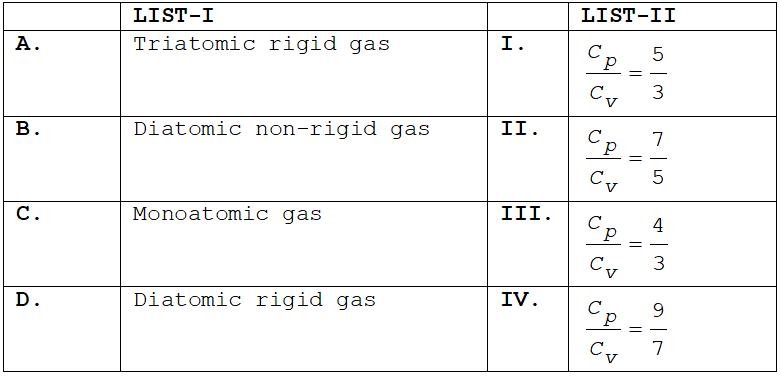
For a diatomic gas, if \(\displaystyle \gamma_{1} = \left( \frac{C_{p}}{C_{v}} \right) \) for rigid molecules and \(\displaystyle \gamma_{2} = \left( \frac{C_{p}}{C_{v}} \right) \) for another diatomic molecules, but also having vibrational modes. Then, which one of the following options is correct? (\( C_{p} \) and \( C_{v} \) are specific heats of the gas at constant pressure and volume)
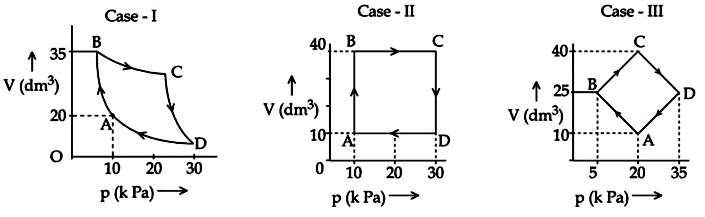
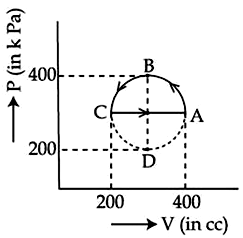
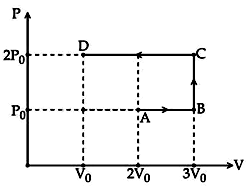
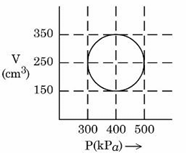
An ideal gas undergoes a cyclic transformation starting from the point \( A \) and coming back to the same point by tracing the path \( A \rightarrow B \rightarrow C \rightarrow D \rightarrow A \) as shown in the three cases above. Choose the correct option regarding \( DU \):
The work done in an adiabatic change in an ideal gas depends upon only:
The equation for real gas is given by \( \left(P + \frac{a}{V^{2}}\right)(V-b) = RT \), where \( P \), \( V \), \( T \) and \( R \) are the pressure, volume, temperature and gas constant, respectively. The dimension of \( ab^{-2} \) is equivalent to that of:
For a particular ideal gas which of the following graphs represents the variation of mean squared velocity of the gas molecules with temperature?
An ideal gas initially at \( 0^\circ \text{C} \) temperature, is compressed suddenly to one fourth of its volume. If the ratio of specific heat at constant pressure to that at constant volume is \( \tfrac{3}{2} \), the change in temperature due to the thermodynamic process is __________ \( \text{K} \).
Given below are two statements. One is labelled as Assertion (A) and the other is labelled as Reason (R).Assertion (A): In an insulated container, a gas is adiabatically shrunk to half of its initial volume. The temperature of the gas decreases.Reason (R): Free expansion of an ideal gas is an irreversible and an adiabatic process.In the light of the above statements, choose the correct answer from the options given below:
An ideal gas goes from an initial state to final state. During the process, the pressure of gas increases linearly with temperature.(A) The work done by gas during the process is zero.(B) The heat added to gas is different from change in its internal energy.(C) The volume of the gas is increased.(D) The internal energy of the gas is increased.(E) The process is isochoric (constant volume process)Choose the correct answer from the options given below:
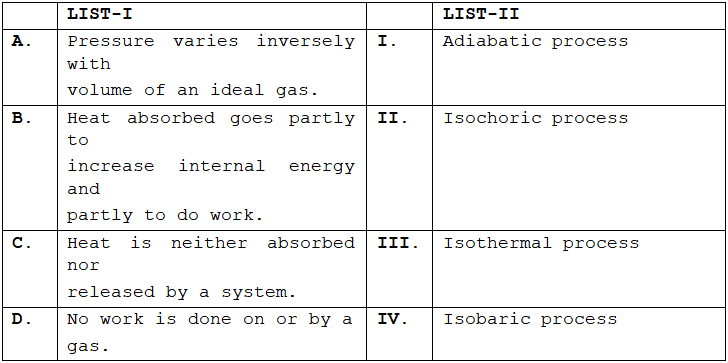
Match the LIST-I with LIST-II.
The kinetic energy of translation of the molecules in \( 50 \, \text{g} \) of \( \text{CO}_2 \) gas at \( 17^\circ \text{C} \) is:
The mean free path and the average speed of oxygen molecules at \( 300 \, \text{K} \) and \( 1 \, \text{atm} \) are \( 3 \times 10^{-7} \, \text{m} \) and \( 600 \, \text{m/s} \), respectively. Find the frequency of its collisions.
Pressure of an ideal gas, contained in a closed vessel, is increased by \( 0.4\% \) when heated by \( 1^\circ \text{C} \). Its initial temperature must be:
A container of fixed volume contains a gas at $27^\circ\text{C}$. To double the pressure of the gas, the temperature of gas should be raised to _________ $^\circ\text{C}$.
A monatomic gas having \( \gamma = \frac{5}{3} \) is stored in a thermally insulated container and the gas is suddenly compressed to \( \left(\frac{1}{8}\right)^{\text{th}} \) of its initial volume. The ratio of final pressure and initial pressure is: [\( \gamma \) is the ratio of specific heats of the gas at constant pressure and at constant volume]
Which of the following figure represents the relation between Celsius and Fahrenheit temperatures?
In an adiabatic process, which of the following statements is true?
The magnitude of heat exchanged by a system for the given cyclic process \( ABCA \) (as shown in figure) is (in SI unit).
The temperature of a body in air falls from \( 40^\circ \text{C} \) to \( 24^\circ \text{C} \) in \( 4 \) minutes. The temperature of the air is \( 16^\circ \text{C} \). The temperature of the body in the next \( 4 \) minutes will be:
The ratio of vapour densities of two gases at the same temperature is \(\displaystyle \frac{4}{25} \), then the ratio of r.m.s. velocities will be:
Using the given \( P-\!V \) diagram, the work done by an ideal gas along the path \( ABCD \) is:
An ideal gas has undergone through the cyclic process as shown in the figure. Work done by the gas in the entire cycle is ________ \( \times 10^{-1} \) \( \text{J} \) (Take \( \pi = 3.14 \) )
The temperature of \( 1 \) mole of an ideal monoatomic gas is increased by \( 50^\circ \text{C} \) at constant pressure. The total heat added and change in internal energy are \( E_1 \) and \( E_2 \), respectively. If \( \frac{E_1}{E_2} = \frac{x}{9} \) then the value of \( x \) is ________.
A Carnot engine \( (E) \) is working between two temperatures \( 473 \, \text{K} \) and \( 273 \, \text{K} \). In a new system two engines - engine \( E_1 \) works between \( 473 \, \text{K} \) to \( 373 \, \text{K} \) and engine \( E_2 \) works between \( 373 \, \text{K} \) to \( 273 \, \text{K} \). If \( \eta_{12} \), \( \eta_1 \) and \( \eta_2 \) are the efficiencies of the engines \( E \), \( E_1 \) and \( E_2 \), respectively, then:
There are two vessels filled with an ideal gas where volume of one is double the volume of other. The large vessel contains the gas at \( 8\,\text{kPa} \) at \( 1000\,\text{K} \) while the smaller vessel contains the gas at \( 7\,\text{kPa} \) at \(500\,\text{K} \). If the vessels are connected to each other by a thin tube allowing the gas to flow and the temperature of both vessels is maintained at \( 600\,\text{K} \), at steady state the pressure in the vessels will be (in \( \text{kPa} \)).