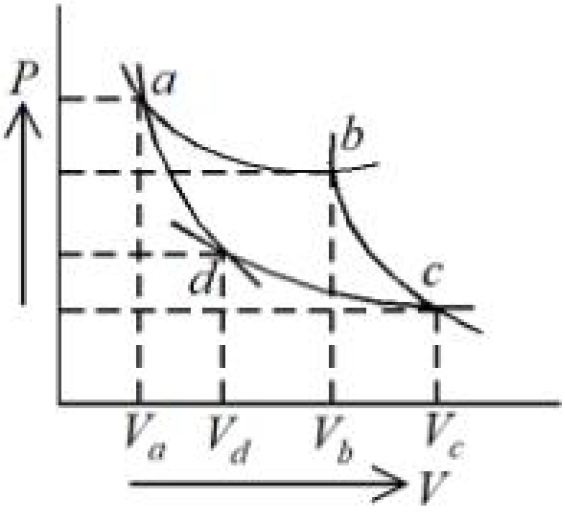
Two different adiabatic paths for the same gas intersect two isothermal curves as shown in P–V diagram. The relation between the ratio \( \dfrac{V_a}{V_d} \) and the ratio \( \dfrac{V_b}{V_c} \) is:
\( \dfrac{V_a}{V_d} = \dfrac{V_b}{V_c} \)
\( \dfrac{V_a}{V_d} \neq \dfrac{V_b}{V_c} \)
\( \dfrac{V_a}{V_d} = \left( \dfrac{V_b}{V_c} \right)^{2} \)
\( \dfrac{V_a}{V_d} = \left( \dfrac{V_b}{V_c} \right)^{-1} \)