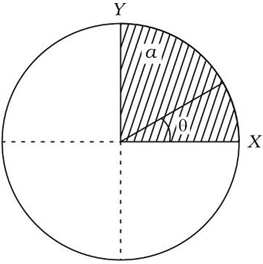
A ball of mass \( 10 \, \text{kg} \) moving with a velocity \( 10\sqrt{3} \, \text{m}\!/\!\text{s} \) along the x-axis, hits another ball of mass \( 20 \, \text{kg} \) which is at rest. After this collision, first ball comes to rest while the second ball disintegrates into two equal pieces. One piece starts moving along y-axis with a speed of \( 10 \, \text{m}\!/\!\text{s} \). The second piece starts moving at an angle of \( 30^\circ \) with respect to the x-axis. The velocity of the ball moving at \( 30^\circ \) with x-axis is \( x \, \text{m}\!/\!\text{s} \). The configuration of pieces after collision is shown in the figure below. The value of \( x \) to the nearest integer is ____________.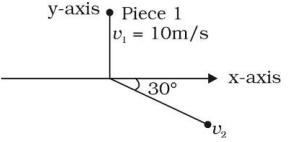
A uniform chain of length \( 3 \, \text{meter} \) and mass \( 3 \, \text{kg} \) overhangs a smooth table with \( 2 \, \text{meter} \) laying on the table. If \( k \) is the kinetic energy of the chain in joule as it completely slips off the table, then the value of \( k \) is ________. (Take \( g = 10 \, \text{m/s}^{2} \))