7 questions from 2022
If \( \vec{A} = (2\hat{i} + 3\hat{j} - \hat{k}) \, \text{m} \) and \( \vec{B} = (\hat{i} + 2\hat{j} + 2\hat{k}) \, \text{m} \). The magnitude of component of vector \( \vec{A} \) along vector \( \vec{B} \) will be ________ \( \text{m} \).
\( \vec{A} \) is a vector quantity such that \( |\vec{A}| \) = non-zero constant. Which of the following expression is true for \( \vec{A} \)?
If force \( \vec{F}=3\hat{i}+4\hat{j}-2\hat{k} \) acts on a particle having position vector \(2\hat{i}+\hat{j}+2\hat{k} \) then, the torque about the origin will be:
Two vectors \( \vec{A} \) and \( \vec{B} \) have equal magnitudes. If magnitude of \( \vec{A} + \vec{B} \) is equal to two times the magnitude of \( \vec{A} - \vec{B} \), then the angle between \( \vec{A} \) and \( \vec{B} \) will be:
If the projection of \( 2\hat{i}+4\hat{j}-2\hat{k} \) on \( \hat{i}+2\hat{j}+\alpha \hat{k} \) is zero. Then, the value of \( \alpha \) will be _______.
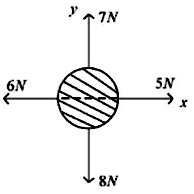
For a free body diagram shown in the figure, the four forces are applied in the ‘\( x \)’ and ‘\( y \)’ directions. What additional force must be applied and at what angle with positive \( x \)-axis so that the net acceleration of body is zero?
Which of the following relations is true for two unit vector \( \vec{A} \) and \( \vec{B} \) making an angle \( \theta \) to each other?