If \( \vec{A} = (2\hat{i} + 3\hat{j} - \hat{k}) \, \text{m} \) and \( \vec{B} = (\hat{i} + 2\hat{j} + 2\hat{k}) \, \text{m} \). The magnitude of component of vector \( \vec{A} \) along vector \( \vec{B} \) will be ________ \( \text{m} \).
Vector \( a\hat{i} + b\hat{j} + \hat{k} \) & \( 2\hat{i} - 3\hat{j} + 4\hat{k} \) are perpendicular to each other when \( 3a + 2b = 7 \) the ratio of \( a \) to \( b \) is \( \frac{x}{2} \). The value of \( x \) is ______.
Two vectors \( \vec{P} \) and \( \vec{Q} \) have equal magnitudes. If the magnitude of \( \vec{P} + \vec{Q} \) is \( n \) times the magnitude of \( \vec{P} - \vec{Q} \), then angle between \( \vec{P} \) and \( \vec{Q} \) is:
A boy reaches the airport and finds that the escalator is not working. He walks up the stationary escalator in time \( t_{1} \). If he remains stationary on a moving escalator then the escalator takes him up in time \( t_{2} \). The time taken by him to walk up on the moving escalator will be:
\( \vec{A} \) is a vector quantity such that \( |\vec{A}| \) = non-zero constant. Which of the following expression is true for \( \vec{A} \)?
If \( \vec{P} = 3\hat{i} + \sqrt{3}\hat{j} + 2\hat{k} \) and \( \vec{Q} = 4\hat{i} + \sqrt{3}\hat{j} + 2.5\hat{k} \) then, The unit vector in the direction of \( \vec{P} \times \vec{Q} \) is \( \frac{1}{x}\left( \sqrt{3}\hat{i} + \hat{j} - 2\sqrt{3}\hat{k} \right) \). The value of \( x \) is:
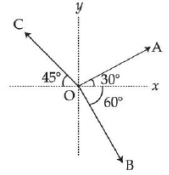
The magnitude of vectors \( \overrightarrow{OA} \), \( \overrightarrow{OB} \) and \( \overrightarrow{OC} \) in the given figure are equal. The direction of \( \overrightarrow{OA} + \overrightarrow{OB} - \overrightarrow{OC} \) with x-axis will be:
If \( \vec{a} \) and \( \vec{b} \) make angle \( \cos^{-1}\!\left(\dfrac{5}{9}\right) \) with each other, then \( \lvert \vec{a} + \vec{b} \rvert = \sqrt{2} \, \lvert \vec{a} - \vec{b} \rvert \) for \( \lvert \vec{a} \rvert = n \, \lvert \vec{b} \rvert \). The integer value of \( n \) is ________.
If force \( \vec{F}=3\hat{i}+4\hat{j}-2\hat{k} \) acts on a particle having position vector \(2\hat{i}+\hat{j}+2\hat{k} \) then, the torque about the origin will be:
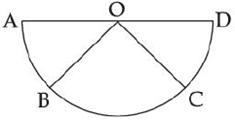
Assertion A : If A, B, C and D are four points on a semi-circular arc with centre at 'O' such that \( |\overrightarrow {AB}| = |\overrightarrow {BC}| = |\overrightarrow {CD}| \), then \( \overrightarrow{AB} + \overrightarrow{AC} + \overrightarrow{AD} = 4\overrightarrow{AO} + \overrightarrow{OB} + \overrightarrow{OC} \).Reason R : Polygon law of vector addition yields \( \overrightarrow{AB} + \overrightarrow{BC} + \overrightarrow{CD} = \overrightarrow{AD} = 2\overrightarrow{AO} \).In the light of the above statements, choose the most appropriate answer from the options given below:
A person is swimming with a speed of \( 10 \, \text{m/s} \) at an angle of \( 120^\circ \) with the flow and reaches to a point directly opposite on the other side of the river. The speed of the flow is \(' x' \, \text{m/s} \). The value of \( 'x '\) to the nearest integer is __________ .
A swimmer can swim with velocity of \( 12 \ \text{km/h} \) in still water. Water flowing in a river has velocity \( 6 \ \text{km/h} \). The direction with respect to the direction of flow of river water he should swim in order to reach the point on the other bank just opposite to his starting point is __________.\(^\circ\) (Round off to the Nearest Integer) (Find the angle in degrees)
Two vectors \( \vec{A} \) and \( \vec{B} \) have equal magnitudes. If magnitude of \( \vec{A} + \vec{B} \) is equal to two times the magnitude of \( \vec{A} - \vec{B} \), then the angle between \( \vec{A} \) and \( \vec{B} \) will be:
Statement I:If three forces \( \vec{F_1}, \vec{F_2} \) and \( \vec{F_3} \) are represented by three sides of a triangle and \( \vec{F_1} + \vec{F_2} = -\vec{F_3} \), then these three forces are concurrent forces and satisfy the condition for equilibrium.Statement II:A triangle made up of three forces \( \vec{F_1}, \vec{F_2} \) and \( \vec{F_3} \) as its sides taken in the same order, satisfy the condition for translatory equilibrium.In the light of the above statements, choose the most appropriate answer from the options given below:
If the projection of \( 2\hat{i}+4\hat{j}-2\hat{k} \) on \( \hat{i}+2\hat{j}+\alpha \hat{k} \) is zero. Then, the value of \( \alpha \) will be _______.
The speed of a swimmer is \( 4 \, \text{km h}^{-1} \) in still water. If the swimmer makes his strokes normal to the flow of river of width \( 1 \, \text{km} \), he reaches a point \( 750 \, \text{m} \) down the stream on the opposite bank.The speed of the river water is, ______ \( \text{km h}^{-1} \)
A vector in \( x - y \) plane makes an angle of \( 30^\circ \) with y-axis. The magnitude of y-component of vector is \( 2\sqrt{3} \). The magnitude of x-component of the vector will be:
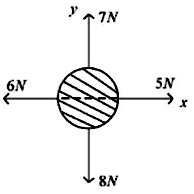
For a free body diagram shown in the figure, the four forces are applied in the ‘\( x \)’ and ‘\( y \)’ directions. What additional force must be applied and at what angle with positive \( x \)-axis so that the net acceleration of body is zero?
Which of the following relations is true for two unit vector \( \vec{A} \) and \( \vec{B} \) making an angle \( \theta \) to each other?
Three particle \( P, Q \) and \( R \) are moving along the vectors \( \vec{A} = \hat{i} + \hat{j} \), \( \vec{B} = \hat{j} + \hat{k} \) and \( \vec{C} = -\hat{i} + \hat{j} \) respectively. They strike on a point and start to move in different directions. Now particle \( P \) is moving normal to the plane which contains vector \( \vec{A} \) and \( \vec{B} \). Similarly particle \( Q \) is moving normal to the plane which contains vector \( \vec{A} \) and \( \vec{C} \). The angle between the direction of motion of \( P \) and \( Q \) is \( \cos^{-1}\!\left( \dfrac{1}{\sqrt{x}} \right) \). Then the value of \( x \) is _______.
Statement I: Two forces $(\vec{P} + \vec{Q})$ and $(\vec{P} - \vec{Q})$ where $\vec{P} \perp \vec{Q}$, when act at an angle $\theta_1$ to each other, the magnitude of their resultant is $\sqrt{3 \left(P^2 + Q^2\right)}$, when they act at an angle $\theta_2$, the magnitude of their resultant becomes $\sqrt{2 \left(P^2 + Q^2\right)}$. This possible only when $\theta_1 < \theta_2$.Statement II: In the situation given above $\theta_1 = 60^\circ \text{ and } \theta_2 = 90^\circ$.In the light of the above statements, choose the most appropriate answer from the options given below:
Two forces having magnitude \( A \) and \( \dfrac{A}{2} \) are perpendicular to each other. The magnitude of their resultant is:
The resultant of two vectors \( \vec{A} \) and \( \vec{B} \) is perpendicular to \( \vec{A} \) and its magnitude is half that of \( \vec{B} \). The angle between vectors \( \vec{A} \) and \( \vec{B} \) is…..\( ^\circ \).
Two forces \( \vec{F}_{1} \) and \( \vec{F}_{2} \) are acting on a body. One force has magnitude thrice that of the other force and the resultant of the two forces is equal to the force of larger magnitude. The angle between \( \vec{F}_{1} \) and \( \vec{F}_{2} \) is \( \cos^{-1}\!\left( \frac{1}{n} \right) \). The value of \( |n| \) is ________.