The dimensional formula of \( \frac{1}{2}\varepsilon_{0}E^{2} \) (\( \varepsilon_{0} = \) permittivity of vacuum and \( E = \) electric field) is \( M^{a}L^{b}T^{c} \). The value of \( 2a - b + c \) is ______.
\( 0 \)
\( 1 \)
\( -1 \)
\( 2 \)
The potential energy of a particle changes with distance \( x \) from a fixed origin as \( V=\dfrac{A\sqrt{x}}{x+B} \), where \( A \) and \( B \) are constant with appropriate dimensions. The dimensions of \( AB \) are ______.
The angle which a vector \( \hat{i}-\hat{j}+\sqrt{2}\,\hat{k} \) makes with y-axis is:
Consider a physical quantity \( (Y) \) defined as \( Y=\dfrac{F^{2}}{m v L} \) where \( F, m, v, L \) represents force, mass, velocity and length respectively. Difference of dimension of mass and time in \( Y \) is ________.
A new unit \( (\alpha) \) of length is chosen such that it is equal to the speed of light in vacuum. What is the distance between Venus and Earth in terms of \( \alpha \) units if light takes \( 6 \,\text{min}\, 40 \,\text{s} \) to cover this distance?
If \( \varepsilon E \) and \( t \) represent the free space permittivity, electric field and time respectively, then the unit of \( \dfrac{\varepsilon E}{t} \) will be:
Dimensions of universal gravitational constant \( (G) \) in terms of Planck’s constant \( (h) \), distance \( (L) \), mass \( (M) \) and time \( (T) \) are ________.
\( L \), \( C \) and \( R \) represents physical quantities inductance, capacitance and resistance respectively. The dimensional formula \( M L^{2} \, T^{-3} \, A^{-2} \) corresponds to ______.
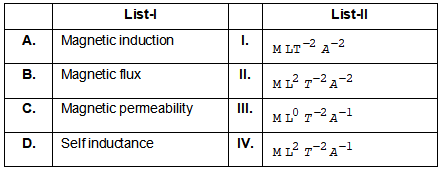
Match the List-I with List-II.
Choose the correct answer from the options given below:
The percentage error in the calculated volume of a sphere, if there is \( 2\% \) error in its diameter measurement, is_________.
Consider aa physical quantity (Y) defined as\( Y=\dfrac{F^2}{m v L} \)where \( F, m, v, L \) represents force, mass, velocity and length respectively. Difference of dimension of mass and time in \( Y \) is ________.
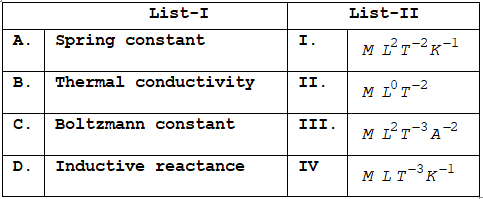
Match the LIST-I with LIST-II
A ball of radius \( r \) and density \( \rho \) dropped through a viscous liquid of density \( \sigma \) and viscosity \( \eta \) attains its terminal velocity at time \( t \), given by \( t = A \rho^{a} r^{b} \eta^{c} \sigma^{d} \), where \( A \) is a constant and \( a, b, c \) and \( d \) are integers. The value of \( \frac{b+c}{a+d} \) is _______.
Keeping the significant figures in view, the sum of the physical quantities \( 52.01 \, \text{m} \), \( 153.2 \, \text{m} \) and \( 0.123 \, \text{m} \) is: