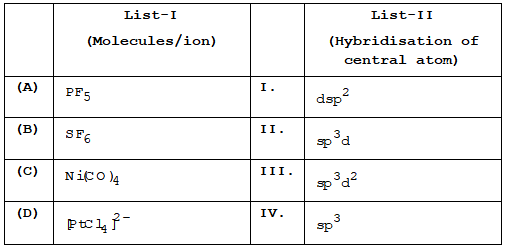
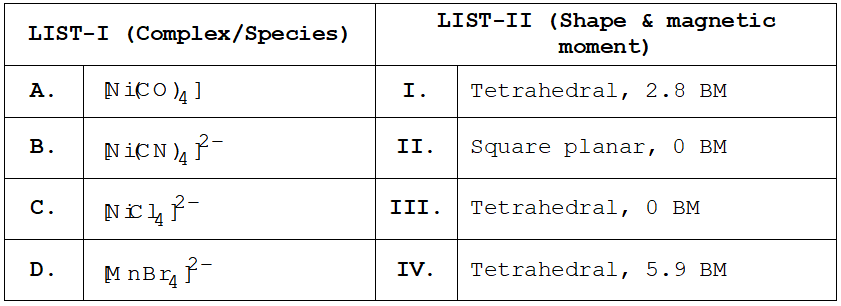
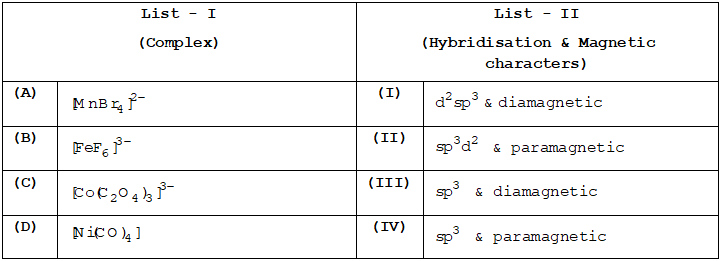
Match the List-I with List-II:
Choose the correct answer from the options given below:
A–II, B–III, C–IV, D–I
A–IV, B–I, C–II, D–III
A–III, B–I, C–IV, D–II
A–I, B–II, C–III, D–IV
The number of paramagnetic metal complex species among d\( \left[\mathrm{Co(NH_3)_6}\right]^{3+}, \left[\mathrm{Co(C_2O_4)_3}\right]^{3-}, \left[\mathrm{MnCl_6}\right]^{3-}, \left[\mathrm{Mn(CN)_6}\right]^{3-}, \left[\mathrm{CoF_6}\right]^{3-}, \left[\mathrm{Fe(CN)_6}\right]^{3-} \) and \( \left[\mathrm{FeF_6}\right]^{3-} \) with same number of unpaired electrons is ________.
What amount of bromine will be required to convert \( 2 \ \text{g} \) of phenol into \( 2,4,6 \)-tribromophenol?(Given molar mass in \( \text{g mol}^{-1} \) of C, H, O, Br are \( 12 \), \( 1 \), \( 16 \), \( 80 \) respectively)
From the magnetic behaviour of \( [\mathrm{NiCl_4}]^{2-} \) (paramagnetic) and \( [\mathrm{Ni(CO)_4}] \) (diamagnetic), choose the correct geometry and oxidation state.
The number of optical isomers exhibited by the iron complex \( (A) \) obtained from the following reaction is __________. \( \mathrm{FeCl_3} + \mathrm{KOH} + \mathrm{H_2C_2O_4} \rightarrow A \)
Identify the homoleptic complex(es) that is/are low spin.(A) \( \left[\mathrm{Fe}(\mathrm{CN})_5\mathrm{NO}\right]^{2-} \) (B) \( \left[\mathrm{CoF}_6\right]^{3-} \) (C) \( \left[\mathrm{Fe}(\mathrm{CN})_6\right]^{4-} \) (D) \( \left[\mathrm{Cr}(\mathrm{H}_2\mathrm{O})_6\right]^{2+} \) (E) \( \left[\mathrm{Co}(\mathrm{NH}_3)_6\right]^{3+} \)
The correct order of the complexes \( [\mathrm{Co(NH_3)_5(H_2O)}]^{3+} (A), [\mathrm{Co(NH_3)_6}]^{3+} (B), [\mathrm{Co(CN)_6}]^{3-} (C) \) and \( [\mathrm{CoCl(NH_3)_5}]^{2+} (D) \) in terms of wavelength of light absorbed is:
The number of unpaired electrons responsible for the paramagnetic nature of the following complex species are respectively:\([Fe(CN)_6]^{3-}, [FeF_6]^{3-}, [CoF_6]^{3-}, [Mn(CN)_6]^{3-}\)
A transition metal \( (M) \) among \( \mathrm{Mn} \), \( \mathrm{Cr} \), \( \mathrm{Co} \) and \( \mathrm{Fe} \) has the highest standard electrode potential \( (M^{3+} / M^{2+}) \). It forms a metal complex of the type \( [M(CN)_6]^{4-} \). The number of electrons present in the \( e_g \) orbital of the complex is ____________.
Given below are two statements:Statement I : A homoleptic octahedral complex, formed using monodentate ligands, will not show stereoisomerism.Statement II : cis- and trans-platin are heteroleptic complexes of Pd.In the light of the above statements, choose the correct answer from the options given below:
Identify the diamagnetic octahedral complex ions from below: (A) \( [\mathrm{Mn(CN)_6}]^{3-} \) (B) \( [\mathrm{Co(NH_3)_6}]^{3+} \) (C) \( [\mathrm{Fe(CN)_6}]^{4-} \) (D) \( [\mathrm{Co(H_2O)_3F_3}] \) Choose the correct answer from the options given below:
\( \mathrm{FeO_4^{2-}} \; \overset{+2.0\,\text{V}}{\longrightarrow} \; \mathrm{Fe^{3+}} \; \overset{0.8\,\text{V}}{\longrightarrow} \; \mathrm{Fe^{2+}} \; \overset{-0.5\,\text{V}}{\longrightarrow} \; \mathrm{Fe^0} \)In the above diagram, the standard electrode potentials are given in volts (over the arrow).
The number of paramagnetic complexes among \( [\mathrm{FeF}_6]^{3-} \), \( [\mathrm{Fe}(\mathrm{CN})_6]^{3-} \), \( [\mathrm{Mn}(\mathrm{CN})_6]^{3-} \), \( [\mathrm{Co}(\mathrm{C}_2\mathrm{O}_4)_3]^{3-} \), \( [\mathrm{MnCl}_6]^{3-} \) and \( [\mathrm{CoF}_6]^{3-} \), which involved \( d^{2}sp^{3} \) hybridization is ________.
Identify the homoleptic complexes with odd number of \( d \) electrons in the central metal:(A) \( [\mathrm{FeO_{4}}]^{2-} \) (B) \( [\mathrm{Fe(CN)_{6}}]^{3-} \) (C) \( [\mathrm{Fe(CN)_{5}NO}]^{2-} \) (D) \( [\mathrm{CoCl_{4}}]^{2-} \) (E) \( [\mathrm{Co(H_{2}O)_{3}F_{3}}] \)Choose the correct answer from the options given below:
The correct increasing order of stability of the complex based on \( \Delta_o \) value is:I. \([\mathrm{Mn}(\mathrm{CN})_6]^{3-}\) II. \([\mathrm{Co}(\mathrm{CN})_6]^{4-}\) III. \([\mathrm{Fe}(\mathrm{CN})_6]^{3-}\) IV. \([\mathrm{Fe}(\mathrm{CN})_6]^{3-}\)
The number of species from the following that are involved in \( sp^3d^2 \) hybridization is: \( \mathrm{[Co(NH_3)_6]^{3+}} \), \( \mathrm{SF_6} \), \( \mathrm{[CrF_6]^{3-}} \), \( \mathrm{[CoF_6]^{3-}} \), \( \mathrm{[Mn(CN)_6]^{3-}} \) and \( \mathrm{[MnCl_6]^{3-}} \)
‘\( X \)’ is the number of electrons in \( t_{2g} \) orbitals of the most stable complex ion among \( [Fe(NH_3)_6]^{3+} \), \( [Fe(Cl)_6]^{3-} \), \( [Fe(C_2O_4)_3]^{3-} \) and \( [Fe(H_2O)_6]^{3+} \). The nature of oxide of vanadium of the type \( V_2O_X \) is:
Match the LIST-I with LIST-II.
The complex of \( \text{Ni}^{2+} \) ion and dimethyl glyoxime contains __________ number of Hydrogen \( (\text{H}) \) atoms.
The correct order of \( [\mathrm{FeF_6}]^{3-} \), \( [\mathrm{CoF_6}]^{3-} \), \( [\mathrm{Ni(CO)_4} ]\) and \( [\mathrm{Ni(CN)_4}]^{2-} \) complex species based on the number of unpaired electrons present is:
Match List - I with List - II.Choose the correct answer from the options given below:
One mole of the octahedral complex compound \( \mathrm{Co(NH_3)_5 Cl_3} \) give \( 3 \) moles of ions on dissolution in water. One mole of the same complex reacts with excess of \( \mathrm{AgNO_3} \) solution to yield two moles of \( \mathrm{AgCl(s)} \). The structure of the complex is:
An octahedral complex having molecular composition \( \mathrm{Co.5NH3.Cl.SO4} \) has two isomers A and B. The solution of A gives a white precipitate with \( \mathrm{AgNO3} \) solution and the solution of B gives white precipitate with \( \mathrm{BaCl2} \) solution. The type of isomerism exhibited by the complex is:
Identify the coordination complexes in which the central metal ion has \( d^4 \) configuration. (A) \( \mathrm{[FeO_4]^{2-}} \) (B) \( \mathrm{[Mn(CN)_6]^{3-}} \) (C) \( \mathrm{[Fe(CN)_6]^{3-}} \) (D) \( \text{Cr}_2(\text{O}-\overset{\overset{\text{O}}{\parallel}}{\text{C}}-\text{Me})_4(\text{H}_2\text{O})_2\) (E) \( \mathrm{[NiF_6]^{2-}} \) Choose the correct answer from the options given below:
Number of stereoisomers possible for the complexes, \( [\text{CrCl}_3(\text{py})_3] \) and \( [\text{CrCl}_2(\text{ox})_2]^{3-} \) are respectively (py = pyridine, ox = oxalate)
Total number of molecules/species from following which will be paramagnetic is ____________.\([ \mathrm{O_2}, \ \mathrm{O_2^{+}}, \ \mathrm{O_2^{-}}, \ \mathrm{NO}, \ \mathrm{NO_2}, \ \mathrm{CO}, \ \mathrm{K_2[NiCl_4]}, \ [\mathrm{Co(NH_3)_6}]\mathrm{Cl_3}, \ \mathrm{K_2[Ni(CN)_4]} \)
The correct order of the following complexes in term of their crystal field stabilization energies is:
Given below are two statements:Statement (I) : The octahedral complexes, when \( \Delta_o < P \) high spin complex are formed. When \( \Delta_o > P \) low spin complexes are formed.Statement (II) : In tetrahedral complexes because of \( \Delta_t < P \), low spin complex are rarely formed.In the light of the above statements, choose the most appropriate answer from the options given below:
The type of hybridization and the magnetic property of \( [\mathrm{MnCl_6}]^{3-} \) are,