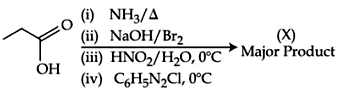
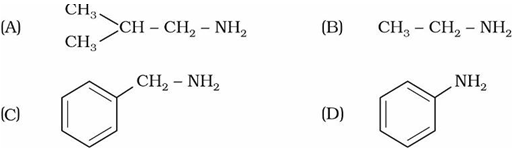
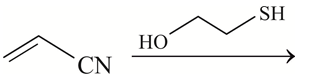
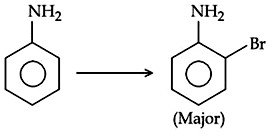
Consider the following reactions given major product. Identify the correct reaction.
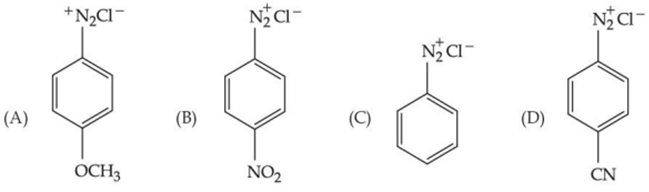
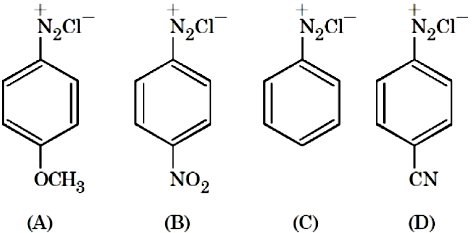
The correct stability order of the following diazonium salt is
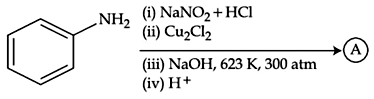
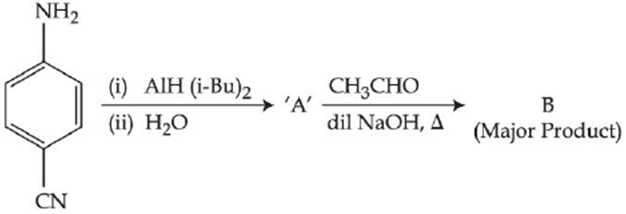
Identify the product in the following reaction.
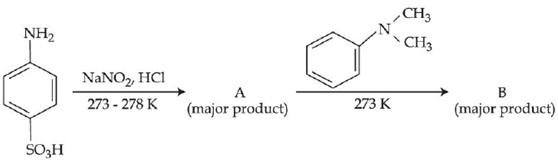
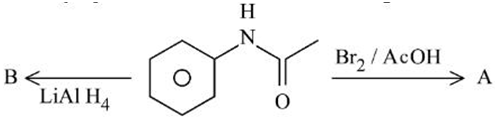
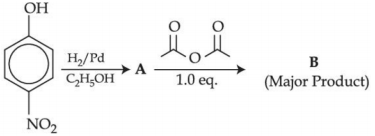
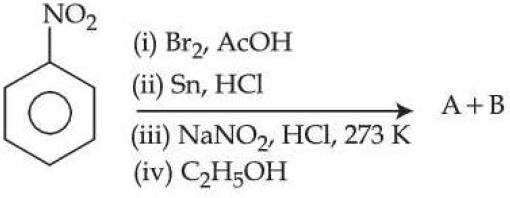
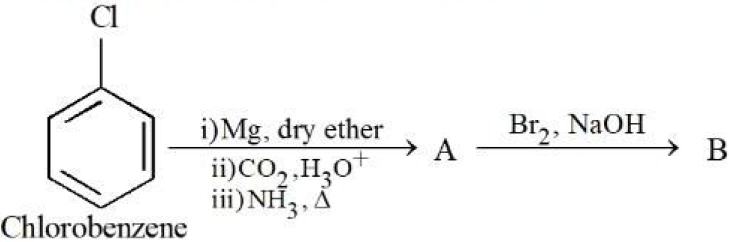
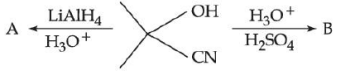
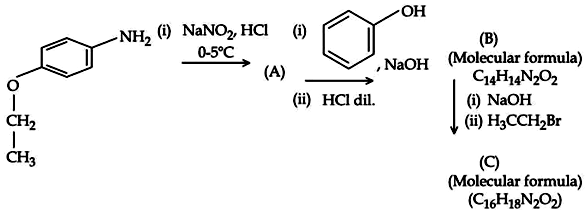
Consider the above reaction, compound B is:
If \( 279 \\ \mathrm{g} \) of aniline is reacted with one equivalent of benzenediazonium chloride, the maximum amount of aniline yellow formed will be ______ \( \mathrm{g} \). (Nearest integer) [Consider complete conversion]
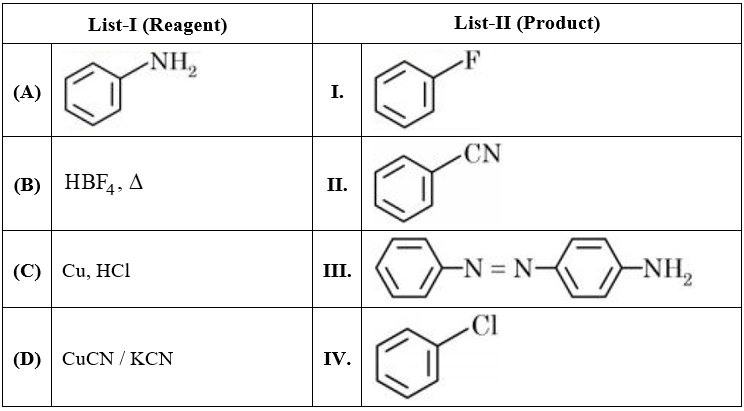
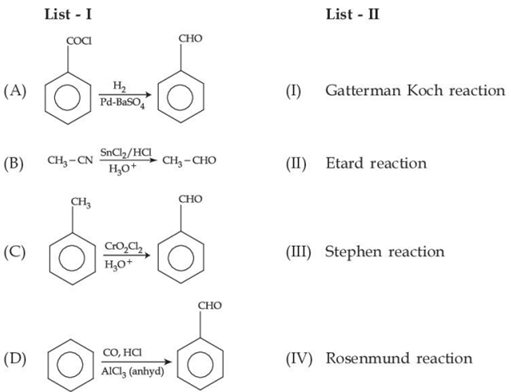
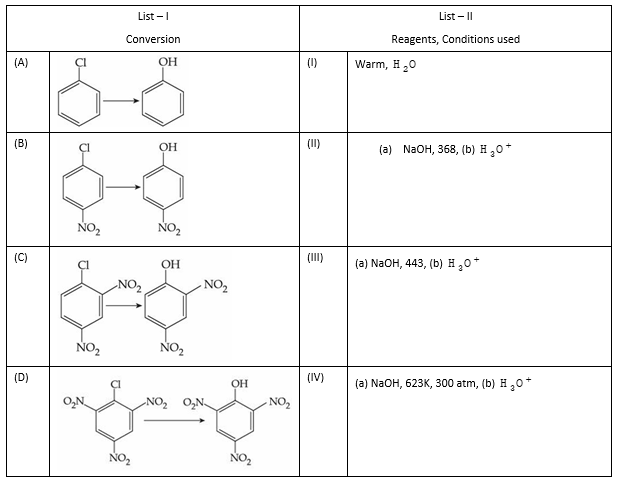
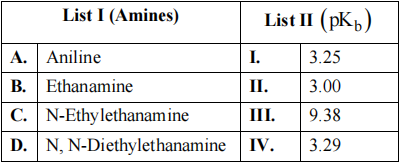
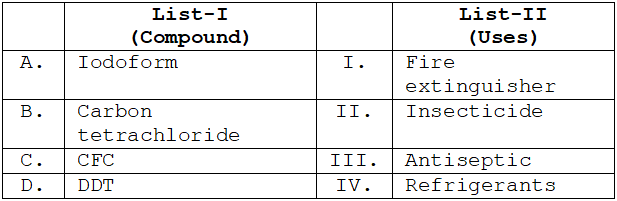
Match List-I with List-II.
Choose the correct answer from the options given below:
An amine \( (X) \) is prepared by ammonolysis of benzyl chloride. On adding p-toluenesulphonyl chloride to it the solution remains clear. Molar mass of the amine \( (X) \) formed is ______ \( \mathrm{g\, mol^{-1}} \). (Given molar mass in \( \mathrm{g\, mol^{-1}} \) \( \mathrm{C}:12, \mathrm{H}:1, \mathrm{O}:16, \mathrm{N}:14 \) )
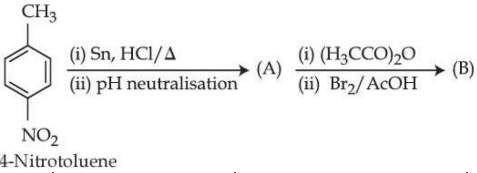
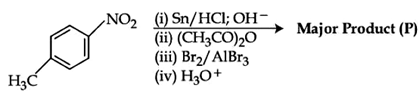
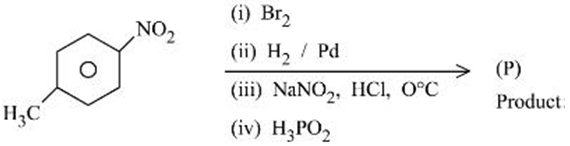
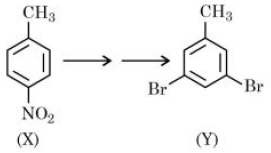
Consider the following sequence of reactions. Assuming that the reaction proceeds to completion, then \( 137 \, \text{mg} \) of \( 4 \)-nitrotoluene will produce ______ \( \, \text{mg} \) of B. [Given molar mass in \( \, \text{g mol}^{-1} \): H \( = 1 \), C \( = 12 \), N \( = 14 \), O \( = 16 \) and Br \( = 80 \)]
Given below are two statements:Statement -I : In Hofmann degradation reaction, the migration of only an alkyl group takes place from carbonyl of the amide to the nitrogen atom.Statement -II : The group is migrated in Hofmann degradation reaction to electron deficient atom.
An organic compound ‘A’ on reaction with \( \mathrm{NH_3} \) followed by heating gives compound B. Which on further strong heating gives compound C \( \mathrm{(C_8H_5NO_2)} \). Compound C on sequential reaction with ethanolic \( \mathrm{KOH} \), alkyl chloride and hydrolysis with alkali gives a primary amine. The compound A is:
Given below are two statements :Statement-I : Aniline is less basic than acetamide.Statement-II : In aniline, the lone pair of electrons on nitrogen atom is delocalized over benzene ring due to resonance and hence less available to a proton.Choose the most appropriate option :
\( X \) \( \mathrm{g} \) of ethylamine is subjected to reaction with \( \mathrm{NaNO}_2 / \mathrm{HCl} \) followed by water; evolved dinitrogen gas which occupied \( 2.24 \, \mathrm{L} \) volume at STP. \( X \) is \( \_\_\_\_\_\_ \times 10^{-1} \, \mathrm{g} \).
The major products A and B from the following reactions are:
The final product \([B]\) is:
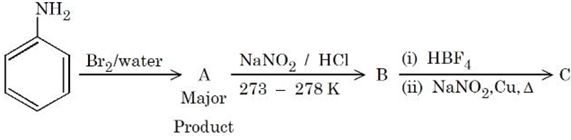
Product C of the following reaction sequence will be:
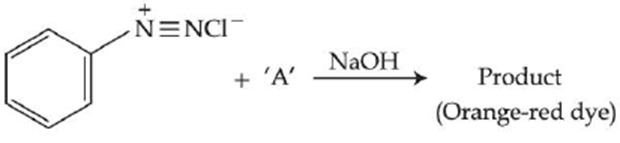
Which one of the following reaction sequences will give an azo dye?
Identify B formed in the reaction. \( \mathrm{Cl-(CH_2)_4-Cl} \xrightarrow{\text{excess } \mathrm{NH_3}} \mathrm{A} \xrightarrow{\mathrm{NaOH}} \mathrm{B} + \mathrm{H_2O} + \mathrm{NaCl} \)
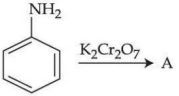
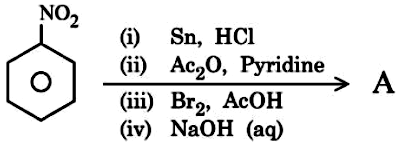
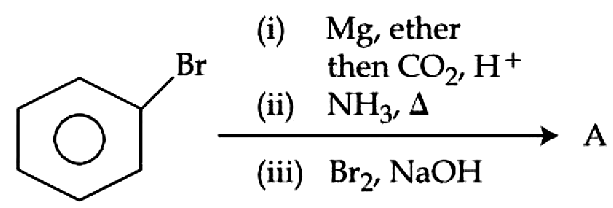
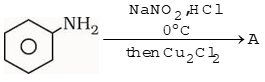
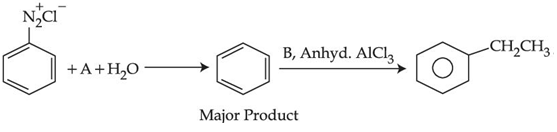
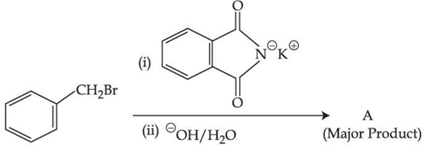
Identify \( A \) in the following reaction.
An organic compound \( (\mathrm{P}) \) on treatment with aqueous ammonia under hot condition forms compound \( (\mathrm{Q}) \) which on heating with \( \mathrm{Br_2} \) and \( \mathrm{KOH} \) forms compound \( (\mathrm{R}) \) having molecular formula \( \mathrm{C_6H_7N} \). Names of P, Q and R respectively are:
Consider the following organic reaction sequence. Choose the final product \( (X) \) from the following (consider the major product in all intermediate reactions)
The compound which will have the lowest rate towards nucleophilic aromatic substitution on treatment with \( \mathrm{OH^-} \) is:
The correct structures of A and B formed in the following reactions are :
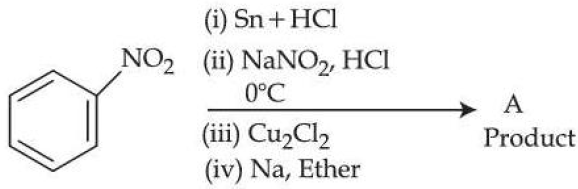
The major product \( (\mathrm{A}) \) formed in the following reaction sequence is:
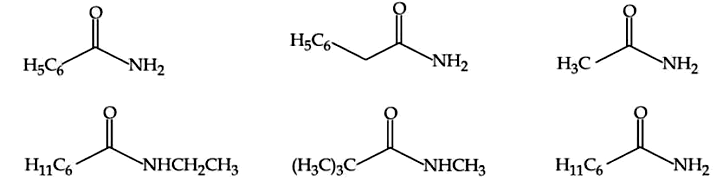
The total number of amines among the following which can be synthesized by Gabriel synthesis is _____.
The products formed in the following reaction sequence are:
Which statements are True?A. In Hoffmann bromamide degradation, \( 4 \) moles of \( \mathrm{NaOH} \) and \( 2 \) moles of \( \mathrm{Br_2} \) are consumed per mole of an amide.B. Hoffmann bromamide reaction is not given by alkyl amides.C. Primary amines can be synthesized by Hoffmann bromamide degradation.D. Secondary amide on reaction with \( \mathrm{Br_2} \) and \( \mathrm{NaOH} \) will give secondary amine.E. The by-products of Hoffmann degradation are \( \mathrm{Na_2CO_3} \), \( \mathrm{NaBr} \) and \( \mathrm{H_2O} \).Choose the correct answer from the options given below:
The final product A, formed in the following multistep reaction sequence is:
The correct stability order of the following diazonium salts is :
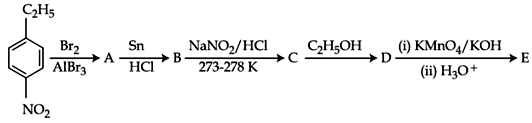
Identify compounds A and E in the following reaction sequence.
A reaction of \( 0.1 \) mole of Benzylamine with bromomethane gave \( 23 \, \text{g} \) of Benzyl trimethyl ammonium bromide. The number of moles of bromomethane consumed in this reaction are \( n \times 10^{-1} \), when \( n = \) ____________. (Round off to the Nearest Integer).[Given: Atomic masses: \( \text{C} : 12.0 \, \text{u} \), \( \text{H} : 1.0 \, \text{u} \), \( \text{N} : 14.0 \, \text{u} \), \( \text{Br} : 80.0 \, \text{u} \)]
\( 9.3 \, \text{g} \) of pure aniline is treated with bromine water at room temperature to give a white precipitate of the product ‘P’. The mass of product ‘P’ obtained is \( 26.4 \, \text{g} \). The percentage yield is __________ \( \% \).
In the reaction of hypobromite with amide, the carbonyl carbon is lost as:
From \( 6.55 \, \text{g} \) of aniline, the maximum amount of acetanilide that can be prepared will be _______________ \( \times 10^{-1} \, \text{g} \) .
Number of compounds from the following which cannot undergo Friedel-Crafts reactions is :toluene, nitrobenzene, xylene, cumene, aniline, chlorobenzene, m-nitroaniline, m-dinitrobenzene
The major product for the following reaction is :
Number of amine compounds from the following giving solids which are soluble in \( \mathrm{NaOH} \) upon reaction with Hinsberg's reagent is ______.
Given below are two statements.Statement I: Pure Aniline and other arylamines are usually colourless.Statement II: Arylamines get coloured on storage due to atmospheric reductionIn the light of above statements, choose the most appropriate answer from the options given below:
The correct sequence of correct reagents for the following transformation is:
Primary, secondary and tertiary amines can be separated using :
Given below are two statements, one is labelled as Assertion (A) and other is labelled as Reason (R).Assertion (A): Gabriel phthalimide synthesis cannot be used to prepare aromatic primary amines.Reason (R): Aryl halides do not undergo nucleophilic substitution reaction.In the light of the above statements, choose the correct answer from the options given below:
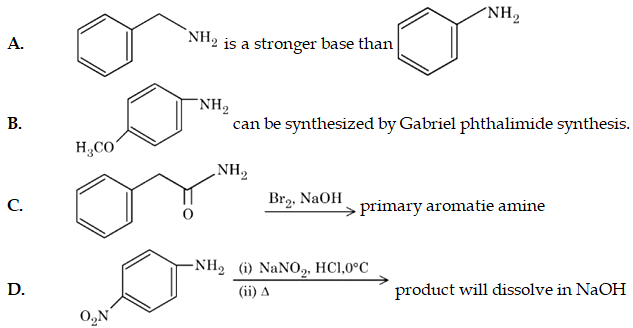
Identify the incorrect statements.Choose the correct answer from the options given below:
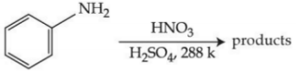
Given below are two statements : one is labelled as Assertion A and the other is labelled as Reason R Assertion A: Aniline on nitration yields ortho, meta & para nitro derivatives of aniline Reason R : Nitrating mixture is a strong acidic mixture In the light of the above statements, choose the correct answer from the options given below.
Arrange the following compounds according to increasing order of boiling points.\( \mathrm{n-C_4H_9OH (A)}, \mathrm{ n-C_4H_9NH_2 (B)}, \mathrm{ n-C_4H_{10} (C)} \) and \( \mathrm{C_2H_5NHC_2H_5 (D)} \).
. Match List -I with List-IIChoose the correct answer from the options given below:
Consider the following reaction.The major product \((P)\) formed is:
Reagent, \( 1 \)-naphthylamine and sulphanilic acid in acetic acid is used for the detection of:
Consider the following reactions sequence When the product (P) is subjected to Carius analysis using \( \text{AgNO}_{3} \), \( 1.0 \, \text{g} \) of the product (P) will produce ________ \( \text{g} \) of the precipitate of \( \text{AgBr} \). (Nearest Integer) (Given : molar mass in \( \text{g mol}^{-1} \) C : \( 12 \); H : \( 1 \); O : \( 16 \); N : \( 14 \); Br : \( 80 \); Ag : \( 108 \))
Match List – I with List – IIChoose the correct answer from the options given below:
Given below are two statements: one is labelled as Assertion (A) and the other is labelled as Reason (R).Assertion (A): Experimental reaction of \( \mathrm{CH_3Cl} \) with aniline and anhydrous \( \mathrm{AlCl_3} \) does not give o and p-methylaniline.Reason (R): The \( -\mathrm{NH_2} \) group of aniline becomes deactivating because of salt formation with anhydrous \( \mathrm{AlCl_3} \) and hence yields m-methyl aniline as the product.In the light of the above statements, choose the most appropriate answer from the options given below:
Compound \( A \) is converted to \( B \) on reaction with \( \mathrm{CHCl_3} \) and \( \mathrm{KOH} \). The compound \( B \) is toxic and can be decomposed by \( C \). \( A \), \( B \) and \( C \) respectively are:
The major product of the following reaction is:
Consider the following sequence of reactions: \( 11.25 \, \mathrm{mg} \) of chlorobenzene will produce ______ \( \times 10^{-1} \, \mathrm{mg} \) of product B. (Consider the reactions result in complete conversion) [Given molar mass of C, H, O, N and Cl as \( 12 \), \( 1 \), \( 16 \), \( 14 \) and \( 35.5 \, \mathrm{g\, mol^{-1}} \) respectively]
Given below are two statements:Statement (I) : The \( \mathrm{NH_2} \) group in aniline is ortho and para directing and powerful activating group.Statement (II) : Aniline does not undergo Friedel-Craft’s reaction (alkylation and acylation).In the light of the above statements, choose the most appropriate answer from the options given below:
In gaseous triethyl amine the "\( \mathrm{-C-N-C-} \)" bond angle is _______ degree.
The Hinsberg reagent is:
The product \( (P) \) formed from the following multistep reaction is:
The product A formed in the following reaction is:
Given below are two statements:Statement (I): All the following compounds react with \( p \)-toluenesulfonyl chloride. \( \mathrm{C_6H_5NH_2} \) \(( \mathrm{C_6H_5)_2NH} \) \(( \mathrm{C_6H_5)_3N} \)Statement (II): Their products in the above reaction are soluble in aqueous \( \mathrm{NaOH} \)In the light of the above statements, choose the correct answer from the options given below:
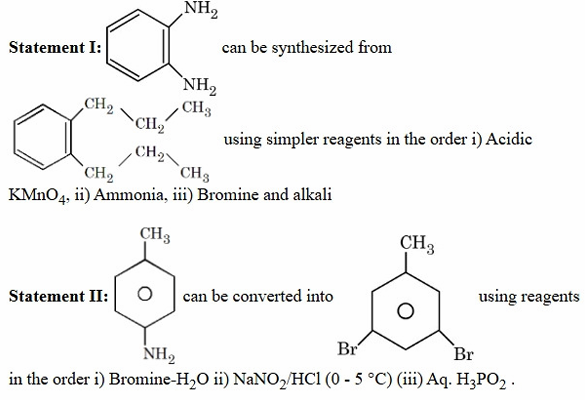
In the light of the above statements, choose the correct answer from the options given below:
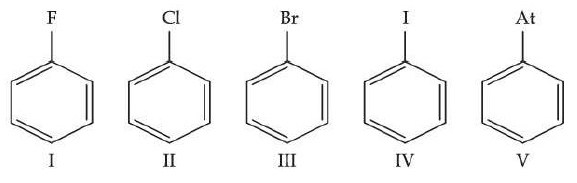
The number of halobenzenes from the following that can be prepared by Sandmeyer's reaction is __________.
\( 9.3 \) \( \mathrm{g} \) of pure aniline upon diazotization followed by coupling with phenol gives an orange dye. The mass of orange dye produced (assume \( 100\% \) yield/conversion) is _______ \( \mathrm{g} \) (nearest integer).
An organic compound “\( A \)” on treatment with benzene sulphonyl chloride gives compound \( B \), \( B \) is soluble in dil. \( \mathrm{NaOH} \) solution. Compound \( A \) is:
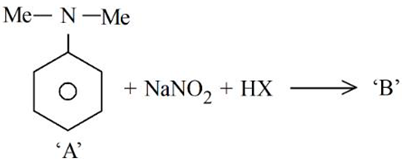
Consider the following sequence of reactions.The percentage of nitrogen in the yellow product (X) formed is ________ %. (Nearest Integer)(Given Molar mass in \( \text{g} \, \text{mol}^{-1} \) H: \( 1 \), C: \( 12 \), N: \( 14 \))
Consider the above reaction, the Product “P” is:
Identify the major product formed in the following sequence of reactions:
Consider the following sequence of reactions: The product ‘B’ is:
A student has been given a compound "\( x \)" of molecular formula \( \mathrm{C_6H_7N} \). ‘\( x \)’ is sparingly soluble in water. However, on addition of dilute mineral acid, ‘\( x \)’ becomes soluble in water. ‘\( x \)’ when treated with \( \mathrm{CHCl_3} \) and \( \mathrm{KOH\ (alc)} \), ‘\( y \)’ is produced. ‘\( y \)’ has a specific unpleasant smell. On treatment with benzene sulphonyl chloride, ‘\( x \)’ gives a compound ‘\( z \)’ which is soluble in alkali. The number of different “\( \mathrm{H} \)” atoms present in ‘\( z \)’ is:
Which among the following represent reagent ‘A’?
Given below are two statements:Statement I: Aniline reacts with con. \( \mathrm{H_2SO_4} \), followed by heating at \( 453\text{–}473 \, \mathrm{K} \) gives p-aminobenzene sulphonic acid, which gives blood red colour in the ‘Lassaigne’s test’.Statement II: In Friedel–Craft’s alkylation and acylation reactions, aniline forms salt with the \( \mathrm{AlCl_3} \) catalyst. Due to this, nitrogen of aniline aquires a positive charge and acts as deactivating group.In the light of the above statements, choose the correct answer from the options given below:
Given below are two statements: one is labelled as Assertion (A) and the other is labelled as Reason (R).Assertion (A): \( \alpha \)-halocarboxylic acid on reaction with dil \( \mathrm{NH_3} \) gives good yield of \( \alpha \)-amino carboxylic acid whereas the yield of amines is very low when prepared from alkyl halides.Reason (R): Amino acids exist in zwitter ion form in aqueous medium.In the light of the above statements, choose the correct answer from the options given below:
Which of the following reaction is an example of ammonolysis?
What is the major product “\( P \)” of the following reaction?
An organic compound ‘A’ contains nitrogen and chlorine. It dissolves readily in water to give a solution that turns litmus red. Titration of compound ‘A’ with standard base indicates that the molecular weight of ‘A’ is \(131 \pm 2\). When a sample of ‘A’ is treated with aq. \( \mathrm{NaOH} \), a liquid separate which contains \( \text{N} \) but not \( \text{Cl} \). Treatment of the obtained liquid with nitrous acid followed by phenol gives orange precipitate. The compound ‘A’ is:
Consider the following reaction sequence: The product B is:
Hoffmann bromamide degradation of benzamide gives product A, which upon heating with \( \mathrm{CHCl_3} \) and \( \mathrm{NaOH} \)
Statement I: Sodium hydride can be used as an oxidizing agent. Statement II: The lone pair of electrons on nitrogen in pyridine makes it basic. Choose the CORRECT answer from the options given below:
Which statement is NOT correct for p-toluenesulphonyl chloride?
In the chemical reactions given above \( A \) and \( B \) respectively.
Compound P is neutral, Q gives effervescence with \( \mathrm{NaHCO_3} \) while R reacts with Hinsbergs reagent to give solid soluble in \( \mathrm{NaOH} \). Compound P is:
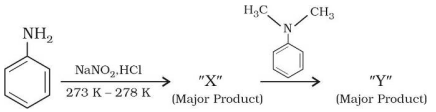
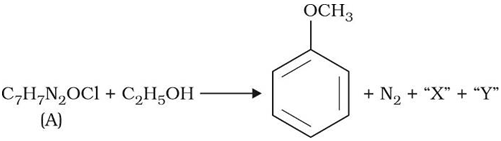
Consider the above reaction, X and Y respectively are:
Given below are two statements:Statement (I) : Aminobenzene and aniline are same organic compounds.Statement (II) : Aminobenzene and aniline are different organic compounds.In the light of the above statements, choose the most appropriate answer from the options given below:
Which one of the following reactions does not occur?
Consider the given reaction, percentage yield of:
Which of the following is not a correct statement for primary aliphatic amines?
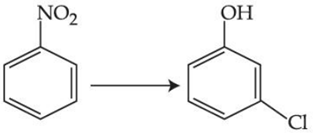
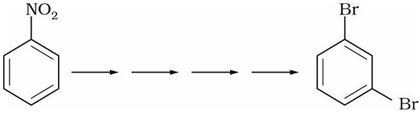
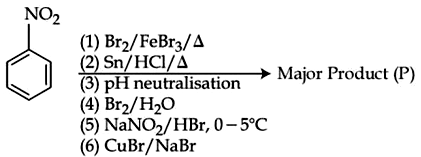
What is the correct sequence of reagents used for converting nitrobenzene into m-dibromobenzene?
Ammonolysis of Alkyl halides followed by the treatment with NaOH solution can be used to prepare primary, secondary and tertiary amines. The purpose of NaOH in the reaction is:
Match List I with List II.Choose the correct answer from the options given below:
The major product formed in the following reaction is:
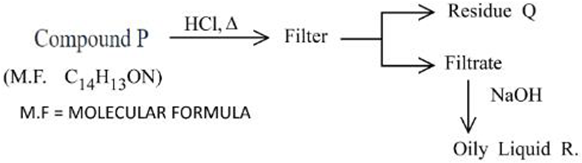
‘A’ is a neutral organic compound (M. F : \( \mathrm{C_8H_9ON} \)). On treatment with aqueous \( \mathrm{Br_2} \) \( / \) \( \mathrm{HO^{(-)}} \), ‘A’ forms a compound ‘B’ which is soluble in dilute acid. ‘B’ on treatment with aqueous \( \mathrm{NaNO_2} \) \( / \) \( \mathrm{HCl} \) \( (0\text{-}5^\circ \mathrm{C}) \) produces a compound ‘C’ which on treatment with \( \mathrm{CuCN} \) \( / \) \( \mathrm{NaCN} \) produces ‘D’. Hydrolysis of ‘D’ produces ‘E’ which is also obtainable from the hydrolysis of ‘A’. ‘E’ on treatment with acidified \( \mathrm{KMnO_4} \) produces ‘F’. ‘F’ contains two different types of hydrogen atoms. The structure of ‘A’ is:
Which of the following amine(s) show(s) positive carbylamine test?Choose the correct answer from the options given below:
The total number of reagents from those given below, that can convert nitrobenzene into aniline is __________. (Integer answer)\( \mathrm{I.}\ \mathrm{Sn} - \mathrm{HCl} \) \( \mathrm{II.}\ \mathrm{Sn} - \mathrm{NH_4OH} \) \( \mathrm{III.}\ \mathrm{Fe} - \mathrm{HCl} \) \( \mathrm{IV.}\ \mathrm{Zn} - \mathrm{HCl} \) \( \mathrm{V.}\ \mathrm{H_2} - \mathrm{Pd} \) \( \mathrm{VI.}\ \mathrm{H_2} - \text{Raney Nickel} \)
The products \( A \) and \( B \) formed in the formed reaction scheme are respectively
Consider the above sequence of reactions. The number of bromine atom(s) in the final product \( (P) \) will be:
The number of compounds from the following which can undergo reaction with \( \mathrm{Br_2/KOH} \) (alcoholic) to give respective products and these respective products can also be obtained separately by Gabriel phthalimide reaction is:
A student has planned to prepare acetanilide from aniline using acetic anhydride. The student has started from \( 9.3 \, \text{g} \) of aniline. However, the student has managed to obtain \( 11 \, \text{g} \) of dry acetanilide. The \( \% \) yield of this reaction is:
\( X \) g of ethanamine was subjected to reaction with \( \mathrm{NaNO_2/HCl} \) followed by hydrolysis to liberate \( \mathrm{N_2} \) and \( \mathrm{HCl} \). The \( \mathrm{HCl} \) generated was completely neutralized by \( 0.2 \) moles of \( \mathrm{NaOH} \). \( X \) is \( \_ \_ \_ \_ \_ \) g.
Choose the correct answer from the options given below
The major products \( A \) and \( B \) in the following set of reactions are:
An organic compound \([A](\mathrm{C_4H_{11}N})\), shows optical activity and gives \( \mathrm{N_2} \) gas on treatment with \( \mathrm{HNO_2} \). The compound \([A]\) reacts with \( \mathrm{PhSO_2Cl} \) producing a compound which is soluble in \( \mathrm{KOH} \). The structure of \( A \) is:
Isomeric amines with molecular formula \( \mathrm{C_8H_{11}N} \) give the following testsIsomer (P) ⇒ Can be prepared by Gabriel phthalimide synthesis.Isomer (Q) ⇒ Reacts with Hinsberg’s reagent to give sold insoluble in \( \mathrm{NaOH} \).Isomer (R) ⇒ Reacts with \( \mathrm{HONO} \) followed by \( \beta \)-naphthol in \( \mathrm{NaOH} \) to give red dye.Isomers (P), (Q) and (R) respectively are:P Q R
Number of compounds which give reaction with Hinsberg’s reagent is ___________.
Compound ‘P’ undergoes the following sequence of reactions:
What is A in the following reaction?
Compound A from the following reaction sequence is :
In the above reactions, product A and product B respectively are:
In Friedel-Crafts alkylation of aniline, one gets
The arenium ion which is not involved in the bromination of Aniline is __________.
The structure of X is:
Which one of the products of the following reactions does not react with Hinsberg reagent to form sulphonamide?
Which of the following reaction is correct?
Identify correct A, B and C in the reaction sequence given below:
Match List – I with List – II:
Number of isomeric aromatic amines with molecular formula \( \mathrm{C}_8\mathrm{H}_{11}\mathrm{N} \), which can be synthesized by Gabriel Phthalimide synthesis is \( \_ \_ \_ \_ \_ \_ \).
The correct sequential order of the reagents for the given reaction is
The major products A and B formed in the following reaction sequence are:
Given below are two statements: IUPAC name of compound A is \( 4 \)-chloro-\( 1 \), \( 3 \)-dinitrobenzene.IUPAC name of compound B is \( 4 \)-ethyl-\( 2 \)-methylaniline.In the light of the above statements, choose the most appropriate answer from the options given below:
Given below are two statements:Statement I: Sulphanilic acid gives esterification test for carboxyl group.Statement II: Sulphanilic acid gives red colour in Lassaigne’s test for extra element detection.In the light of the above statements, choose the most appropriate answer from the option given below:
The reaction of with bromine and \( \mathrm{KOH} \) gives \( \mathrm{RNH_2} \) as the end product. Which one of the following is the intermediate product formed in this reaction?
Consider the above chemical reaction and identify product “A”:
Consider the following sequence of reactions.Total number of \( \text{sp}^3 \) hybridized carbon atoms in the major product \( C \) formed is ________.
The incorrect Statement regarding the reaction given below is:
Which of the following is strongest Bronsted base?
In the above reaction, the structural formula of (A), “X” and “Y” respectively are :
Phthalimide is made to undergo following sequence of reactions. Total number of \( \pi \) bonds present in product ‘P’ is/are ____________ .
\( 9.3 \, \text{g} \) of aniline is subjected to reaction with excess of acetic anhydride to prepare acetanilide. The mass of acetanilide produced if the reaction is \( 100\% \) completed is __________ × \( 10^{-1} \, \text{g} \).(Given molar mass in \( \text{g mol}^{-1} \, \text{g} \) \( \mathrm{N: 14, \ O: 16, \ C: 12, \ H: 1} \))
A primary aliphatic amine on reaction with nitrous acid in cold \( 273 \, \mathrm{K} \) and there after raising temperature of reaction mixture to room temperature \( 298 \, \mathrm{K} \), gives a/an:
Which one of the following gives the most stable Diazonium salt?
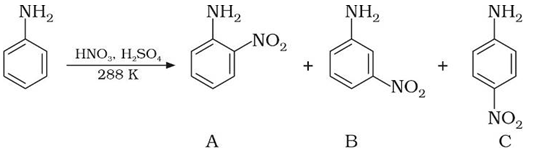
With respect to the following reaction, consider the given statements:(a) o-Nitroaniline and p-nitroaniline are the predominant products(b) p-Nitroaniline and m-nitroaniline are the predominant products(c) \( \mathrm{HNO_3} \) acts as an acid(d) \( \mathrm{H_2SO_4} \) acts as an acid
The sequence from the following that would result in giving predominantly \( 3, 4, 5 \) Tribromoaniline is:
In the above conversion of compound \( (X) \) to product \( (Y) \), the sequence of reagents to be used will be :
The diazonium salt of which of the following compounds will form a coloured dye on reaction with \( \beta \)-Naphthol in \( \mathrm{NaOH} \)?
Reaction of propanamide with \( \mathrm{Br_2} / \mathrm{KOH(aq)} \) produces:
The final product ‘C’ in the following series of reactions:
For reactionThe correct order of set of reagents for the above conversion is:
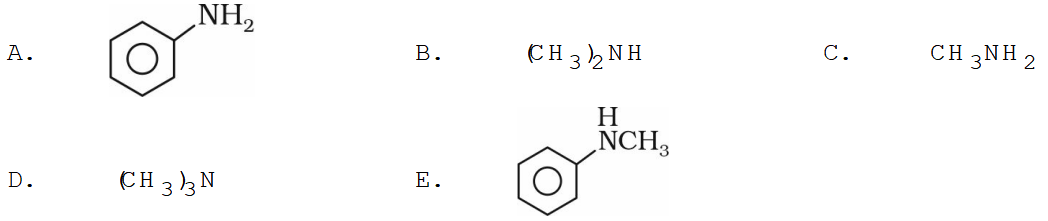
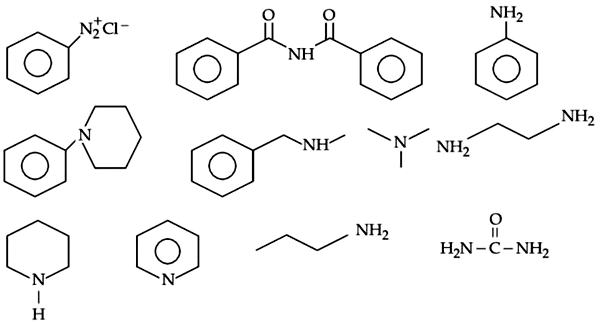
The descending order of basicity of following amines is:
Consider the following sequence of reactions:Molar mass of the product formed (A) is _________ \( \text{g mol}^{-1} \).
Consider the three aromatic molecules (P, Q and R) whose structures have been given below:The correct order regarding the reactivity of these compounds with under optimum but slightly acidic medium is:
Following is a confirmatory test for aromatic primary amines. Identify reagent (A) and (B).

 in the following reaction.


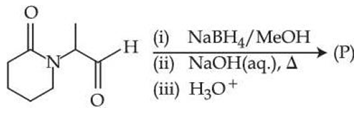



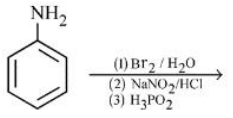





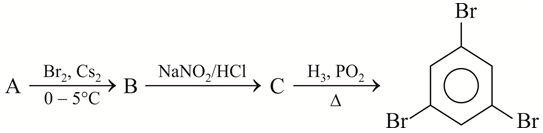
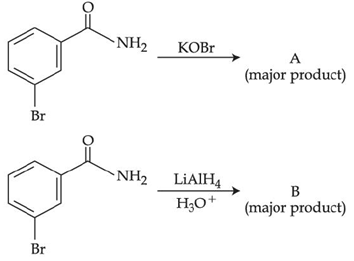
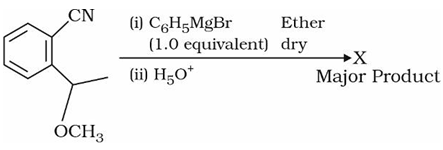

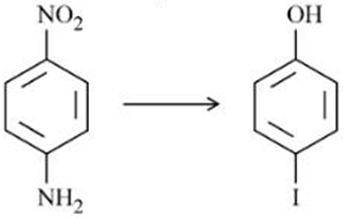

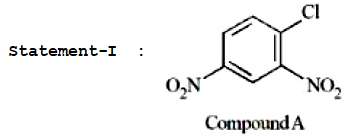 IUPAC name of compound A is \( 4 \)-chloro-\( 1 \), \( 3 \)-dinitrobenzene.
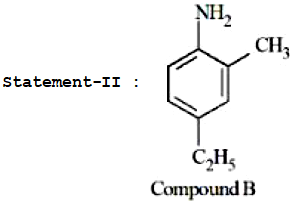 IUPAC name of compound B is \( 4 \)-ethyl-\( 2 \)-methylaniline.
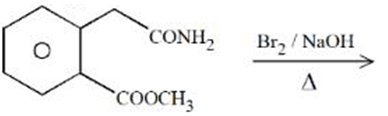
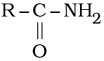 with bromine and \( \mathrm{KOH} \) gives \( \mathrm{RNH_2} \) as the end product. Which one of the following is the intermediate product formed in this reaction?
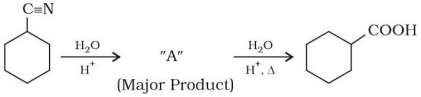



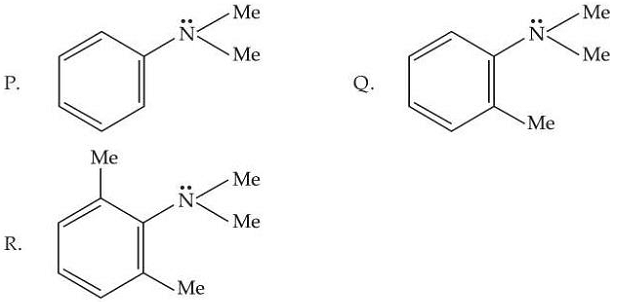
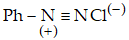 under optimum but slightly acidic medium is:
