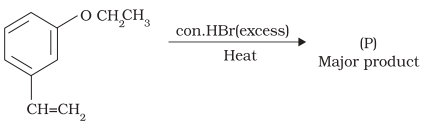
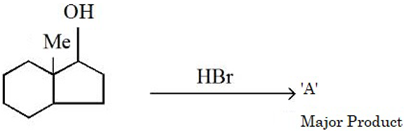
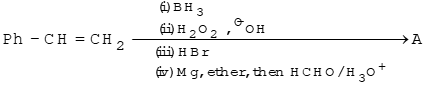
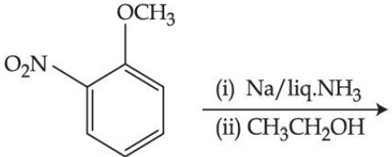
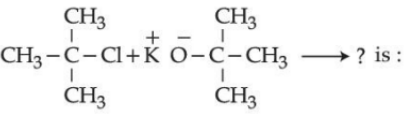
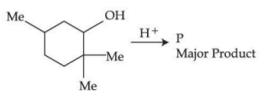
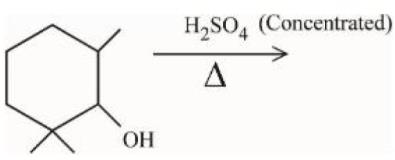
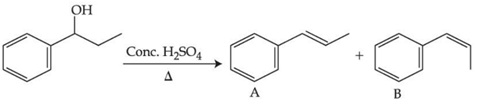
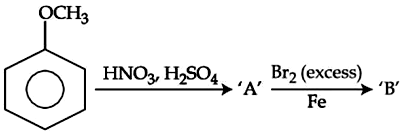
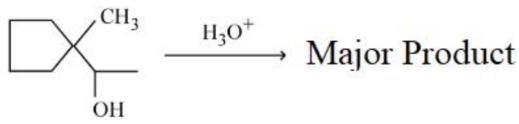
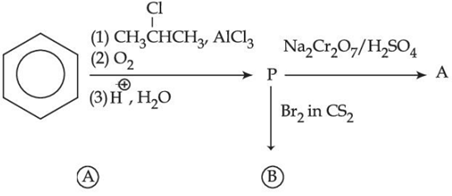
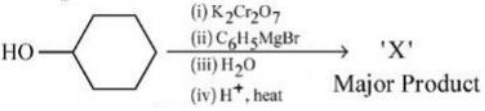
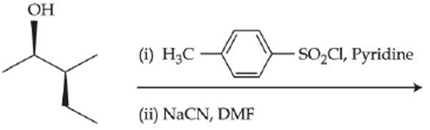
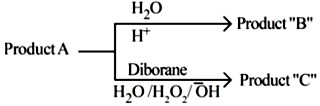
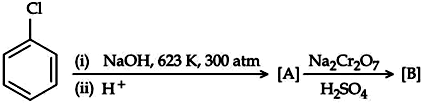
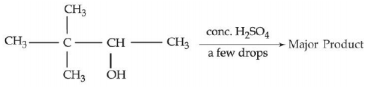
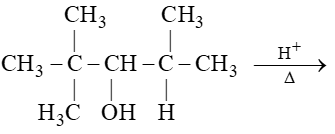
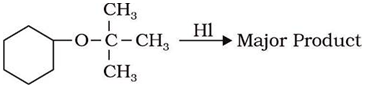
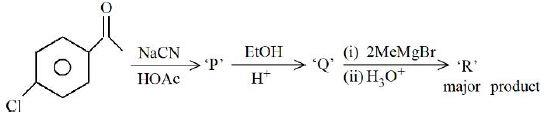
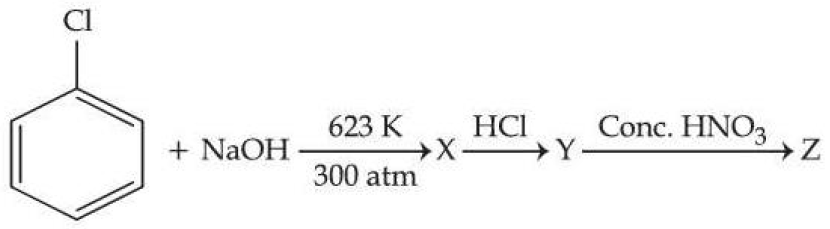
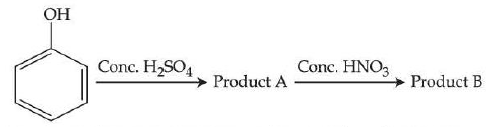
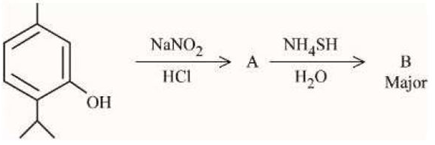
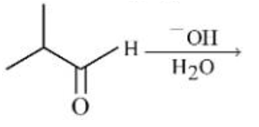
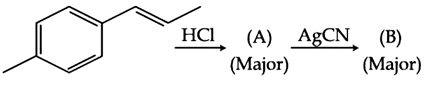
The major product \((P)\) in the following reaction is:
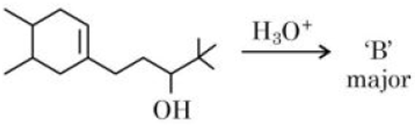
The number of hyperconjugation structures involved to stabilize carbocation formed in the above reaction is _________.
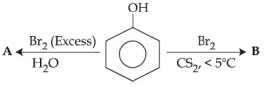
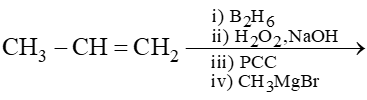
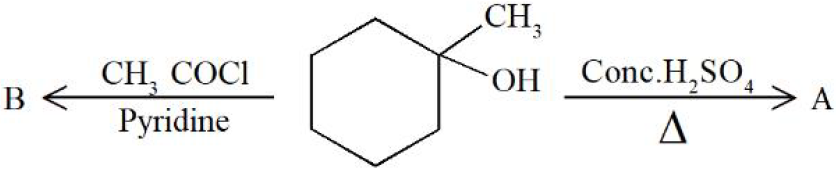
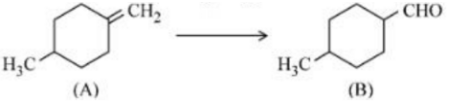
The final product A, formed in the following reaction sequence is:
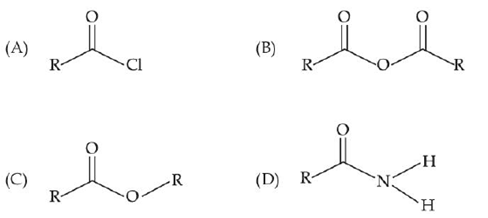
Which one of the following compounds will provide a tertiary alcohol on reaction with excess of \( \mathrm{CH_3MgBr} \) followed by hydrolysis?
Given below are two statements: One is labelled as Assertion A and the other is labelled as Reason R:Assertion A: Alcohols react both as nucleophiles and electrophiles.Reason R: Alcohols reacts with active metals such as sodium, potassium and aluminium to yield corresponding alkoxides and liberate hydrogen.In the light of the above statements, choose the correct answer from the options given below:
Given below are two statements :Statement (I) : p-nitrophenol is more acidic than m-nitrophenol and o-nitrophenol.Statement (II) : Ethanol will give immediate turbidity with Lucas reagent.In the light of the above statements, choose the correct answer from the options given below :
Consider the following reaction sequenceCompound \( (y) \) develops characteristic colour with neutral \( \mathrm{FeCl_3} \) solution.Identify the INCORRECT statement from the following for the above sequence.
The major product of the following reaction is
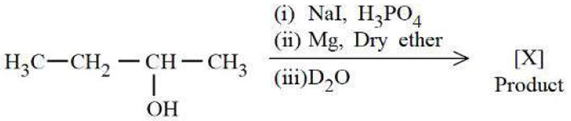
Product \([X]\) formed in the above reaction is :
The conversion of propan-1-ol to n-butylamine involves the sequential addition of reagents. The correct sequential order of reagents is:
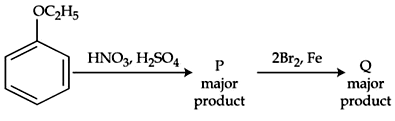
The ratio of number of oxygen atoms to bromine atoms in the product Q is ______ \( \times 10^{-1} \).
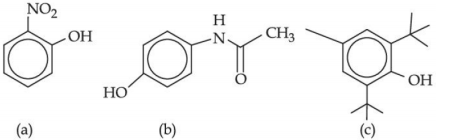
Which one the following compounds will readily react with dilute \( \mathrm{NaOH} \) ?
The major product in the following reaction is:
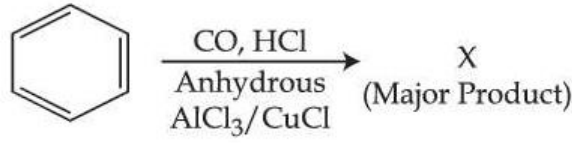
Identify major product “X” formed in the following reaction:
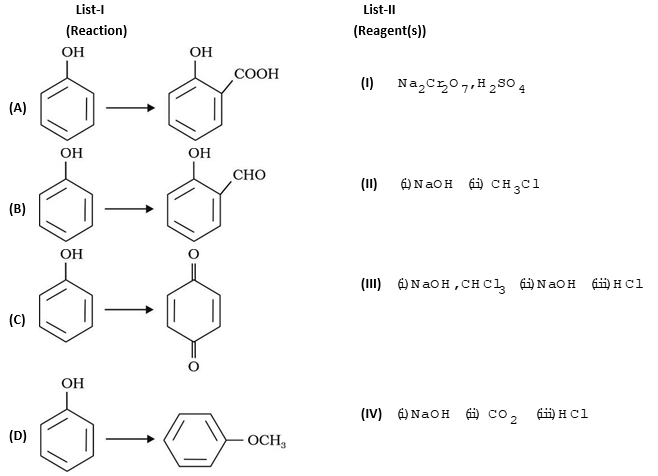
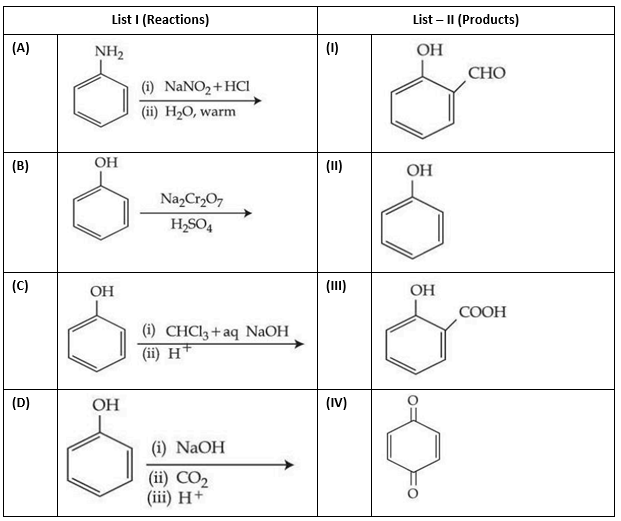
Match List-I with List-II.
Identify the colour of compound ‘X’ in the sequence of the reaction.
Compound \( I \) is heated with Conc. \( \mathrm{HI} \) to give a hydroxy compound \( A \) which is further heated with \( \mathrm{Zn} \) dust to give compound \( B \). Identify \( A \) and \( B \).
The correct options for the products A and B of the following reactions are:
The major product in the reaction is:
The major product \( (P) \) of the given reaction is(where, Me is \( -\mathrm{CH_3} \) )
Terylene polymer is obtained by condensation of:
Consider the above reaction, and choose the correct statement :
When ethanol is heated with conc. \( \mathrm{H_2SO_4} \) , A gas is produced. The compound formed, when this gas is treated with cold dilute aqueous solution of Baeyer’s reagent, is:
Main product formed during a reaction of \( 1 \)-methoxy naphthalene with hydroiodic acid are:
In a reaction,reagents ‘X’ and ‘Y’ respectively are:
The major products formed:A and B respectively are:
Given below are two statement: one is labelled as Assertion (A) and the other is labelled as Reason(R).Assertion (A): Synthesis of ethyl phenyl ether may be achieved by Williamson synthesis.Reason (R): Reaction of bromobenzene with sodium ethoxide yields ethyl phenyl ether.In the light of the above statements, choose the most appropriate answer from the options given below:
Find out the major product for the following reaction.
Identify the major products \( A \) and \( B \) for the below given reaction sequence.
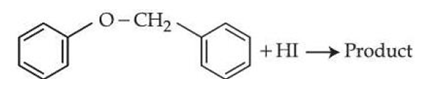
Consider the following reaction : Statement I : In the above reaction, product formed will be a mixture of benzyl alcohol and iodobenzene. Statement II : In the above reaction, the \( -\mathrm{O{-}CH_2}- \) bond is cleaved to give the product. In the light of the above statements, choose the correct answer from the options given below :
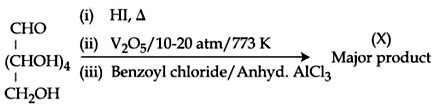
Consider the following reactions. Total number of electrons in the \( \pi \) bonds and lone pair of electrons in the product \( (X) \) is:
Number of isomeric compounds with molecular formula \( \mathrm{C}_9\mathrm{H}_{10}\mathrm{O} \) which (i) do not dissolve in \( \mathrm{NaOH} \) (ii) do not dissolve in \( \mathrm{HCl} \). (iii) do not give orange precipitate with \( 2,4\text{-DNP} \) (iv) on hydrogenation give identical compound with molecular formula \( \mathrm{C}_9\mathrm{H}_{12}\mathrm{O} \) is _________.
Match List – I with List – II
Choose the correct answer from the options given below:
Given below are two statements:Statement I: The esterification of carboxylic acid with an alcohol is a nucleophilic acyl substitution.Statement II: Electron withdrawing groups in the carboxylic acid will increase the rate of esterification reaction.Choose the most appropriate option:
The product formed in the following multistep reaction is:
In the reaction given below‘B’ is:
Match List I with List II
Choose the correct answer from the option given below:
A compound ‘\( X \)’ when treated with phthalic anhydride in presence of concentrated \( \mathrm{H_2SO_4} \) yields ‘\( Y \)’. ‘\( Y \)’ is used as an acid base indicator.‘\( X \)’ and ‘\( Y \)’ are respectively.
Which among the following halides will generate the most stable carbocation in the nucleophilic substitution reaction?
Which among the following has highest boiling point?
In the given reaction,The number of \( \text{sp}^2 \) hybridized carbon(s) in compound ‘X’ is _______.
Common name of Benzene-\( 1, 2 \)-diol is:
An organic compound A \( (\mathrm{C_6H_6O}) \) gives dark green colouration with ferric chloride. On treatment with \( \mathrm{CHCl_3} \) and \( \mathrm{KOH} \), followed by acidification gives compound B. can also be obtained from compound C on reaction with pyridinium chlorochromate (PCC).
Incorrect method of preparation for alcohols from the following is:
Given below are two statements: One is labelled as Assertion A and the other is labelled as Reason R:Assertion A: \( pK_a \) value of phenol is \( 10.0 \) while that of ethanol is \( 15.9 \).Reason R: Ethanol is stronger acid than phenol.In the light of the above statements, choose the correct answer from the options given below:
Most stable product of the following reaction is:
\(\text{CH}_3-\text{CH}_2-\text{CH}_2-\text{Br} + \text{NaOH} \xrightarrow{\text{C}_2\text{H}_5\text{OH}} \text{Product 'A'}\)Consider the above reactions, identify product B and product C.
Identify the product [A] and [B], respectively in the following reaction:
The number of chiral alcohol(s) with molecular formula \( \text{C}_4\text{H}_{10}\text{O} \) is _______.
Given below are two statements: One is labelled as Assertion A and the other is labelled as Reason R.Assertion A : Butan-\( 1 \)-ol has higher boiling point than ethoxyethane.Assertion B : Extensive hydrogen bonding leads to stronger association of molecules.In the light of the above statements, choose the correct answer from the options given below:
An organic compound \( (X) \) with molecular formula \( \mathrm{C_3H_6O} \) is not readily oxidized. On reduction it gives \( \mathrm{C_3H_8O} \) \( (Y) \) which reacts with \( \mathrm{HBr} \) to give a bromide \( (Z) \) which is converted to Grignard reagent. This Grignard reagent on reaction with \( (X) \) followed by hydrolysis give \( 2, 3 \)-dimethylbutan-\( 2 \)-ol. Compounds \( (X) \), \( (Y) \) and \( (Z) \) respectively are:
Identify the major products \( A \) and \( B \) respectively in the following set of reactions.
Phenol treated with chloroform in presence of sodium hydroxide, which further hydrolyzed in presence of an acid results.
The major product \( (P) \) in the following reaction is:
The correct sequence of acidic strength of the following aliphatic acids in their decreasing order is:\( \mathrm{CH_3CH_2COOH} \), \( \mathrm{CH_3COOH} \), \( \mathrm{CH_3CH_2CH_2COOH} \), \( \mathrm{HCOOH} \)
The ascending order of acidity of —\( \text{OH} \) group in the following compounds is:
The major product formed in the following reaction is:
A sample of \( 4.5 \, \text{mg} \) of an unknown monohydric alcohol, \( \mathrm{R{-}OH} \) was added to methylmagnesium iodide. A gas is evolved and is collected and its volume measured to be \( 3.1 \, \text{mL} \). The molecular weight of the unknown alcohol is ________ \( \text{g/mol} \). [Nearest integer]
The intermediate \( X \), in the reaction:
Suitable reaction condition for preparation of Methyl phenyl ether is:
The correct order of their reactivity towards hydrolysis at room temperature is:
Given below are two statements :Statement I : On heating with \( \mathrm{KHSO_4} \), glycerol is dehydrated and acrolein is formed.Statement II : Acrolein has fruity odour and can be used to test glycerol’s presence.Choose the correction option :
Match List I with List II.
Given below are two statements:Statement I: Picric acid is \( 2, 4, 6 \)-trinitrotoluene.Statement II: Phenol \(-2,4\)-disulphonic acid is treated with Conc. \( \mathrm{HNO_3} \) to get picric acid.In the light of the above statements, choose the most appropriate answer from the options given below:
The difference in the reaction of phenol with bromine in chloroform and bromine in water medium is due to:
The major product in the given reaction is:
The number of non-ionizable protons present in the product \( B \) obtained from the following reactions is ______.\( \mathrm{C_2H_5OH} + \mathrm{PCl_3} \rightarrow \mathrm{C_2H_5Cl} + A \) \( A + \mathrm{PCl_3} \rightarrow B \)
Hydrolysis of which compound will give carbolic acid?
Given below are two statements : one is labelled as Assertion A and the other is labelled as Reason R.Assertion A : Aryl halides cannot be prepared by replacement of hydroxyl group of phenol by halogen atom.Reason R : Phenols react with halogen acids violently.In the light of the above statements, choose the most appropriate from the options given below:
A toxic compound ‘A’ when reacted with \( \mathrm{NaCN} \) in aqueous acidic medium yields an edible cooking component and food preservative ‘'B’'. '‘B’' is converted to '‘C’' by diborane and can be used as an additive to petrol to reduce emission. ‘'C’' upon reaction with oleum at \( 140^\circ \mathrm{C} \) yields an inhalable anesthetic '‘D’'. Identify ‘'A'’, '‘B’', '‘C'’ & '‘D’', respectively:
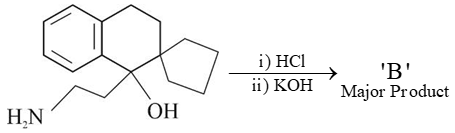
For the given reactionThe total number of possible products formed by tertiary carbocation of A is _____.
Major product formed in the following reaction is a mixture of:
One mole of phenol is treated with dilute \( \mathrm{HNO_3} \) at \( 298 \, \text{K} \) to give a mixture of products. The mixture is separated by steam distillation. The steam volatile compound \( (X) \) is separated. The increase in percentage of oxygen in \( (X) \) with respect to phenol is ______ \( \times 10^{-1}\% \).(Given molar mass in \( \text{g mol}^{-1} \) \( \mathrm{H:1} \) , \( \mathrm{C:12} \) , \( \mathrm{N:14} \) , \( \mathrm{O:16} \) )
\( \mathrm{C_6H_{12}O_6} \xrightarrow{\text{Zymase}} A \xrightarrow[\Delta]{\mathrm{NaOI}} B + \mathrm{CHI_3} \)The number of carbon atoms present in the product \( B \) is __________.
‘R’ formed in the following sequence of reactions is:
Given below are two statements :Statement-I : \( 2 \)-methylbutane on oxidation with \( \mathrm{KMnO_4} \) gives \( 2 \)-methylbutane-\( 2 \)-ol.Statement-II : \( n \)-alkanes can be easily oxidised to corresponding alcohols with \( \mathrm{KMnO_4} \).Choose the correct option :
To synthesis \( 1.0 \, \text{mole} \) of 2-methylpropan-2-ol from Ethylethanoate ________ equivalents of \( \mathrm{CH_3MgBr} \) reagent will be required. (Integer value)
In Reimer-Tiemann reaction, phenol is converted into salicylaldehyde through an intermediate. The structure of intermediate is_________.
Consider compounds A, B and C with following structural formulae\( A = \mathrm{CH_3-CH_2-CH_2-CH_2-CH_2-OH} \)\( B = \mathrm{CH_2=CH-CH_2-CH_2-CH_3} \)\( C = \mathrm{HO-CH_2-CH_2-CH(OH)-CH_3} \)For the conversion of B from A, reagent \( (D) \) required is ______ and structural formula of product \( (E) \) obtained when C undergoes same reaction using excess reagent \( (D) \) is ______.
Match List – I with List – II Choose the correct answer from the options given below:
In the following reaction: The compounds \( A \) and \( B \) respectively are:
The incorrect statement among the following is:
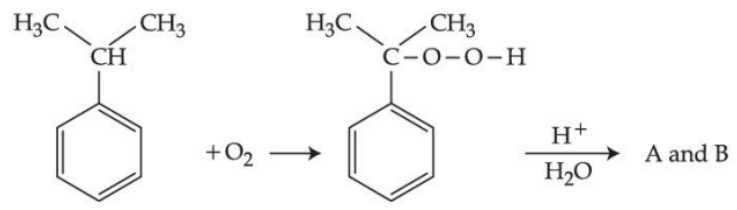
In the cumene to phenol preparation in presence of air, the intermediate is:
A compound ‘X’ is acidic and it is soluble in \( \mathrm{NaOH} \) solution, but insoluble in \( \mathrm{NaHCO_3} \) solution. Compound ‘X’ also gives violet colour with neutral \( \mathrm{FeCl_3} \) solution. The compound ‘X’ is:
Identify compound \( (Z) \) in the following reaction sequence.
Which one of the following reactions will not lead to the desired ether formation in major proportion? (iso-Bu \( \Rightarrow \) isobutyl, sec-Bu \( \Rightarrow \) sec-butyl, nPr \( \Rightarrow \) n-propyl, t-Bu \( \Rightarrow \) tert-butyl, Et \( \Rightarrow \) ethyl)
Consider the given chemical reaction sequence: Total sum of oxygen atoms in Product A and Product B are \( \_\_\_\_\_\_\_\_ \).
Decreasing order of dehydration of the following alcohols is:
Compound ‘B’ is:
What is the major product of the following reaction?
A mixed ether (\( P \)), when heated with excess of hot concentrated hydrogen iodide produces two different alkyl iodides which when treated with aq. \( \mathrm{NaOH} \) give compound (\( Q \)) and (\( R \)), given yellow precipitate with \( \mathrm{NaOI} \). Identify the mixed ether (\( P \)) :
Statement I: Phenols are weakly acidic.Statement II: Therefore they are freely soluble in NaOH solution and are weaker acids than alcohols and water.Choose the most appropriate option:
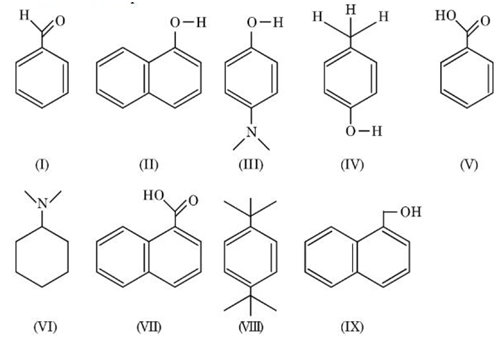
The compound/s which will show significant intermolecular H-bonding is/are :
Amongst the following, the total number of compounds soluble in aqueous \( \mathrm{NaOH} \) at room temperature is:
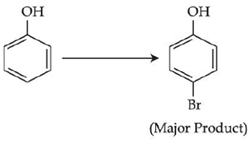
The given reaction can occur in the presence of:(a) Bromine water(b) \( \mathrm{Br_2} \) in \( \mathrm{CS_2} \), \( 273 \, \text{K} \)(c) \( \mathrm{Br_2/FeBr_3} \)(d) \( \mathrm{Br_2} \) in \( \mathrm{CHCl_3} \), \( 273 \, \text{K} \)Choose the correct answer from the options given below:
Given below are two statements: Statements (I): The boiling points of alcohols and phenols increase with increase in the number of C-atoms. Statement (II): The boiling points of alcohols and phenols are higher in comparison to other class of compounds such as ethers, haloalkanes. In the light of the above statements, choose the correct answer from the options given below:
In the given conversion the compound \( \mathrm{A} \) is:
In the following reaction, ‘B’ is:
The increasing order of \( pK_a \) for the following phenols is:\( (A) \) \( 2, 4 \) - Dinitrophenol \( (B) \) \( 4 \) - Nitrophenol \( (C) \) \( 2, 4, 5 \) – Trimethylphenol \( (D) \) Phenol \( (E) \) \( 3 \)-ChlorophenolChoose the correct answer from the options given below:
The product B formed in the following reaction sequence is:
Which of the following reagents / reactions will convert 'A' to 'B'?
Which one of the following, with \( \mathrm{HBr} \) will give a phenol?
Hex-4-ene-2-ol on treatment with PCC gives 'A'. 'A' on reaction with sodium hypoiodite gives 'B', which on further heating with soda lime gives 'C'. The compound 'C' is: