12 questions from 2025
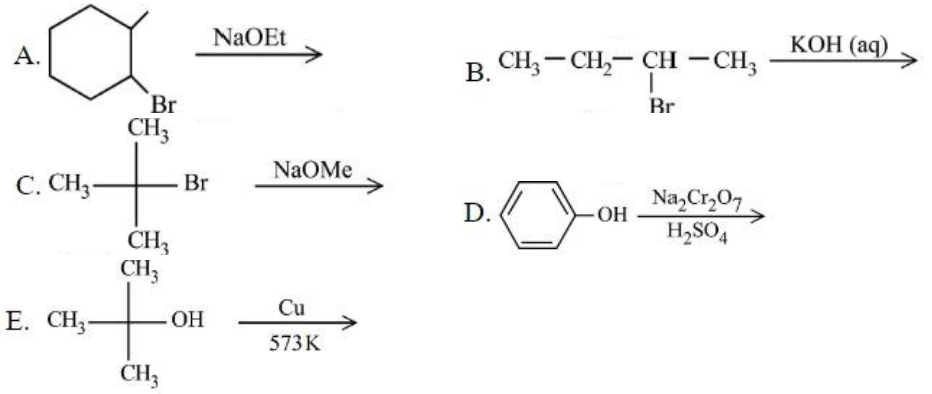
In the following reactions, which one is NOT correct?
An optically active alkyl halide \( \mathrm{C_4H_9Br} \) \([A]\) reacts with hot \( \mathrm{KOH} \) dissolved in ethanol and forms alkene \([B]\) as major product which reacts with bromine to give dibromide \([C]\). The compound \([C]\) is converted into a gas \([D]\) upon reacting with alcoholic \( \mathrm{NaNH_2} \). During hydration \( 18 \) gram of water is added to \( 1 \) mole of gas \([D]\) on warming with mercuric sulphate and dilute acid at \( 333 \, \mathrm{K} \) to form compound \([E]\). The IUPAC name of compound \([E]\) is :
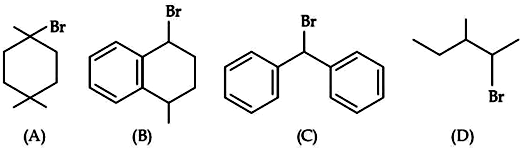
When sec-butylcyclohexane reacts with bromine in the presence of sunlight, the major product is:
The reactions which cannot be applied to prepare an alkene by elimination, are:Choose the correct answer from the options given below:
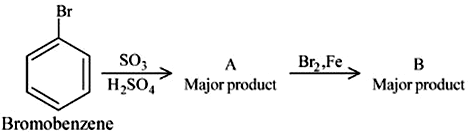
In the following series of reactions identify the major products A and B respectively:
The products A and B in the following reactions, respectively are:\( A \xleftarrow{\mathrm{AgNO_2}} \\ \mathrm{CH_3-CH_2-CH_2-Br} \\ \xrightarrow{\mathrm{AgCN}} B \)
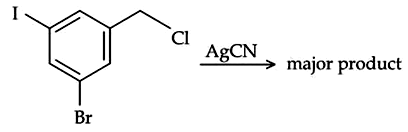
The structure of the major product formed in the following reaction is :
Given below are two statements: Statement (I): Alcohols are formed when alkyl chlorides are treated with aqueous potassium hydroxide by elimination reaction. Statement (II): In alcoholic potassium hydroxide, alkyl chlorides form alkenes by abstracting the hydrogen from the \( \beta \)-carbon. In the light of the above statements, choose the most appropriate answer from the options given below:
Number of molecules from below which cannot give iodoform reaction is: Ethanol, Isopropyl alcohol, Bromoacetone, \( 2 \)-Butanol, \( 2 \)-Butanone, Butanal, \( 2 \)-Pentanone, \( 3 \)-pentanone, Pentanal and \( 3 \)-Pentanol.
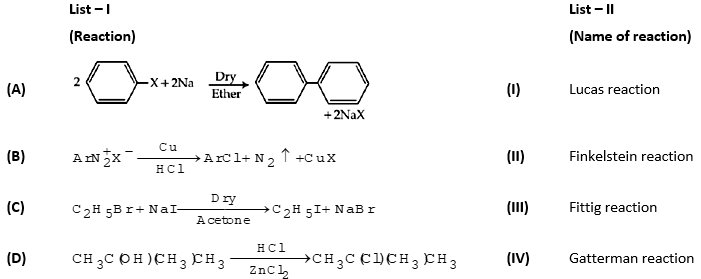
Match List - \( I \) with List - \( II \).
The ascending order of relative rate of solvolysis of following compounds is:
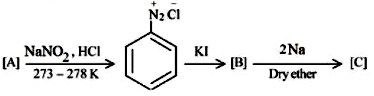
Identify \( [\mathrm{A}], [\mathrm{B}] \) and \( [\mathrm{C}] \), respectively in the following reaction sequence: