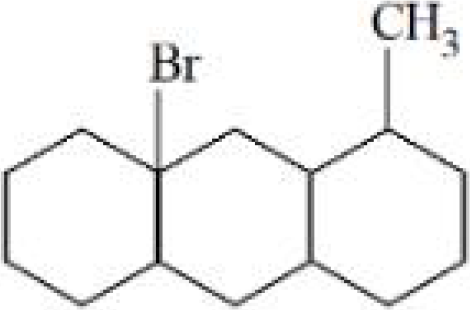
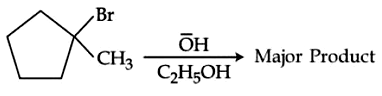
The number of optical isomers in following compound is ______.
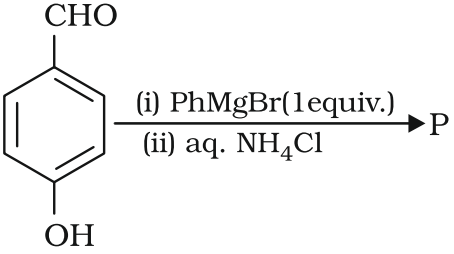
The product of the following reaction is \( P \).The number of hydroxyl groups present in the product \( P \) is ______.
\( \text{C}_2\text{H}_5\text{Br} \xrightarrow{\text{alc. KOH}} \text{A} \xrightarrow[\text{CCl}_4]{\text{Br}_2} \text{B} \xrightarrow[\text{Excess}]{\text{KCN}} \text{C} \xrightarrow[\text{Excess}]{\text{H}_3\text{O}^+} \text{D}\) Acid D formed in above reaction is:
Given below are two statements: one is labelled as Assertion (A) and the other is labelled as Reason (R).Assertion (A):$\text{CH}_2 = \text{CH} - \text{CH}_2 - \text{Cl}$ is an example of allyl halide.Assertion (R): Allyl halides are the compounds in which the halogen atom is attached to $\text{sp}^2$ hybridized carbon atom.In the light of the above statements, choose the most appropriate answer from the options given below:
Match List-I with List-II.
Choose the correct answer from the options given below:
Given below are two statements :Statement (I) : \( \mathrm{S}_{\mathrm{N}}2 \) reactions are ‘stereospecific’, indicating that they result in the formation of only one stereo-isomer as the productStatement (II) : \( \mathrm{S}_{\mathrm{N}}1 \) reactions generally result in formation of product as racemic mixtures.In the light of the above statements, choose the correct answer from the options given below
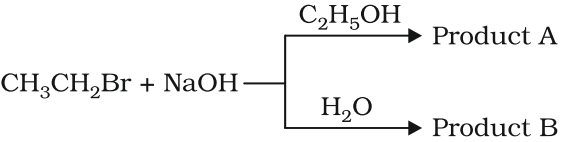
The total number of hydrogen atoms in product \( A \) and product \( B \) is ______.
Alkyl halide is converted into alkyl isocyanide by reaction with:
.
Total number of isomeric compounds (including stereoisomers) formed by monochlorination of \( 2 \)-methylbutane is _________.
Which one of the following reactions is NOT possible?
Given below are two statements:Statement – I: High concentration of strong nucleophilic reagent with secondary alkyl halide which do not have bulky substituents will follow \( \mathrm{S_N}{^2} \) mechanism.Statement – II: A secondary alkyl halide when treated with a large excess of ethanol follows \( \mathrm{S_N}{^1} \) mechanism.In the light of the above statements, choose the most appropriate from the options given below:
Identify the major product in the following reaction.
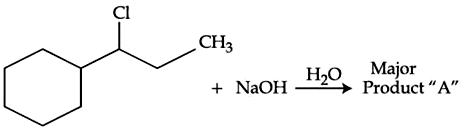
Consider the above chemical reaction. Product “A” is:
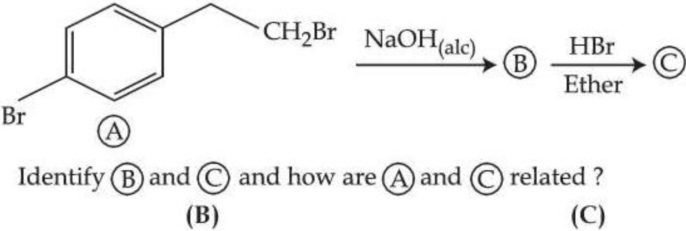
The product \( (C) \) in the below mentioned reaction is: