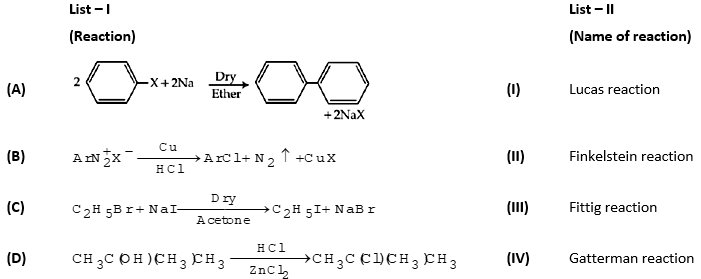
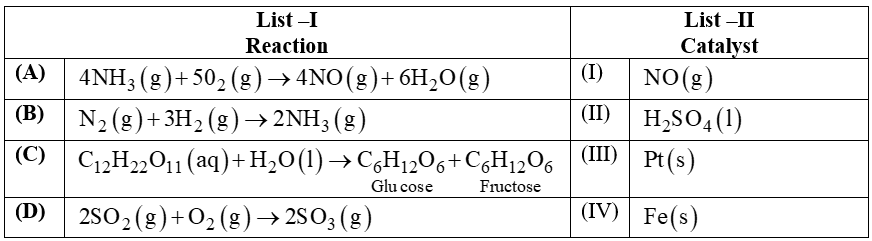
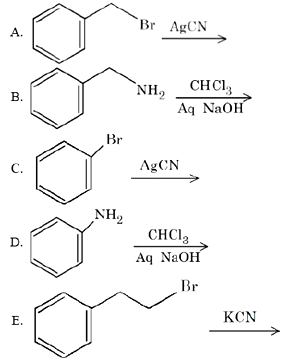
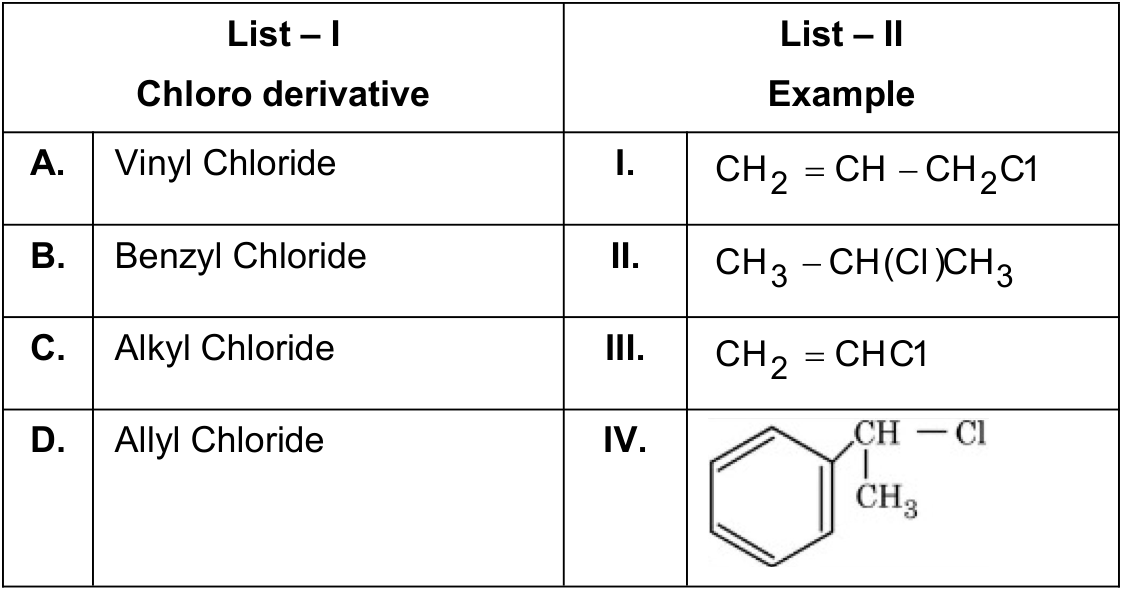
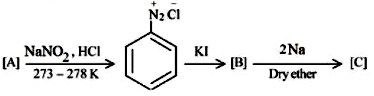
Match List - \( I \) with List - \( II \).
\( (A)-(III),\ (B)-(II),(C)-(IV),\ (D)-(I) \)
\( (A)-(IV),\ (B)-(III), (C)-(I), (D)-(II) \)
\( (A)-(III), (B)-(IV),(C)-(II), (D)-(I) \)
\( (A)-(IV), (B)-(I), (C)-(II), (D)-(III) \)
An optically active alkyl halide \( \mathrm{C_4H_9Br} \) \([A]\) reacts with hot \( \mathrm{KOH} \) dissolved in ethanol and forms alkene \([B]\) as major product which reacts with bromine to give dibromide \([C]\). The compound \([C]\) is converted into a gas \([D]\) upon reacting with alcoholic \( \mathrm{NaNH_2} \). During hydration \( 18 \) gram of water is added to \( 1 \) mole of gas \([D]\) on warming with mercuric sulphate and dilute acid at \( 333 \, \mathrm{K} \) to form compound \([E]\). The IUPAC name of compound \([E]\) is :
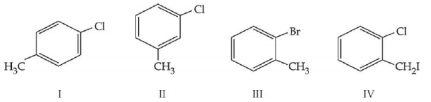
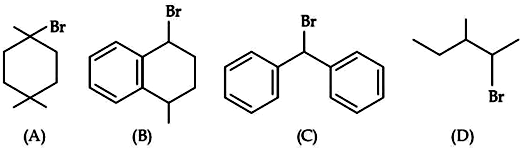
Which among the following compounds will undergo fastest \( \mathrm{S_{N}2} \) reaction?
Consider all the structural isomers with molecular formula \( \mathrm{C_5H_{11}Br} \) are separately treated with \( \mathrm{KOH(aq)} \) to give respective substitution products, without any rearrangement. The number of products which can exhibit optical isomerism from these is ________.
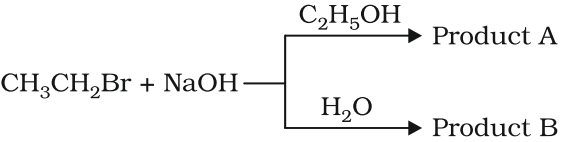
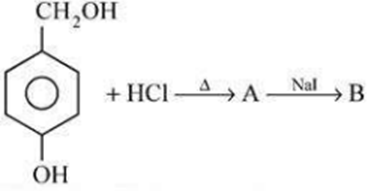
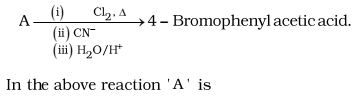
In the following reaction A is:
Assertion (A) : Hydrolysis of an alkyl chloride is a slow reaction but in the presence of \( \mathrm{NaI} \), the rate of the hydrolysis increases.Reason (R) : \( \mathrm{I^-} \) is a good nucleophile as well as a good leaving group.In the above statements, choose the correct answer from the options given below
Given below are two statements: one is labelled as Assertion (A) and the other is labelled as Reason (R).Assertion (A): Haloalkanes react with \( \mathrm{KCN} \) to form alkyl cyanides as a main product while with \( \mathrm{AgCN} \) form isocyanide as the main product.Reason (R): \( \mathrm{KCN} \) and \( \mathrm{AgCN} \) both are highly ionic compounds.In the light of the above statements, choose the most appropriate answer from the options given below:
In which of the following pairs, electron gain enthalpies of constituent elements are nearly the same or identical?(a) Rb and Cs (b) Na and K(c) Ar and Kr (d) I and AtChoose the correct answer form the options given below:
Match List –I with List –II
Choose the correct answer form the options given below:
Match the List-I wit List-II
Choose the correct answer from the options given below:
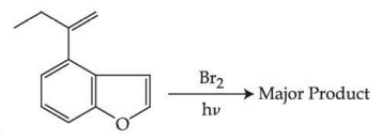
When sec-butylcyclohexane reacts with bromine in the presence of sunlight, the major product is:
Number of isomeric products formed by monochlorination of \( 2 \)-methylbutane in presence of sunlight is _________.
Example of vinylic halide is:
\( \text{2–chlorobutane} + \mathrm{Cl_2} \rightarrow \mathrm{C_4H_8Cl_2} \) (isomers)Total number of optically active isomers shown by \( \mathrm{C_4H_8Cl_2} \), obtained in the above reaction is _______.
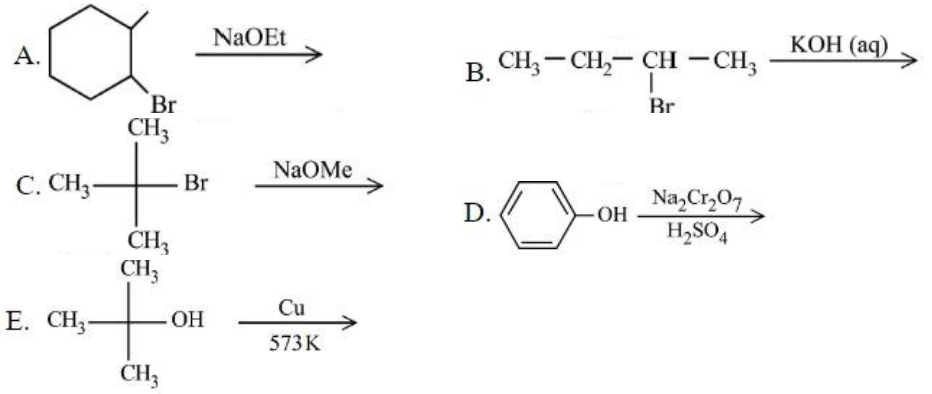
The reactions which cannot be applied to prepare an alkene by elimination, are:Choose the correct answer from the options given below:
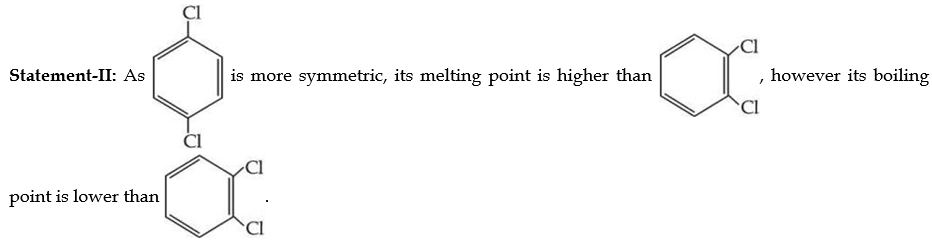
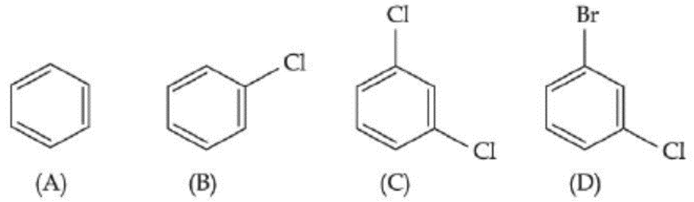
The correct order of melting points of dichlorobenzenes is:
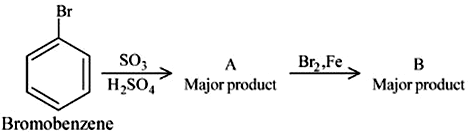
Product ‘A’ of following sequence of reactions is
Two isomers \( (A) \) and \( (B) \) with Molar mass \( 184 \, \mathrm{g/mol} \) and elemental composition \( \mathrm{C}, 52.2\% ; \mathrm{H}, 4.9\% \) and \( \mathrm{Br}, 42.9\% \) gave benzoic acid and \( p \)-bromobenzoic acid, respectively on oxidation with \( \mathrm{KMnO_4} \). Isomer \( 'A' \) is optically active and gives a pale yellow precipitate when warmed with alcoholic \( \mathrm{AgNO_3} \). Isomer \( 'A' \) and \( 'B' \) are, respectively.
In the following series of reactions identify the major products A and B respectively:
The product of the following reaction is \( P \).The number of hydroxyl groups present in the product \( P \) is ______.
\( \text{C}_2\text{H}_5\text{Br} \xrightarrow{\text{alc. KOH}} \text{A} \xrightarrow[\text{CCl}_4]{\text{Br}_2} \text{B} \xrightarrow[\text{Excess}]{\text{KCN}} \text{C} \xrightarrow[\text{Excess}]{\text{H}_3\text{O}^+} \text{D}\) Acid D formed in above reaction is:
The products A and B in the following reactions, respectively are:\( A \xleftarrow{\mathrm{AgNO_2}} \\ \mathrm{CH_3-CH_2-CH_2-Br} \\ \xrightarrow{\mathrm{AgCN}} B \)
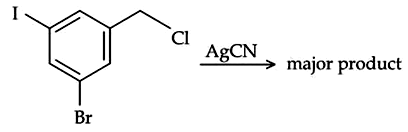
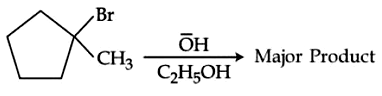
The major product of the following reaction is:
The correct pair(s) of the ambident nucleophiles is (are) :(A) \( \mathrm{AgCN} \) / \( \mathrm{KCN} \) (B) \( \mathrm{RCOOAg} \) / \( \mathrm{RCOOK} \) (C) \( \mathrm{AgNO_2} \) / \( \mathrm{KNO_2} \) (D) \( \mathrm{AgI} \) / \( \mathrm{KI} \)
Given below are two statements: one is labelled as Assertion (A) and the other is labelled as Reason (R).Assertion (A):$\text{CH}_2 = \text{CH} - \text{CH}_2 - \text{Cl}$ is an example of allyl halide.Assertion (R): Allyl halides are the compounds in which the halogen atom is attached to $\text{sp}^2$ hybridized carbon atom.In the light of the above statements, choose the most appropriate answer from the options given below:
Identify the correct statement for the below given transformation.
Match List-I with List-II.
Benzyl isocyanide can be obtained fromChoose the correct answer from the options given below:
Considering the above reactions, the compound ‘A’ and compound ‘B’ respectively are:
Correct structure of \( \gamma \)-methylcyclohexane carbaldehyde is:
Given below are two statements :Statement (I) : \( \mathrm{S}_{\mathrm{N}}2 \) reactions are ‘stereospecific’, indicating that they result in the formation of only one stereo-isomer as the productStatement (II) : \( \mathrm{S}_{\mathrm{N}}1 \) reactions generally result in formation of product as racemic mixtures.In the light of the above statements, choose the correct answer from the options given below
The structure of the major product formed in the following reaction is :
Given below are two statements:Statement-I: Due to increase in van der Waals forces, the order of boiling points is \( \mathrm{CH_3CH_2CH_2I} > \mathrm{CH_3CH_2I} > \mathrm{CH_3} \).
In the light of the above statements, choose the correct answer from the options given below:
The major product formed in the Friedel-Craft acylation of chlorobenzene is:
Given below are two statements: Statement (I): Alcohols are formed when alkyl chlorides are treated with aqueous potassium hydroxide by elimination reaction. Statement (II): In alcoholic potassium hydroxide, alkyl chlorides form alkenes by abstracting the hydrogen from the \( \beta \)-carbon. In the light of the above statements, choose the most appropriate answer from the options given below:
The correct decreasing order of densities of the following compounds is:
Number of molecules from below which cannot give iodoform reaction is: Ethanol, Isopropyl alcohol, Bromoacetone, \( 2 \)-Butanol, \( 2 \)-Butanone, Butanal, \( 2 \)-Pentanone, \( 3 \)-pentanone, Pentanal and \( 3 \)-Pentanol.
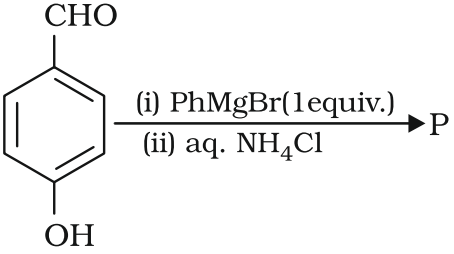
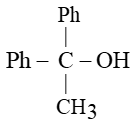
Which reactant will give the following alcohol on reaction with one mole of phenyl magnesium bromide (\( \mathrm{PhMgBr} \)) followed by acidic hydrolysis?
The total number of hydrogen atoms in product \( A \) and product \( B \) is ______.
Match List - I with List - II. Choose the correct answer from the options given below:
Alkyl halide is converted into alkyl isocyanide by reaction with:
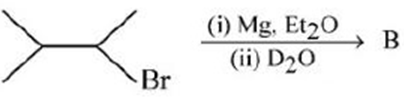
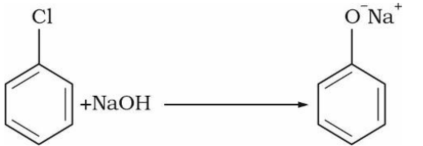
.
Among the following compounds I–IV, which one forms a yellow precipitate on reacting sequentially with \( \mathrm{(i)\ NaOH} \) \( \mathrm{(ii)\ dil.\ HNO_3} \) \( \mathrm{(iii)\ AgNO_3} \)?
In the below reaction product \( \mathrm{B} \) is:
Total number of isomeric compounds (including stereoisomers) formed by monochlorination of \( 2 \)-methylbutane is _________.
Match List I with List II.\( 1 \)-Bromopropane is reacted with reagents in List I to give product in List II.
Choose the correct answer from the options given below :
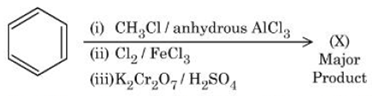
Consider the following sequences of reactions to give the major product \( (X) \). \( P \,\text{g} \) of the major product \( (X) \) formed is reacted with \( \text{NaHCO}_3 \) solution to liberate a gas which occupied \( 11.2 \,\text{dm}^3 \) at STP.\( P = \) _______ \( \text{g} \).\( \big(\text{Given molar mass in } \text{g mol}^{-1}\ \text{H}: 1;\ \text{C}: 12;\ \text{O}: 16;\ \text{Cl}: 35.5\big) \)
Which one of the following reactions is NOT possible?
In the following sequence of reactions the P is:
The ascending order of relative rate of solvolysis of following compounds is:
The ratio \( x/y \) on completion of the above reaction is ________ .
Given below are two statements:Statement – I: High concentration of strong nucleophilic reagent with secondary alkyl halide which do not have bulky substituents will follow \( \mathrm{S_N}{^2} \) mechanism.Statement – II: A secondary alkyl halide when treated with a large excess of ethanol follows \( \mathrm{S_N}{^1} \) mechanism.In the light of the above statements, choose the most appropriate from the options given below:
Identify the major product in the following reaction.
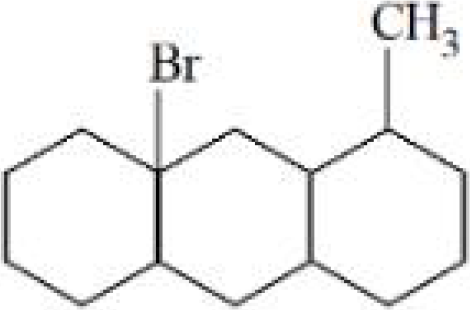
The number of optical isomers in following compound is ______.
In the given reaction \( \displaystyle 3\text{-Bromo-2,2-dimethylbutane} \xrightarrow{\text{C}_2\text{H}_5\text{OH}} \underset{(\text{Major Product})}{\text{'A'}} \) is:Product \(A\) is:
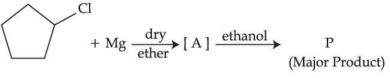
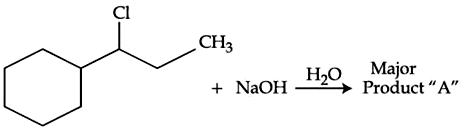
Consider the above chemical reaction. Product “A” is:
Compound ‘A’ undergoes following sequence of reactions to give compound ‘B’ The correct structure and chirality of compound ‘B’ is:Compound ‘A’
The above reaction requires which of the following reaction conditions?
The product \( (C) \) in the below mentioned reaction is:
\( \text{CH}_3-\text{CH}_2-\text{CN} \xrightarrow[\text{Ether}]{\text{CH}_3\text{MgBr}} A \xrightarrow{\text{H}_3\text{O}^+} B \xrightarrow[\text{HCl}]{\text{Zn–Hg}} C \) The correct structure of \( C \) is:
In the following halogenated organic compounds the one with maximum number of chlorine atoms in its structure is:
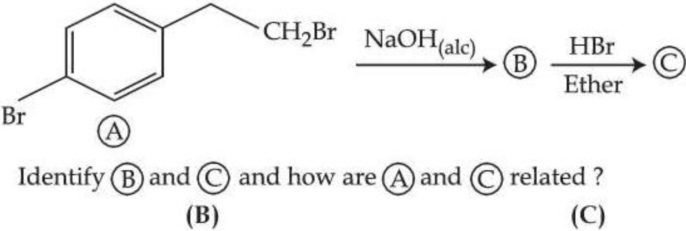
Identify \( [\mathrm{A}], [\mathrm{B}] \) and \( [\mathrm{C}] \), respectively in the following reaction sequence:
The major product of the following reaction contains __________ bromine atoms(s).
A reaction of benzonitrile with one equivalent \( \mathrm{CH_3MgBr} \) followed by hydrolysis produces a yellow liquid “\( P \)”. The compound “\( P \)” will give positive ________.