21 questions from 2023
\( 20 \,\text{mL} \) of \( 0.5 \,\text{M} \) \( \text{NaCl} \) is required to coagulate \( 200 \,\text{mL} \) of \( \text{As}_2\text{S}_3 \) solution in \( 2 \) hours. The coagulating value of \( \text{NaCl} \) is __________.
The number of statement/s which are the characteristics of physisorption is _______ .(A) It is highly specific in nature(B) Enthalpy of adsorption is high(C) It decreases with increase in temperature(D) It results into unimolecular layer(E) No activation energy is needed
Given below are two statements: one is labelled as Assertion (A) and the other labelled as Reason (R).Assertion (A): In expensive scientific instruments, silica gel is kept in watch-glasses or in semipermeable membrane bags.Reason (R): Silica gel adsorbs moisture from air via adsorption, thus protects the instrument from water corrosion (rusting) and / or prevents malfunctioningIn the light of the above statements, choose the correct from the options given below:
The graph of \( \log \frac{x}{m} \) vs \( \log p \) for an adsorption process is a straight line inclined at an angle of \( 45^\circ \) with intercept equal to \( 0.6020 \). The mass of gas absorbed per unit mass of absorbent at the pressure of \( 0.4 \, \text{atm} \) is ______ \( \times 10^{-1} \) (Nearest integer). Given: \( \log 2 = 0.3010 \)
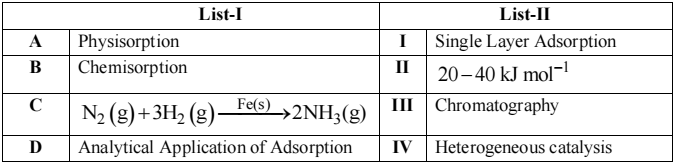
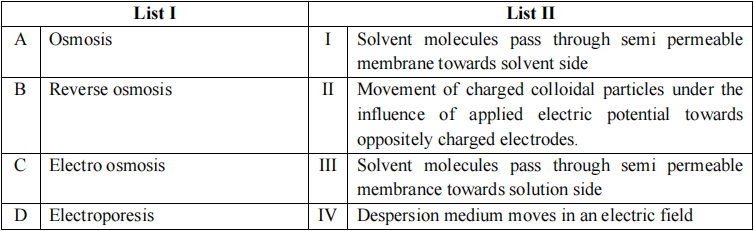
Match List I with List II:
Choose the correct answer from the options given below:
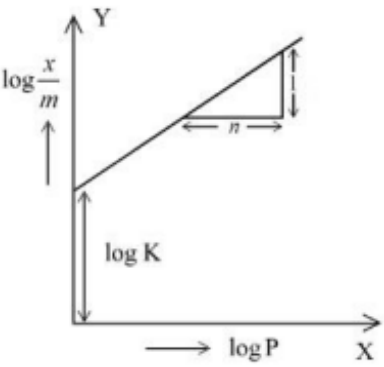
In figure, a straight line is given for Freundlich Adsorption \( (y = 3x + 2.505) \). The value of \( \frac{1}{n} \) and \( \log K \) are respectively.
Coagulating value of the electrolytes \( \mathrm{AlCl_3} \) and \( \mathrm{NaCl} \) for \( \mathrm{As_2S_3} \) are \( 0.09 \) and \( 50.04 \) respectively. The coagulating power of \( \mathrm{AlCl_3} \) is \( x \) times the coagulating power of \( \mathrm{NaCl} \). The value of \( x \) is _________.
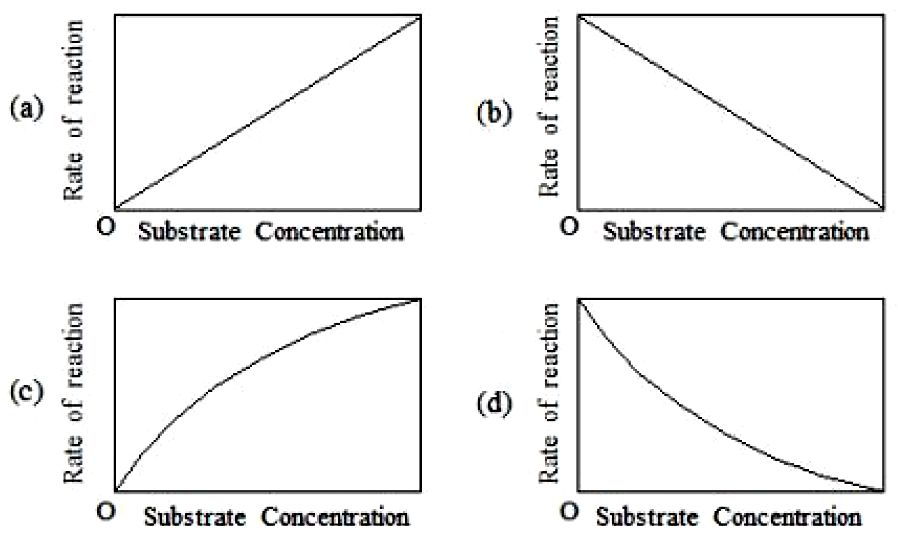
The variation of the rate of an enzyme catalyzed reaction with substrate concentration is correctly represented by graph.
Which of the following salt solutions would coagulate the colloid solution formed when \( \mathrm{FeCl_3} \) is added to \( \mathrm{NaOH} \) solution, at the fastest rate?
Match List I with List II
What happens when a lyophilic sol is added to a lyophobic sol?
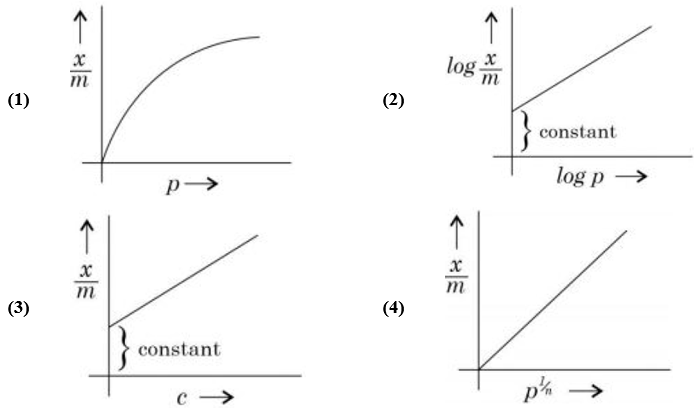
Which of the following represent the Freundlich adsorption isotherms?Choosethe correct answer from the options given below:
Match List I and List II
Among the following, the number of compounds which will give positive iodoform reaction is ________ .(a) \( 1 \)-Phenylbutan-\( 2 \)-one(b) \( 2 \)-Methylbutan-\( 2 \)-ol(c) \( 3 \)-Methylbutan-\( 2 \)-ol(d) \( 1 \)-Phenylethanol(e) \( 3, \, 3 \)-dimethylbutan-\( 2 \)-one(f) \( 1 \)-Phenylpropan-\( 2 \)-ol
The number of incorrect statement/s from the following is/are _______. A. Water vapours are adsorbed by anhydrous calcium chloride. B. There is a decrease in surface energy during adsorption. C. As the adsorption proceeds, \( \Delta H \) becomes more and more negative. D. Adsorption is accompanied by decrease in entropy of the system.
Given below are two statements, one is labelled as Assertion A and the other is labelled as Reason R.Assertion A: The diameter of colloidal particles in solution should not be much smaller than wavelength of light to show Tyndall effect.Reason R: The light scatters in all directions when the size of particles is large enough.In the light of the above statements, choose the correct answer from the options given below:
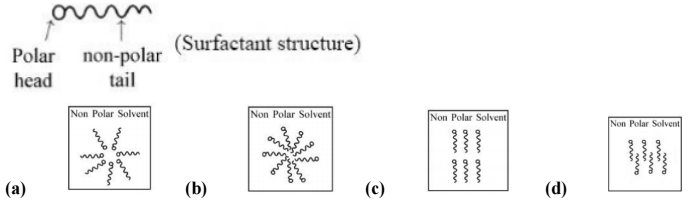
Adding surfactants in non – polar solvent, the micelles structure will look like:
Four gases A, B, C and D have critical temperatures \( 5.3 \), \( 33.2 \), \( 126.0 \) and \( 154.3 \, \text{K} \) respectively. For their adsorption on a fixed amount of charcoal, the correct order is:
The enthalpy change for the adsorption process and micelle formation respectively are:
The number of correct statement about modern adsorption theory of heterogeneous catalysis from the following is _______.A. The catalyst is diffused over the surface of reactantsB. Reactants are adsorbed on the surface of the catalystC. Occurrence of chemical reaction on the catalyst’s surface through formation of an intermediateD. It is combination of intermediate compound formation theory and the old adsorption theoryE. It explains the action of the catalyst as well as those of catalytic promoters and poisons
Ferric chloride is applied to stop bleeding because: