27 questions from 2023
Consider the following data
Heat of combustion of \( \mathrm{H}_2(g) \) \( = -241.8 \, \mathrm{kJ} \, \mathrm{mol}^{-1} \)
Heat of combustion of \( \mathrm{C}(s) \) \( = -393.5 \, \mathrm{kJ} \, \mathrm{mol}^{-1} \)
Heat of combustion of \( \mathrm{C}_2\mathrm{H}_5\mathrm{OH}(I) \) \( = -1234.7 \, \mathrm{kJ} \, \mathrm{mol}^{-1} \)
The heat of formation of \( \mathrm{C}_2\mathrm{H}_5\mathrm{OH}(I) \) is (\( - \)) \( \_ \_ \_ \_ \_ \_ \_ \_ \_ \_ \) \( \mathrm{kJ} \, \mathrm{mol}^{-1} \) (Nearest integer).
\( 0.004 \, \text{M} \) \( \text{K}_2\text{SO}_4 \) solution is isotonic with \( 0.01 \, \text{M} \) glucose solution. Percentage dissociation of \( \text{K}_2\text{SO}_4 \) is ______ (Nearest integer)
If the boiling points of two solvents \( X \) and \( Y \) (having same molecular weights) are in the ratio \( 2:1 \) and their enthalpy of vaporizations are in the ratio \( 1:2 \), then the boiling point elevation constant of \( X \) is \( m \) times the boiling point elevation constant of \( Y \). The value of \( m \) is _____________ (nearest integer)
\( 80 \) mole percent of \( \mathrm{MgCl_2} \) is dissociated in aqueous solution. The vapour pressure of \( 1.0 \) molal aqueous solution of \( \mathrm{MgCl_2} \) at \( 38^\circ\text{C} \) is ____ \( \text{mm Hg} \). (Nearest integer)
Given: Vapour pressure of water at \( 38^\circ\text{C} \) is \( 50 \, \text{mm Hg} \).
Sea water contains \( 29.25\% \) \( \mathrm{NaCl} \) and \( 19\% \) \( \mathrm{MgCl_2} \) by weight of solution. The normal boiling point of the sea water is ________ \( ^\circ\mathrm{C} \) (Nearest integer)
Assume \( 100\% \) ionization for both \( \mathrm{NaCl} \) and \( \mathrm{MgCl_2} \)
Given : \( K_b(\mathrm{H_2O}) = 0.52 \, \mathrm{K\,kg\,mol^{-1}} \)
Molar mass of \( \mathrm{NaCl} \) and \( \mathrm{MgCl_2} \) is \( 58.5 \) and \( 95 \, \mathrm{g\,mol^{-1}} \) respectively.
Statement I : For colloidal particles, the values of colligative properties are of small order as compared to values shown by true solutions at same concentration.
Statement II : For colloidal particles, the potential difference between the fixed layer and the diffused layer of same charges is called the electrokinetic potential or zeta potential.
In the above statements, choose the correct answer from the options given below
Some amount of dichloromethane \( (\mathrm{CH_2Cl_2}) \) is added to \( 671.141 \, \text{mL} \) of chloroform \( (\mathrm{CHCl_3}) \) to prepare \( 2.6 \times 10^{-3} \, \text{M} \) solution of \( \mathrm{CH_2Cl_2} \) (DCM). The concentration of DCM is ________ ppm (by mass). [Given : Atomic mass : \( \mathrm{C} = 12 \), \( \mathrm{H} = 1 \), \( \mathrm{Cl} = 35.5 \) density of \( \mathrm{CHCl_3} = 1.49 \, \text{g cm}^{-3} \)]
Match List I and List II
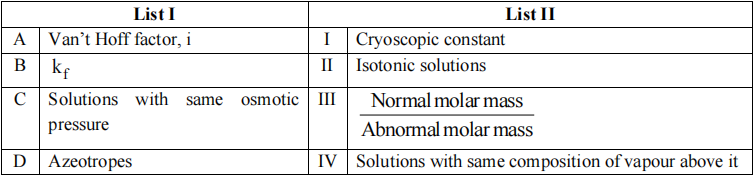
Choose the correct answer from the options given below:
What weight of glucose must be dissolved in \( 100 \, \text{g} \) of water to lower the vapour pressure by \( 0.20 \, \text{mm Hg} \)? (Assume dilute solution is being formed)
Given: Vapour pressure of pure water is \( 54.2 \, \text{mm Hg} \) at room temperature. Molar mass of glucose is \( 180 \, \text{g mol}^{-1} \).
The molality of a \( 10\% \) (v/v) solution of di-bromine solution in \( \mathrm{CCl_4} \) (carbon tetrachloride) is ‘\( x \)’.
\( x = \_\_\_\_\_ \times 10^{-2}\,\mathrm{M} \). [Nearest integer]
(Given: molar mass of \( \mathrm{Br_2} = 160 \, \mathrm{g\,mol^{-1}} \), atomic mass of \( \mathrm{C} = 12 \, \mathrm{g\,mol^{-1}} \), atomic mass of \( \mathrm{Cl} = 35.5 \, \mathrm{g\,mol^{-1}} \), density of dibromine \( = 3.2 \, \mathrm{g\,cm^{-3}} \), density of \( \mathrm{CCl_4} = 1.6 \, \mathrm{g\,cm^{-3}} \)).
Evaluate the following statements for their correctness.
(A) The elevation in boiling point temperature of water will be same for \( 0.1 \, \mathrm{M} \) \( \mathrm{NaCl} \) and \( 0.1 \, \mathrm{M} \) urea.
(B) Azeotropic mixtures boil without change in their composition.
(C) Osmosis always takes place from hypertonic to hypotonic solution.
(D) The density of \( 32\% \) \( \mathrm{H_2SO_4} \) solution having molarity \( 4.09 \, \mathrm{M} \) is approximately \( 1.26 \, \mathrm{g\, mL^{-1}} \).
(E) A negatively charged sol is obtained when KI solution is added to silver nitrate solution.
Choose the correct answer from the options given below:
In the depression of freezing point experiment
I. Vapour pressure of the solutions is less than that of pure solvent
II. Vapour pressure of the solution is more than that of pure solvent
III. Only solute molecules solidify at the freezing point
IV. Only solvent molecules solidify at the freezing point
Choose the most appropriate answer from the options given below :
\( 25 \, \mathrm{mL} \) of an aqueous solution of \( \mathrm{KCl} \) was found to require \( 20 \, \mathrm{mL} \) of \( 1 \, \mathrm{M} \) \( \mathrm{AgNO}_3 \) solution when titrated using \( \mathrm{K}_2\mathrm{CrO}_4 \) as an indicator. What is the depression in freezing point of \( \mathrm{KCl} \) solution of the given concentration? ______ (Nearest integer).
(Given: \( K_f = 2.0 \, \mathrm{K\, kg\, mol^{-1}} \) )
Assume \( (1) \) \( 100\% \) ionization and \( (2) \) density of the aqueous solution as \( 1 \, \mathrm{g\, mL^{-1}} \)
If the degree of dissociations of aqueous solution of weak monobasic acid is determined to be \( 0.3 \), then the observed freezing point will be ______\( \% \) higher tan the expected/theoretical freezing point. (Nearest integer)
At \( 27^\circ\text{C} \), a solution containing \( 2.5\,\text{g} \) of solute in \( 250.0\,mL \) of solution exerts an osmotic pressure of \( 400\,\text{Pa} \). The molar mass of solute is \( \_\_\_\_\,\text{g mol}^{-1} \). (Nearest integer)
(Given: \( R = 0.083\,\text{L bar K}^{-1}\text{ mol}^{-1} \))
Mass of Urea (\( \text{NH}_2\text{CONH}_2 \)) required to be dissolved in \( 1000 \, \text{g} \) of water in order to reduce the vapour pressure of water by \( 25\% \) is _______ \( \text{g} \). (Nearest integer)
Given: Molar mass of N, C, O and H are \( 14 \), \( 12 \), \( 16 \) and \( 1 \, \text{g mol}^{-1} \) respectively.
The total pressure observed by mixing two liquids A and B is \( 350 \, \text{mm Hg} \) when their mole fractions are \( 0.7 \) and \( 0.3 \) respectively.
The total pressure becomes \( 410 \, \text{mm Hg} \) if the mole fractions are changed to \( 0.2 \) and \( 0.8 \) respectively for A and B. The vapour pressure of pure A is __________ mm Hg. (Nearest integer)
Consider the liquids and solutions behave ideally.
An aqueous solution of volume \( 300 \, \text{cm}^3 \) contains \( 0.63 \, \text{g} \) of protein. The osmotic pressure of the solution at \( 300 \, \text{K} \) is \( 1.29 \, \text{m bar} \). The molar mass of the protein is ______ \( \text{g mol}^{-1} \).
[Given: \( R = 0.083 \, \text{L bar K}^{-1} \, \text{mol}^{-1} \)]
The number of pairs of the solutions having the same value of the osmotic pressure from the following is ______.
(Assume \( 100\% \) ionization)
A. \( 0.50 \, \text{M} \, \text{C}_2\text{H}_5\text{OH} (\text{aq}) \) and \( 0.25 \, \text{M} \, \text{KBr} (\text{aq}) \).
B. \( 0.100 \, \text{M} \, \text{K}_4[\text{Fe}(\text{CN})_6](\text{aq}) \) and \( 0.100 \, \text{M} \, \text{FeSO}_4 \, (\text{NH}_4)_2 \text{SO}_4 (\text{aq}) \).
C. \( 0.05 \, \text{M} \, \text{K}_4[\text{Fe}(\text{CN})_6](\text{aq}) \) and \( 0.25 \, \text{M} \, \text{NaCl} (\text{aq}) \).
D. \( 0.15 \, \text{M} \, \text{NaCl} (\text{aq}) \) and \( 0.1 \, \text{M} \, \text{BaCl}_2 (\text{aq}) \).
E. \( 0.02 \, \text{M} \, \text{KCl} \cdot \text{MgCl}_2 \cdot 6\text{H}_2\text{O} (\text{aq}) \) and \( 0.05 \, \text{M} \, \text{KCl} (\text{aq}) \).
Solid Lead nitrate is dissolved in \( 1 \) litre of water. The solution was found to boil at \( 100.15^\circ \mathrm{C} \). When \( 0.2 \) mol of \( \mathrm{NaCl} \) is added to the resulting solution, it was observed that the solution froze at \( -0.8^\circ \mathrm{C} \). the solubility product of \( \mathrm{PbCl_2} \) formed is __________ \( \times 10^{-6} \) at \( 298 \, \mathrm{K} \). (Nearest integer)
Given : \( K_b = 0.5 \, \mathrm{K \, kg \, mol^{-1}} \) and \( K_f = 1.8 \, \mathrm{K \, kg \, mol^{-1}} \). Assume molality to be equal to molarity in all cases.
A solution containing \( 2 \, \text{g} \) of a non-volatile solute in \( 20 \, \text{g} \) of water boils at \( 373.52 \, \text{K} \). The molecular mass of the solute is ________ \( \text{g mol}^{-1} \). (Nearest integer)
[Given, water boils at \( 373 \, \text{K} \), \( K_b \) for water \( = 0.52 \, \text{K kg mol}^{-1} \)]
The osmotic pressure of solutions of PVC in cyclohexanone at \(300 \ \mathrm{K}\) are plotted on the graph. The molar mass of PVC is ______ \( \mathrm{g \ mol^{-1}} \) (Nearest integer) [Given: \( R = 0.083 \ \mathrm{L \ atm \ K^{-1} \ mol^{-1}} \)] 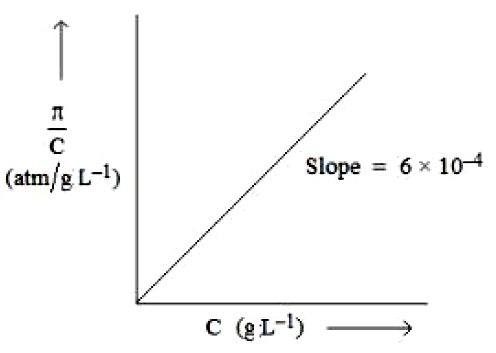
The vapour pressure of \( 30\% \,(\text{w/v}) \) aqueous solution of glucose is __________ \( \text{mm Hg} \) AT \( 25^\circ \text{C} \).
[Given : The density to \( 30\% \,(\text{w/v}) \), aqueous solution of glucose is \( 1.2 \,\text{g cm}^{-3} \) and vapour pressure of pure water is \( 24 \,\text{mm Hg} \).]
(Molar mass of glucose is \( 180 \,\text{g mol}^{-1} \))
\( 20\% \) of acetic acid is dissociated when its \( 5 \, \mathrm{g} \) is added to \( 500 \, \mathrm{mL} \) of water. The depression in freezing point of such water is ______ \( \times 10^{-3} \, ^\circ\mathrm{C} \).
Atomic mass of \( \mathrm{C} \), \( \mathrm{H} \) and \( \mathrm{O} \) are \( 12 \), \( 1 \) and \( 16 \) a.m.u. respectively.
\([\text{Given: Molal depression constant and density of water are } 1.86 \, \mathrm{K\, mol^{-1}} \text{ and } 1 \, \mathrm{g\, cm^{-3}} \text{ respectively].}\)
The vapour pressure vs. temperature curve for a solution solvent system is shown below: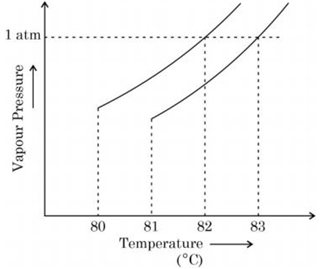
The boiling point of the solvent is ________ \( ^\circ \text{C} \).
Lead storage battery contains \( 38\% \) by weight solution of \( \mathrm{H_2SO_4} \). The van’t Hoff factor is \( 2.67 \) at this concentration. The temperature in Kelvin at which the solution in the battery will freeze is ______. (Nearest integer). (Given \( K_f = 1.8 \, \mathrm{K\,kg\,mol^{-1}} \))
Solution of \( 12 \, \text{g} \) of non-electrolyte (A) prepared by dissolving it in \( 1000 \, \text{mL} \) of water exerts then same osmotic pressure as that of \( 0.05 \, \mathrm{M} \) glucose solution at the same temperature. The empirical formula of A is \( \mathrm{CH_2O} \). The molecular mass of A is _____ \( \text{g} \). (nearest integer)
