The empirical formula for a compound with a cubic close packed arrangement of anions and with cations occupying all the octahedral sites in \( \mathrm{A}_x\mathrm{B}_{} \). The value of \( x \) is _______. (Integer answer)
Metal M crystallizes into a fcc lattice with the edge length \( 4.0 \times 10^{-8} \, \text{cm} \). The atomic mass of the metal is ________ \( \text{g/mol} \). (Nearest integer) (Use: \( N_A = 6.02 \times 10^{23} \, \text{mol}^{-1} \), density of metal, \( M = 9.03 \, \text{g} \, \text{cm}^{-3} \))
Given below are two statements:Statement I: \( \mathrm{O_2}, \mathrm{Cu}^{2+} \) and \( \mathrm{Fe}^{3-} \) are weakly attracted by magnetic field and are magnetized in the same direction as magnetic field.Statement II: \( \mathrm{NaCl} \) and \( \mathrm{H_2O} \) are weakly magnetized in opposite direction to magnetic field.In the light of the above statements, choose the most appropriate answer from the option given below:
Which of the following represents the lattice structures of \( A_{0.95}O \) containing \( A^{2+} \), \( A^{3+} \) and \( O^{2-} \) ions?
An element \( M \) crystallises in a body centred cubic unit cell with a cell edge of \( 300 \, \text{pm} \). The density of the element is \( 6.0 \, \text{g} \, \text{cm}^{-3} \). The number of atoms present in \( 180 \, \text{g} \) of the element is ________ \( \times 10^{23} \). (Nearest integer)
' \( x \) ' \( \text{g} \) of molecular oxygen (\( \text{O\(_2\)} \)) is mixed with \( 200 \, \text{g} \) of neon (\( \text{Ne} \)). The total pressure of the non-reactive mixture of \( \text{O\(_2\)} \) and \( \text{Ne} \) in the cylinder is \( 25 \, \text{bar} \). The partial pressure of \( \text{Ne} \) is \( 20 \, \text{bar} \) at the same temperature and volume. The value of ' \( x \) ' is ________.[Given: Molar mass of \( \text{O\(_2\)} = 32 \, \text{g mol}^{-1} \). Molar mass of \( \text{Ne} = 20 \, \text{g mol}^{-1} \)]
Ionic radii of cation \( A^{+} \) and anion \( B^{-} \) are \( 102 \) and \( 181 \) \( \mathrm{pm} \) respectively. These ions are allowed to crystallize into an ionic solid. This crystal has cubic close packing for \( B^{-} \). \( A^{+} \) is present in all octahedral voids. The edge length of the unit cell of the crystal \( \mathrm{AB} \) is __________ \( \mathrm{pm} \). (Nearest Integer)
The correct relationships between unit cell edge length '\( a \)' and radius of sphere '\( r \)' for face-centred and body–centred cubic structures respectively are:
A copper complex crystallising in a CCP lattice with a cell edge of \( 0.4518 \, \text{nm} \) has been revealed employing X-ray diffraction studies. The density of a copper complex is found to be \( 7.62 \, \text{g cm}^{-3} \). The molar mass of copper complex is ______ \( \text{g mol}^{-1} \). (Nearest integer) [Given: \( N_a = 6.022 \times 10^{23} \, \text{mol}^{-1} \)]
Given below are two statements. One is labeled as Assertion A and the other is labelled as Reason R.Assertion A: Sharp glass edge becomes smooth on heating it upto its melting point.Reason R: The viscosity of glass decrease on melting.Choose the most appropriate answer from the options given below.
A metal \( \mathrm{M} \) forms hexagonal close-packed structure. The total number of voids in \( 0.02 \) mol of it is ______ \( \times 10^{21} \) (Nearest integer).(Given \( N_A = 6.02 \times 10^{23} \) )
The distance between \( \text{Na}^+ \) and \( \text{Cl}^- \) ions in solid \( \text{NaCl} \) of density \( 43.1 \, \text{g}\,\text{cm}^{-3} \) is __________ \( \times 10^{-10} \, \text{m} \) (Nearest Integer)(Given : \( N_A = 6.02 \times 10^{23} \, \text{mol}^{-1} \))
The number of species having a square planar shape from the following is __________ .\( \mathrm{XeF_4}, \, \mathrm{SF_4}, \, \mathrm{SiF_4}, \, \mathrm{BF_4^-}, \, \mathrm{BrF_4^-}, \, [\mathrm{Cu(NH_3)_4}]^{2+}, \, [\mathrm{FeCl_4}]^{2-}, \, [\mathrm{PtCl_4}]^{2-} \)
When \( \mathrm{Fe_{0.93}O} \) is heated in presence of oxygen, it converts to \( \mathrm{Fe_2O_3} \). The number of correct statement/s from the following is \( \_\_\_\_\_ \). I. The equivalent weight of \( \mathrm{Fe_{0.93}O} \) is \( \dfrac{\text{Molecular weight}}{0.79} \) II. The number of moles of \( \mathrm{Fe^{2+}} \) and \( \mathrm{Fe^{3+}} \) in \( 1 \) mole of \( \mathrm{Fe_{0.93}O} \) is \( 0.79 \) and \( 0.14 \) respectively III. \( \mathrm{Fe_{0.93}O} \) is metal deficient with lattice comprising of cubic closed packed arrangement of \( \mathrm{O^{2-}} \) ions IV. The \( \% \) composition of \( \mathrm{Fe^{2+}} \) and \( \mathrm{Fe^{3+}} \) in \( \mathrm{Fe_{0.93}O} \) is \( 85\% \) and \( 15\% \) respectively
A sample of metal oxide has formula \( \mathrm{M_{0.83}O_{1.00}} \). The metal M can exist in two oxidation states \( +2 \) and \( +3 \). In the sample of \( \mathrm{M_{0.83}O_{1.00}} \), the percentage of metal ions existing in \( +2 \) oxidation state is ______ \( \% \). (Nearest integer)
A metal \( \mathrm{M} \) crystallizes into two lattices: face centred cubic \( (\mathrm{fcc}) \) and body centred cubic \( (\mathrm{bcc}) \) with unit cell edge length of \( 2.0 \) and 2.5 Å respectively. The ratio of densities of lattices fcc to bcc for the metal \( \mathrm{M} \) is ______. \([\text{Nearest integer}]\)
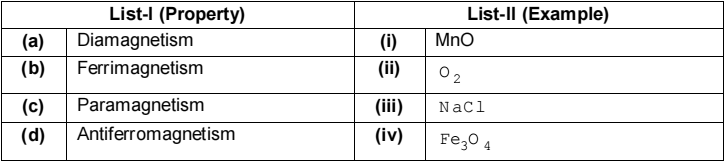
Match items of List-I with those of List-II:
Choose the most appropriate answer from the options given below:
The oxide that shows magnetic property is:
Diamond has a three dimensional structure of \( \text{C} \) atoms formed by covalent bonds. The structure of diamond has face centred cubic lattice where \( 50\% \) of the tetrahedral voids are also occupied by carbon atoms. The number of carbon atoms present per unit cell of diamond is ________ .
An atomic substance A of molar mass \( 12 \, \text{g mol}^{-1} \) has a cubic crystal structure with edge length of \( 300 \, \text{pm} \). The no. of atoms present in one unit cell of A is ________ . (Nearest integer) Given the density of A is \( 3.0 \, \text{g mL}^{-1} \) and \( N_A = 6.02 \times 10^{23} \, \text{mol}^{-1} \)
A cubic solid is made up of two elements X and Y. Atoms of X are present on every alternate corner and one at the center of cube. Y is at \( 1/3 \) rd of the total faces. The empirical formula of the compound is:
Ga (atomic mass \( 70 \, \text{u} \)) crystallizes in a hexagonal close packed structure. The total number of voids in \( 0.581 \, \text{g} \) of Ga is __________ \( \times 10^{21} \). (Round off to the Nearest Integer).
KBr is doped with \( 10^{-5} \) mole percent of \( \mathrm{SrBr}_2 \). The number of cationic vacancies in \( 1 \ \text{g} \) of KBr crystal is ________ \( \times 10^{14} \). (Round off to the Nearest Integer) [Atomic Mass: \( \mathrm{K}: 39.1\,\text{u} \), \( \mathrm{Br}: 79.9\,\text{u} \), \( N_A = 6.023\times 10^{23} \)]
In a solid \( \mathrm{AB} \), \( \mathrm{A} \) atoms are in ccp arrangement and \( \mathrm{B} \) atoms occupy all the octahedral sites. If two atoms from the opposite faces are removed, then the resultant stoichiometry of the compound is \( {A_xB_y} \). The value of \( x \) is _______. [Nearest integer]
Atoms of element \( X \) form hcp lattice and those of element \( Y \) occupy \( \frac{2}{3} \) of its tetrahedral voids. The percentage of element \( X \) in the lattice is ______________. (Nearest integer)
Which of the following expressions is correct in case of a \( \mathrm{CsCl} \) unit cell (edge length ‘\( a \)’)?
Which of the following material is not a semiconductor.
The incorrect statement about the imperfections in solids is: