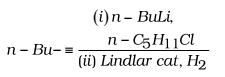
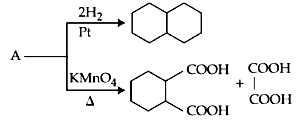
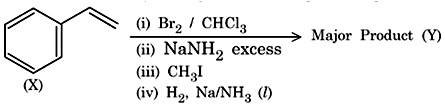
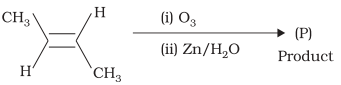
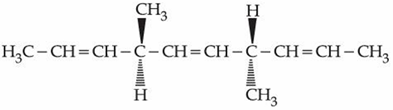
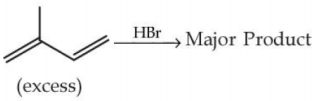
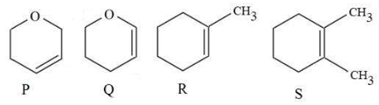
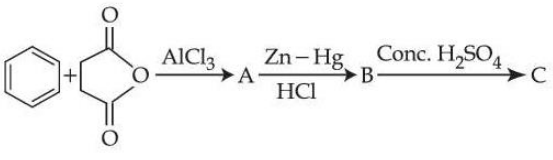
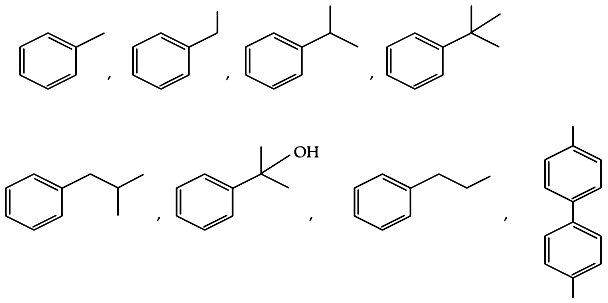
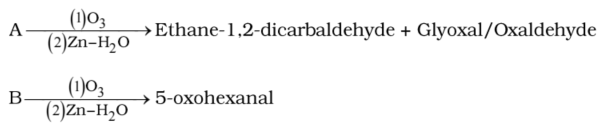
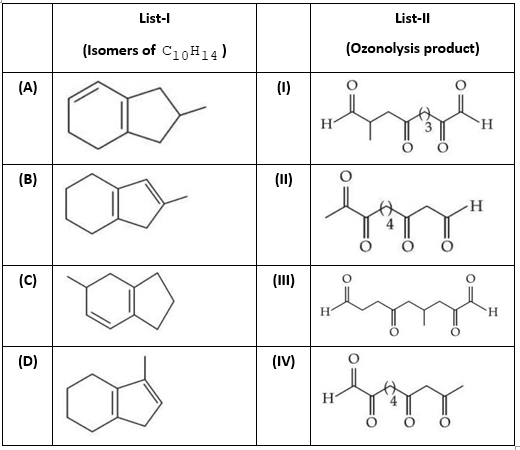
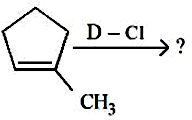
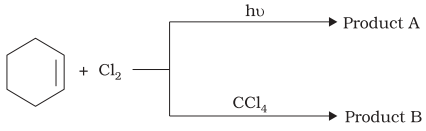
Which among the following pairs of the structures will give different products on ozonolysis? (Consider the double bonds in the structures are rigid and not delocalized.)
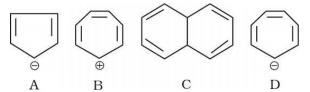
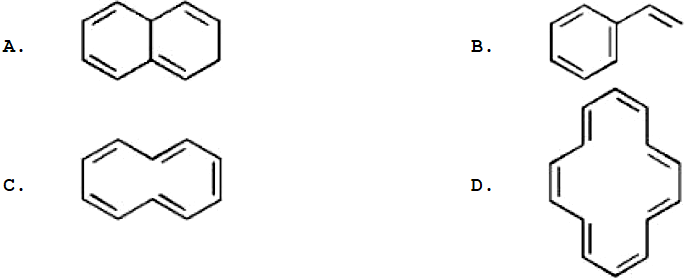
Which of the following structures are aromatic in nature?
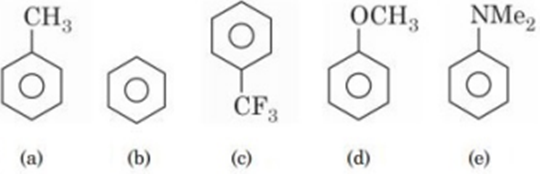
Decreasing order of reactivity towards electrophilic substitution for the following compounds is:
Given below are two statements:Statement I: \( 3 \)-phenylpropene reacts with \( \text{HBr} \) and gives secondary alkyl bromide having a chiral carbon atom as the major product.Statement II: Aryl chlorides and aryl cyanides can be prepared by Sandmeyer reactions as well as Gattermann reaction.In the light of the above statements, choose the correct answer from the options given below:
An organic compound ‘\( P \)’ of molecular formula \( \mathrm{C_6H_{12}O_3} \) gives positive iodoform test but negative Tollen’s test. When ‘\( P \)’ is treated with dilute acid, it produces ‘\( Q \)’. ‘\( Q \)’ gives positive Tollen’s test and also iodoform test. The structure of ‘\( P \)’ is:
Halogenation of which one of the following will yield m-substituted product with respect to methyl group as a major product?
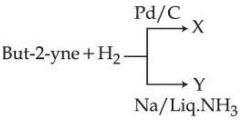
But-2-yne and hydrogen (one mole each) are separately treated with (i) Pd/C and (ii) Na/liq. \( \mathrm{NH_3} \) to give the products X and Y respectively. Identify the incorrect statements.A. X and Y are stereoisomers.B. Dipole moment of X is zero.C. Boiling point of X is higher than Y.D. X and Y react with O3 / Zn + H2O to give different products.
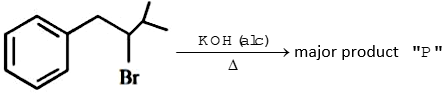
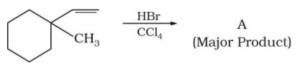
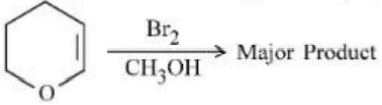
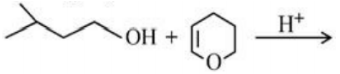
Amongst the following, the major product of the given chemical reaction is
In bromination of Propyne, with Bromine \( 1, 1, 2, 2 \) – tetrabromopropane is obtained in \( 27\% \) yield. The amount of \( 1, 1, 2, 2 \)-tetrabromopropane obtained from \( 1 \, \text{g} \) of Bromine in this reaction is __________ \( \times10^{-1} \) \( \text{g} \). (Nearest integer)(Molar mass: Bromine = \( 80 \; \text{g/mol} \))
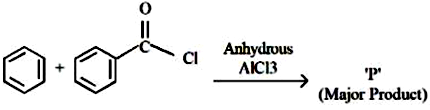
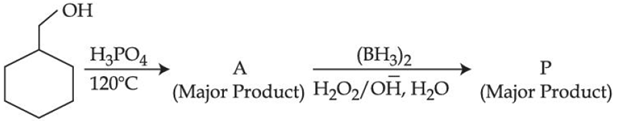
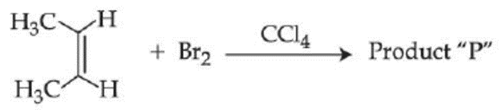
Consider the above reaction and identify the product \( P \):
The incorrect statement regarding ethyne is
Which of the following conformations will be the most stable?
\( 3 \)-Methylhex-\( 2 \)-ene on reaction with HBr in presence of peroxide forms an addition product \( (A) \). The number of possible stereoisomers for ‘A’ is ________.
Identify the structure of the final product \((\mathrm{D})\) in the following sequence of the reactions: Total number of \( \mathrm{sp^2} \) hybridized carbon atoms in product \( \mathrm{D} \) is ________.
Consider the isomers of hydrocarbon with molecular formula \( \text{C}_5\text{H}_{10} \). These isomers do not decolourise \( \text{KMnO}_4 \) solution. These isomers are subjected to chlorination with chlorine in presence of light to give monochloro compounds. The total number of monochloro compounds (structural isomers only) formed is ________.
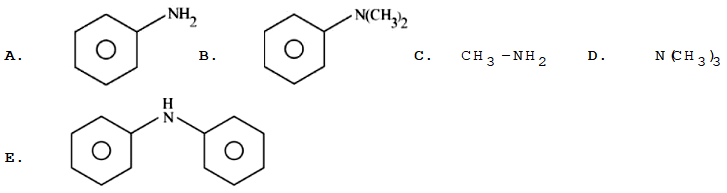
Which among the following react with Hinsberg's reagent?Choose the correct answer from options given below:
Number of alkanes obtained on electrolysis of a mixture of \( \text{CH}_3\text{COONa} \) and \( \text{C}_2\text{H}_5\text{COONa} \) is ________.
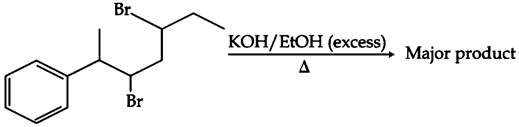
The major product formed in the following reaction, is
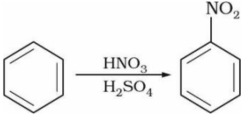
In the above reaction, \( 3.9 \, \text{g} \) of benzene on nitration gives \( 4.92 \, \text{g} \) of nitrobenzene. The percentage yield of nitrobenzene in the above reaction is ______ \( \% \). (Round off to the Nearest Integer).[Given atomic mass : \( \mathrm{C:12.0 \, u , \ H:1.0 \, u , \ O:16.0 \, u , \ N:14.0 \, u} \)]
Identify the product A and product B in the following set of reactions.
A compound ‘X’ absorbs \( 2 \) moles of hydrogen and ‘X’ upon oxidation with \( \mathrm{KMnO_4/H^+} \) gives \(\text{CH}_3-\underset{\overset{\parallel}{\text{O}}}{\text{C}}-\text{CH}_3 , \text{CH}_3-\underset{\overset{\parallel}{\text{O}}}{\text{C}}-\text{O}-\text{H}\) and \(\text{CH}_3-\underset{\overset{\parallel}{\text{O}}}{\text{C}}-\text{CH}_2\text{CH}_2-\underset{\overset{\parallel}{\text{O}}}{\text{C}}-\text{O}-\text{H}\)The total number of \( \sigma \) bonds present in the compound ‘X’ is ________.
\( X \) g of nitrobenzene on nitration gave \( 4.2 \, \text{g} \) of m-dinitrobenzene. \( X = \) __________ g. (nearest integer)[Given: molar mass (in \( \text{g mol}^{-1} \)) C : \( 12 \), H : \( 1 \), O : \( 16 \), N : \( 14 \)]
Identify A and B in the following sequence of reaction:
Which of the following are aromatic?
Consider the given chemical reaction: Product “A” is:
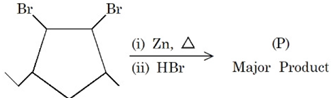
Identify \( P \).
The major product ‘A’ of the following given reaction has __________ \( sp^2 \) hybridized carbon atoms.
\( \mathrm{Ph{-}CH{=}CH_2} \xrightarrow[\mathrm{HBr}]{(\mathrm{PhCOO})_2} \mathrm{Product} \) Consider the above reaction A. The reaction proceeds through a more stable radical intermediate. B. The role of peroxide is to generate H (Hydrogen radical). C. During this reaction, benzene is formed as a byproduct. D. 1-Bromo-2-phenylethane is formed as the minor product. E. The same reaction in absence of peroxide proceeds via carbocation intermediate. Identify the correct statements, Choose the correct answer from the options given below:
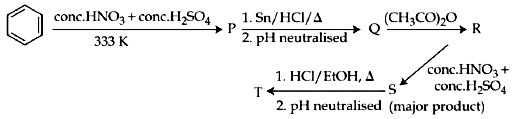
Consider the following reaction sequenceThe percentage of nitrogen in product ‘T’ formed is ____________ \( \% \). (Nearest integer)(Given molar mass in \( \text{g mol}^{-1} \) \( \mathrm{H}: 1, \, \mathrm{C}: 12, \, \mathrm{N}: 14, \, \mathrm{O}: 16 \))
Consider the above chemical reaction. The total number of stereoisomers possible for Product ‘P’ is ________.
Isomeric hydrocarbons \( \rightarrow \) negative Baeyer’s test(Molecular formula \( \mathrm{C_9H_{12}} \))The total number of isomers from above with four different non-aliphatic substitution sites is _______.
Predict the major product of the following reaction sequence:-
The product in the following sequence of reactions has _____ \( \pi \) bonds.
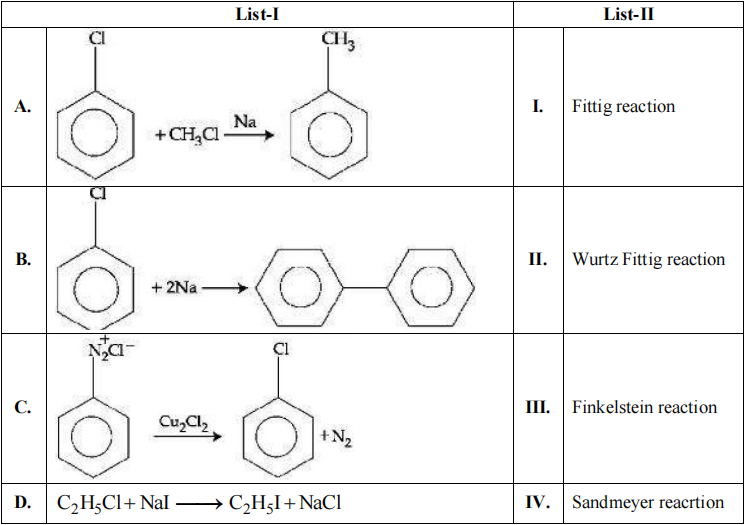
Match List –I with List –II,
Choose the correct answer form the options given below:
Identify the reagent(s) ‘A’ and condition(s) for the reaction:
Match the LIST-I with LIST-II.
Choose the correct answer from the options given below:
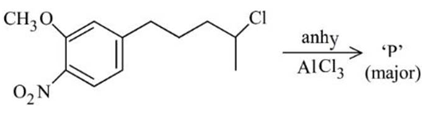
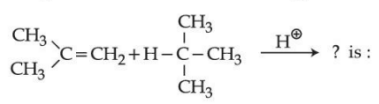
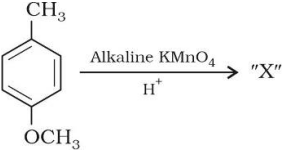
The major product of the following reaction is:
The major product of the following reaction is \( P \).Number of oxygen atoms present in product 'P' is__________. (nearest integer)
The cycloalkene \( (\mathrm{X}) \) on bromination consumes one mole of bromine per mole of \( (\mathrm{X}) \) and gives the product \( (\mathrm{Y}) \) in which \( \mathrm{C} : \mathrm{Br} \) ratio is \( 3 : 1 \). The percentage of bromine in the product \( (\mathrm{Y}) \) is _______ \( \% \). (Nearest integer)(Given: molar mass in \( \mathrm{g\,mol^{-1}} \) \( \mathrm{H} : 1 \), \( \mathrm{C} : 12 \), \( \mathrm{O} : 16 \), \( \mathrm{Br} : 80 \) )
Given below are two statements:Statement-I: One mole of propyne reacts with excess of sodium to liberate half a mole of \( \mathrm{H_2} \) gas.Statement-II: Four of propyne reacts with \( \mathrm{NaNH_2} \) to liberate \( \mathrm{NH_3} \) gas which occupies \( 224 \, \mathrm{mL} \) at STP.In the light of the above statements, choose the most appropriate answer from the options given below:
The major product ‘\( P \)’ formed in the given reaction is:
The one giving maximum number of isomeric alkenes on dehydrohalogenation reaction is (excluding rearrangement)
Among the following marked proton of which compound shows lowest \( pK_a \) value?
For above chemical reactions, identify the correct statement from the following.
Match List-I with List-II.
Identify major product ‘P’ formed in the following reaction.
Presence of which reagent will affect the reversibility of the following reaction, and change it to a irreversible reaction:
Given below are two statements: one is labelled as Assertion (A) and the other is labelled as Reason (R).Assertion (A) : Treatment of bromine water with propene yields \( 1 \)-bromopropan-\( 2 \)-ol.Reason (R) : Attack of water on bromonium ion follows Markovnikov rule and results in \( 1 \)-bromopropan-\( 2 \)-ol.In the light of the above statements, choose the most appropriate answer from the options given below:
Product P is:
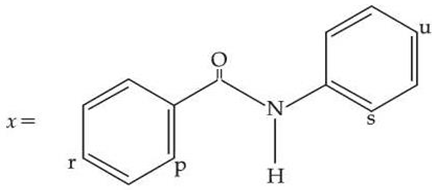
For the given molecule, “x”, the preferred site for the attack of the electrophile is:
Consider the following sequence of reactionsThe major product \( P \) is:
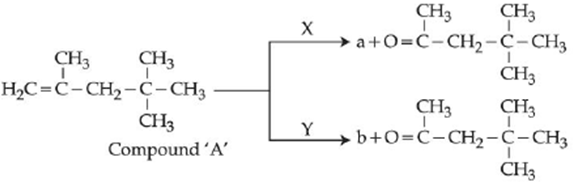
A compound ‘A’ on reaction with ‘X’ and ‘Y’ produces the same major product but different by product ‘a’ and ‘b’. Oxidation of ‘a’ given a substance produced by ants. ‘X’ and ‘Y’ respectively are
The product formed in the following reaction:
An organic compound ‘A’ \( \mathrm{C_4H_8} \) on treatment with \( \mathrm{KMnO_4/H^+} \) yields compound ‘B’ \( \mathrm{C_3H_6O} \). Compound ‘A’ also yields compound ‘B’ on ozonolysis. Compound ‘A’ is:
Benzene is treated with oleum to produce compound \( (X) \) which when further heated with molten sodium hydroxide followed by acidification produces compound \( (Y) \). The compound \( Y \) is treated with zinc metal to produce compound \( (Z) \). Identify the structure of compound \( (Z) \) from the following option.
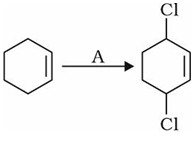
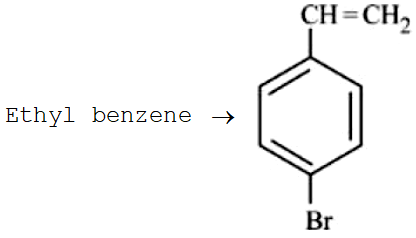
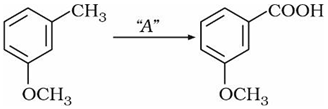
Choose the correct set of reagents for the following conversion.
Compound A formed in the following reaction reacts with B gives the product C. Find out A and B.
Method used for separation of mixture of products \( (\mathrm{B} \text{ and } \mathrm{C}) \) obtained in the following reaction is:
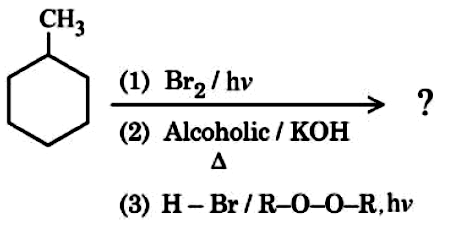
Total number of isomers (including stereoisomers) obtained on monochlorination of methylcyclohexane is _______.
Metallic sodium does not react normally with:
A hydrocarbon ‘X’ with formula \( \mathrm{C_6H_8} \) uses two moles of \( \mathrm{H_2} \) on catalytic hydrogenation of its one mole. On ozonolysis, ‘X’ yields two moles of methane dicarbaldehyde. The hydrocarbon ‘X’ is:
Given below are two statements:Statement (I): Neopentane forms only one monosubstituted derivative.Statement (II): Melting point of neopentane is higher than \( n \)-pentane.In the light of the above statements, choose the most appropriate answer from the options given below:
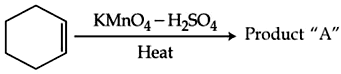
Product “A” in the above chemical reaction is:
What will be the major product of following sequence of reactions?
Products \( A \) and \( B \) formed in the following set of reactions are
Which of the following compound will most easily be attacked by an electrophile?
Identify \( A \) in the following reaction.
In the following sequence of reactions, the final product \( D \) is:
Compound \( (X) \) is subjected to the sequence of reactions as shown above. Molar mass of the major product \( (Y) \) formed is ______ \( \mathrm{g}\,\mathrm{mol}^{-1} \).(Given molar mass in \( \mathrm{g}\,\mathrm{mol}^{-1} \) C: \( 12 \); H: \( 1 \); O: \( 16 \))
Which compound would give \( 3 \)-methyl-\( 6 \)-oxoheptanal upon ozonolysis?
In the following reaction ‘X’ is:
An optically active alkyl bromide \( \mathrm{C_{4}H_{9}Br} \), reacts with ethanolic \( \mathrm{KOH} \) to form major compound [A] which reacts with bromine to give compound [B]. Compound [B] reacts with ethanolic \( \mathrm{KOH} \) and sodamide to give compound [C]. One molecule of water adds to compound [C] on warming with mercuric sulphate and dilute sulphuric acid at \( 333 \, \text{K} \) to form compound [D]. The functional group in compound D will be confirmed by:
\( 2-\text{Hexene} \xrightarrow[\text{(ii) }\text{H}_2\text{O}]{\text{(i) }\text{O}_3} \text{Product} \) The two products formed in above reaction are:
Given below are two statements:Statement I: Ozonolysis followed by treatment with \( \mathrm{Zn}, \mathrm{H_2O} \) of cis-\( 2 \)-butene gives ethanal.Statement II: The product obtained by ozonolysis followed by treatment with \( \mathrm{Zn}, \mathrm{H_2O} \) of \( 3,6 \)-dimethyloct-\( 4 \)-ene has no chiral carbon atom.In the light of the above statements, choose the correct answer from the options given below.
In the presence of sunlight, benzene reacts with \( \text{Cl}_2 \) to give product, \( X \). The number of hydrogens in \( X \) is __________.
An alkane \( (Y) \) requires \( 8 \) moles of oxygen for complete combustion and on chlorination with \( \mathrm{Cl_2}/h\nu \), \( (Y) \) gives only one monochlorinated product \( (Z) \). The total number of primary carbon atoms in \( (Y) \) is _______.
Consider the given reaction. The total number of oxygen atom/s present per molecule of the product \( (P) \) is __________.
Which of the following compounds is not aromatic?
The number of optically active products obtained from the complete ozonolysis of the given compound is:
Identify product \( [A] \), \( [B] \) and \( [C] \) in the following reaction sequence. \( \text{CH}_3-\text{C} \equiv \text{CH} \xrightarrow[\text{H}_2]{\text{Pd/C}} [\text{A}] \xrightarrow[(\text{ii})\,\text{Zn, H}_2\text{O}]{(\text{i})\,\text{O}_3} [\text{B}] + [\text{C}] \)
Which one of the following carbonyl compounds cannot be prepared by addition of water on an alkyne in the presence of \( \mathrm{HgSO_4} \) and \( \mathrm{H_2SO_4} \)?
The total number of structural isomers possible for the substituted benzene derivatives with the molecular formula \( C_9H_{12} \) is __________.
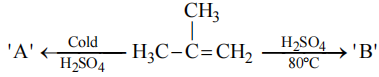
\( R_f \) value for 2-methylpropene in a solvent system (Ethyl acetate + ether) is \( 0.42 \). 2-methylpropene is treated with dilute \( \text{H}_2\text{SO}_4 \) to give major organic product (X). \( R_f \) value of (X) in the same solvent system under identical condition will be:
Total number of deactivating groups in aromatic electrophilic substitution reaction among the following is _______.
Given below are two statements: one is labelled as Assertion (A) and the other is labelled as Reason (R).Assertion (A): Cis form of alkene is found to be more polar than the trans form.Reason (R): Dipole moment of trans isomers of \( 2 \)-butene is \( 0 \).In the light of the above statements, choose the correct answer from the options given below:
The compound \( (\mathrm{X}) \) on\((i)\) on heating in the presence of anhydrous \( \mathrm{AlCl}_3 \) and \( \mathrm{HCl} \) gas gives \( 2, 4 \)-dimethyl pentane\((ii)\) aromatization gives toluene and\((iii)\) cyclisation gives methyl cyclohexaneThe correct name of compound \( (\mathrm{X}) \) is:
The major product formed in the following reaction is:
Given below are two statements:Statement I: Methane can be prepared by decarboxylation of sodium ethanoate, Kolbe’s electrolysis of sodium acetate and reaction \(\mathrm{CH_3MgBr}\) of with water.Statement II: Methane cannot be prepared from unsaturated hydrocarbons and by Wurtz reaction.In the light of the above statements, choose the correct answer from the options given below:
Given below are two statements for the following reaction sequence.Statement I: Compound ‘\( Z \)’ will give yellow precipitate with \( \mathrm{NaOI} \).Statement II: Compound ‘\( Q \)’ has two different types of ‘H’ atoms (aromatic : aliphatic) in the ratio \( 1:3 \).In the light of the above statements, choose the correct answer from the options given below:
Given below are two statements: Statement I: Phenol on treatment with \( \mathrm{CHCl_3} \) / aq. KOH under refluxing condition, followed by acidification produces p-hydroxy benzaldehyde as the major product and o-hydroxy benzaldehyde as the minor product. Statement II: The mixture of p-hydroxybenzaldehyde and o-hydroxybenzaldehyde can be easily separated through steam distillation. In the light of the above statements, choose the correct answer from the options given below:
Molar mass of the hydrocarbon \((X)\) which on ozonolysis consumes one mole of \( \mathrm{O_3} \) per mole of \((X)\) and gives one mole each of ethanal and propanone is ________ \( \text{g mol}^{-1} \).(Molar mass of \( \mathrm{C} = 12 \, \text{g mol}^{-1} \), \( \mathrm{H} : 1 \, \text{g mol}^{-1} \))
Major product ‘B’ of the following reaction sequence is:
The major product of which of the following reaction is not obtained by rearrangement reaction?
Following are the four molecules “P”, “Q”, “R” and “S”. Which one among the four molecules will react with \( \mathrm{H{-}Br_{(aq)}} \) at the fastest rate?
But-\( 2 \)-yne is reacted separately with one mole of Hydrogen as shown below: A. A is more soluble than BB. The boiling point and melting point of A are higher and lower than B respectively.C. A is more polar than B because dipole moment of A is zero.D. \( Br_2 \) adds easily to B than AIdentify the incorrect statements from the options given below:
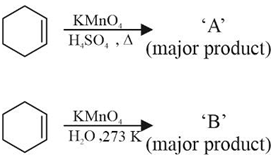
The major products ‘A’ and ‘B’, respectively, are:
What is the structure of \( C \)?
Match List-I with List-II:
Choose the most appropriate match:
One mole of an alkane (x) requires \( 8 \) mole oxygen for complete combustion. Sum of number of carbon and hydrogen atoms in the alkane (x) is _______.
The total number of compounds from below when treated with hot \( KMnO_4 \) giving benzoic acid is:
For the following Friedel Craft's alkylation reaction, which of the statements are correct?A. Major product is n-propyl benzene.B. Iso-propyl carbocation intermediate is also generated.C. Multiple substitution is inevitable.D. Introducing electron-donating substituent on benzene will not produce any alkyl benzene.Choose the correct answer from the options given below:
Excess of isobutane on reaction with \( \mathrm{Br_2} \) in presence of light at \( 125^\circ\mathrm{C} \) gives which one of the following, as the major product?
An alkene \( (X) \) on ozonolysis followed by reduction gives following products.The alkene \( (X) \) is:
‘A’ and ‘B’ respectively are:
Match List-I with List-II. Choose the correct answer from the options given below:
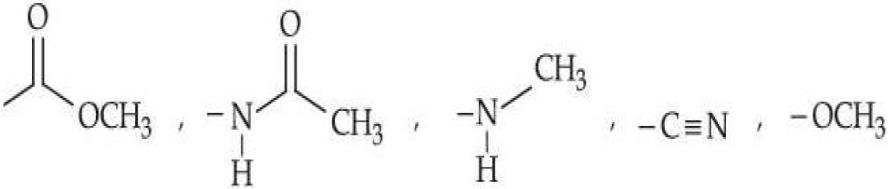
Among the following, total number of meta directing functional groups is __________.(Integer based)–OCH\(_3\), –NO\(_2\), –CN, –CH\(_3\), –NHCOCH\(_3\), –COR, –OH, –COOH, –Cl
The number of possible isomeric products formed when \( 3 \)-chloro-\( 1 \)-butene reacts with HCl through carbocation formation is ________.
A chloro compound “A”.(i) Forms aldehydes on ozonolysis followed by the hydrolysis.(ii) When vaporized completely, \( 1.53 \, \text{g} \) of A, gives \( 448 \, \text{mL} \) of vapour at STP.The number of carbon atoms in a molecule of compound A is ______.
In the above reaction, the reagent “\( A \)” is:
Choose the correct set of reagents for the following conversion. trans \( (\mathrm{Ph{-}CH{=}CH{-}CH_3}) \rightarrow \) cis \( (\mathrm{Ph{-}CH{=}CH{-}CH_3}) \)
Considering the above chemical reaction, identify the product “X”:
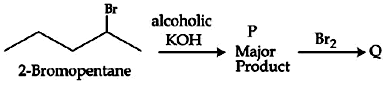
Consider the above sequence of reactions. \( 151 \, \text{g} \) of \( 2 \)-bromopentane is made to react. Yield of major product \( P \) is \( 80\% \) whereas \( Q \) is \( 100\% \). Mass of product \( Q \) obtained is __________ \( \text{g} \).(Given molar mass in \( \text{g mol}^{-1} \) \( \text{H}:1 \), \( \text{C}:12 \), \( \text{O}:16 \), \( \text{Br}:80 \))
The major products from the following reaction sequence are product \( \mathrm{A} \) and product \( \mathrm{B} \) The total sum of \( \pi \) electrons in product \( \mathrm{A} \) and product \( \mathrm{B} \) are ______ (nearest integer)
Major product of the following reaction is:
Identify product \( A \) and product \( B \):
The stereoisomers that are formed by electrophilic addition of bromine to trans-but-\( 2 \)-ene is:





 in the following sequence of reactions has _____ \( \pi \) bonds.