11 questions from 2023
Consider the following equation:
\( 2\mathrm{SO_2}(g) + \mathrm{O_2}(g) \rightleftharpoons 2\mathrm{SO_3}(g), \ \Delta H = -190 \, \mathrm{kJ} \)
The number of factors which will increase the yield of \( \mathrm{SO_3} \) at equilibrium from the following is _____.
A. Increasing temperature
B. Increasing pressure
C. Adding more \( \mathrm{SO_2} \)
D. Adding more \( \mathrm{O_2} \)
E. Addition of catalyst
(i) \( X(g) \rightleftharpoons Y(g) + Z(g) \) \( \quad K_{p1} = 3 \)
(ii) \( A(g) \rightleftharpoons 2B(g) \) \( \quad K_{p2} = 1 \)
If the degree of dissociation and initial concentration of both the reactants \( X(g) \) and \( A(g) \) are equal, then the ratio of the total pressure at equilibrium \( \left(\frac{p_1}{p_2}\right) \) is equal to \( x:1 \). The value of \( x \) is ________. (Nearest integer)
At \( 298 \, \mathrm{K} \)
\( \mathrm{N}_2(\mathrm{g}) + 3\mathrm{H}_2(\mathrm{g}) \rightleftharpoons 2\mathrm{NH}_3(\mathrm{g}), \, K_1 = 4 \times 10^{5} \)
\( \mathrm{N}_2(\mathrm{g}) + \mathrm{O}_2(\mathrm{g}) \rightleftharpoons 2\mathrm{NO}(\mathrm{g}), \, K_2 = 1.6 \times 10^{12} \)
\( \mathrm{H}_2(\mathrm{g}) + \tfrac{1}{2}\mathrm{O}_2(\mathrm{g}) \rightleftharpoons \mathrm{H}_2\mathrm{O}(\mathrm{g}), \, K_3 = 10^{-13} \)
Based on above equilibria, the equilibrium constant of the reaction,
\( 2\mathrm{NH}_3(\mathrm{g}) + \tfrac{5}{2}\mathrm{O}_2(\mathrm{g}) \rightleftharpoons 2\mathrm{NO}(\mathrm{g}) + 3\mathrm{H}_2\mathrm{O}(\mathrm{g}) \) is _______ \( \times 10^{-33} \)
Consider the following reaction approaching equilibrium at \( 27^\circ \mathrm{C} \) and \( 1 \) atm pressure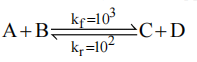
The standard Gibb’s energy change \( (\Delta_r G^\theta) \) at \( 27^\circ \mathrm{C} \) is (–) ________ \( \mathrm{kJ\, mol^{-1}} \)
(Nearest integer) (Given: \( R = 8.3 \, \mathrm{J \, K^{-1} \, mol^{-1}} \) and \( \ln 10 = 2.3 \))
A mixture of \( 1 \) mole of \( \mathrm{H_2O} \) and \( 1 \) mole of \( \mathrm{CO} \) is taken in a \( 10 \) litre container and heated to \( 725 \ \mathrm{K} \). At equilibrium \( 40\% \) of water by mass reacts with carbon monoxide according to the equation: \( \mathrm{CO(g)} + \mathrm{H_2O(g)} \rightleftharpoons \mathrm{CO_2(g)} + \mathrm{H_2(g)} \). The equilibrium constant \( K_c \times 10^2 \) for the reaction is ______. (Nearest integer)
The effect of addition of helium gas to the following reaction in equilibrium state is:
$\text{PCl}_5(\text{g}) \rightleftharpoons \text{PCl}_3(\text{g}) + \text{Cl}_2(\text{g})$
\( 4.5 \) moles each of hydrogen and iodine is heated in a sealed ten litre vessel. At equilibrium \( 3 \) moles of HI were found. The equilibrium constant for \( \mathrm{H_2(g) + I_2(g) \rightleftharpoons 2HI(g)} \) is ________.
The number of correct statement/s involving equilibria in physical processes from the following is __________
(A) Equilibrium is possible only in a closed system at a given temperature.
(B) Both the opposing processes occur at the same rate.
(C) When equilibrium is attained at a given temperature, the value of all its parameters became equal.
(D) For dissolution of solids in liquids, the solubility is constant at a given temperature.
Water decomposes at \( 2300 \, \text{K} \) \( \mathrm{H_2O(g)} \rightarrow \mathrm{H_2(g)} + \tfrac{1}{2}\mathrm{O_2(g)} \). The percent of water decomposing at \( 2300 \, \text{K} \) and \( 1 \, \text{bar} \) is ________ (Nearest integer). Equilibrium constant for the reaction is \( 2 \times 10^{-3} \) at \( 2300 \, \text{K} \).
For reaction: $\text{SO}_2(\text{g}) + \frac{1}{2}\text{O}_2(\text{g}) \rightleftharpoons \text{SO}_3(\text{g})$
$\text{K}_\text{p} = 2 \times 10^{12}$ at $27^\circ\text{C}$ and $1\text{ atm}$ pressure. The $\text{K}_\text{c}$ for the same reaction is$\underline{\hspace{1cm}} \times 10^{13}$. (Nearest integer).
(Given $\text{R} = 0.082\,\text{L atm K}^{-1}\text{mol}^{-1}$)
The total pressure of a mixture of non-reacting gases \( X(0.6\,\text{g}) \) and \( Y(0.45\,\text{g}) \) in a vessel is \( 740\,\text{mm of Hg} \). The partial pressure of the gas \( X \) is \( \_\_\_\_ \) \( \text{mm of Hg} \). (Nearest Integer)
(Given: molar mass \( X = 20 \) and \( Y = 45\,\text{g mol}^{-1} \))
