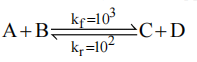
For the reaction, \( \mathrm{H_2(g)} + \mathrm{I_2(g)} \rightleftharpoons 2\,\mathrm{HI(g)} \)Attainment of equilibrium is predicted correctly by:
For the following reaction at \( 50^{\circ}\text{C} \) and at \( 2 \, \text{atm} \) pressure,\( 2\mathrm{N_2O_5(g)} \rightleftharpoons 2\mathrm{N_2O_4(g)} + \mathrm{O_2(g)} \)\( \mathrm{N_2O_5} \) is \( 50\% \) dissociated.The magnitude of standard free energy change at this temperature is \( x \). \( x = \_\_\_\_\_\_ \, \text{J mol}^{-1} \) [Nearest integer].Given : \( R = 8.314 \, \text{J mol}^{-1}\text{K}^{-1} \), log \( 2 = 0.30 \), log \( 3 = 0.48 \), \( \ln 10 = 2.303 \), \( ^{\circ}\text{C} + 273 = \text{K} \)
(i) \( X(g) \rightleftharpoons Y(g) + Z(g) \) \( \quad K_{p1} = 3 \) (ii) \( A(g) \rightleftharpoons 2B(g) \) \( \quad K_{p2} = 1 \) If the degree of dissociation and initial concentration of both the reactants \( X(g) \) and \( A(g) \) are equal, then the ratio of the total pressure at equilibrium \( \left(\frac{p_1}{p_2}\right) \) is equal to \( x:1 \). The value of \( x \) is ________. (Nearest integer)
At \( 298 \, \mathrm{K} \)\( \mathrm{N}_2(\mathrm{g}) + 3\mathrm{H}_2(\mathrm{g}) \rightleftharpoons 2\mathrm{NH}_3(\mathrm{g}), \, K_1 = 4 \times 10^{5} \)\( \mathrm{N}_2(\mathrm{g}) + \mathrm{O}_2(\mathrm{g}) \rightleftharpoons 2\mathrm{NO}(\mathrm{g}), \, K_2 = 1.6 \times 10^{12} \)\( \mathrm{H}_2(\mathrm{g}) + \tfrac{1}{2}\mathrm{O}_2(\mathrm{g}) \rightleftharpoons \mathrm{H}_2\mathrm{O}(\mathrm{g}), \, K_3 = 10^{-13} \)Based on above equilibria, the equilibrium constant of the reaction,\( 2\mathrm{NH}_3(\mathrm{g}) + \tfrac{5}{2}\mathrm{O}_2(\mathrm{g}) \rightleftharpoons 2\mathrm{NO}(\mathrm{g}) + 3\mathrm{H}_2\mathrm{O}(\mathrm{g}) \) is _______ \( \times 10^{-33} \)
Consider the following reaction approaching equilibrium at \( 27^\circ \mathrm{C} \) and \( 1 \) atm pressureThe standard Gibb’s energy change \( (\Delta_r G^\theta) \) at \( 27^\circ \mathrm{C} \) is (–) ________ \( \mathrm{kJ\, mol^{-1}} \)(Nearest integer) (Given: \( R = 8.3 \, \mathrm{J \, K^{-1} \, mol^{-1}} \) and \( \ln 10 = 2.3 \))
The reaction rate for the reaction
$[\text{PtCl}_4]^{2-} + \text{H}_2\text{O} \rightleftharpoons [\text{Pt}(\text{H}_2\text{O})\text{Cl}_3]^- + \text{Cl}^-$
was measured as a function of concentrations of different species. It was observed that
$\frac{-d[\text{PtCl}_4]^{2-}}{dt} = 4.8 \times 10^{-5}[\text{PtCl}_4]^{2-} - 2.4 \times 10^{-3} [[\text{Pt}(\text{H}_2\text{O})\text{Cl}_3]^-] [\text{Cl}^-]$
where square brackets are used to denote molar concentrations. The equilibrium constant $K_c =$_____. (Nearest integer)
For the given hypothetical reactions, the equilibrium constants are as follows:
$X \rightleftharpoons Y; K_1 = 1.0$$$$Y \rightleftharpoons Z; K_2 = 2.0$$$$Z \rightleftharpoons W; K_3 = 4.0$The equilibrium constant for the reaction $X \rightleftharpoons W$ is:
Value of \( K_p \) for the equilibrium reaction \( \mathrm{N_2O_{4(g)}} \rightleftharpoons 2\,\mathrm{NO_{2(g)}} \) at \( 298 \, \text{K} \) is \( 47.9 \). The \( K_c \) for this reaction at same temperature is ______. (Nearest integer) \(( R = 0.83 \, \text{L bar K}^{-1} \text{mol}^{-1} )\)
A mixture of \( 1 \) mole of \( \mathrm{H_2O} \) and \( 1 \) mole of \( \mathrm{CO} \) is taken in a \( 10 \) litre container and heated to \( 725 \ \mathrm{K} \). At equilibrium \( 40\% \) of water by mass reacts with carbon monoxide according to the equation: \( \mathrm{CO(g)} + \mathrm{H_2O(g)} \rightleftharpoons \mathrm{CO_2(g)} + \mathrm{H_2(g)} \). The equilibrium constant \( K_c \times 10^2 \) for the reaction is ______. (Nearest integer)
For a reaction at equilibrium\( \mathrm{A(g)} \rightleftharpoons \mathrm{B(g)} + \tfrac{1}{2}\mathrm{C(g)} \)The relation between dissociation constant \( (K) \), degree of dissociation \( (\alpha) \) and equilibrium pressure \( (p) \) is given by:
The effect of addition of helium gas to the following reaction in equilibrium state is:$\text{PCl}_5(\text{g}) \rightleftharpoons \text{PCl}_3(\text{g}) + \text{Cl}_2(\text{g})$
\( 2\, \mathrm{NOCl}\,(g) \rightleftharpoons 2\mathrm{NO}\,(g) + \mathrm{Cl_2}\,(g) \)In an experiment, \( 2.0 \) moles of \( \mathrm{NOCl} \) was placed in a one-litre flask and the concentration of \( \mathrm{NO} \) after equilibrium established, was found to be \( 0.4 \; \mathrm{mol/L} \). The equilibrium constant at \( 30^\circ \mathrm{C} \) is ________ \( \times 10^{-4} \).
\( 4.5 \) moles each of hydrogen and iodine is heated in a sealed ten litre vessel. At equilibrium \( 3 \) moles of HI were found. The equilibrium constant for \( \mathrm{H_2(g) + I_2(g) \rightleftharpoons 2HI(g)} \) is ________.
Solid carbon, \( \mathrm{CaO} \) and \( \mathrm{CaCO_3} \) are mixed and allowed to attain equilibrium at \( T \ \mathrm{K} \).\( \mathrm{CaCO_3(s)} \rightleftharpoons \mathrm{CaO(s)} + \mathrm{CO_2(g)}; \ K_{p1} = 0.08 \ \mathrm{atm} \)\( \mathrm{C(s)} + \mathrm{CO_2(g)} \rightleftharpoons 2\mathrm{CO(g)}; \ K_{p2} = 2 \ \mathrm{atm} \)The partial pressure of \( \mathrm{CO} \) is ______ \( \times 10^{-1} \) \( \mathrm{atm} \).
When \( 5.1 \, \text{g} \) of solid \( \mathrm{NH}_4\mathrm{HS} \) is introduced into a two litre evacuated flask at \( 27^{\circ}\text{C} \), \( 20\% \) of the solid decomposes into gaseous ammonia and hydrogen sulphide. The \( K_p \) for the reaction at \( 27^{\circ}\text{C} \) is \( x \times 10^{-2} \). The value of \( x \) is _______. (Integer answer) [Given : \( R = 0.082 \, \text{L atm K}^{-1} \text{mol}^{-1} \)]
\( 4.0 \) moles of argon and \( 5.0 \) moles of \( \mathrm{PCl_5} \) are introduced into an evacuated flask of \( 100 \) litre capacity at \( 610 \, \text{K} \). The system is allowed to equilibrate. At equilibrium, the total pressure of mixture was found to be \( 6.0 \) atom. The \( K_p \) for the reaction is [Given: \( R = 0.082 \, \text{L atm K}^{-1} \text{ mol}^{-1} \) ]
For the reaction \( \mathrm{N_2O_4(g)} \rightleftharpoons 2\mathrm{NO_2(g)}, \ K_p = 0.492 \, \mathrm{atm} \) at \( 300 \, \mathrm{K} \). \( K_c \) for the reaction at same temperature is __________ \( \times 10^{-2} \). (Given : \( r = 0.082 \, \mathrm{L \, atm \, mol^{-1} \, K^{-1}} \) )
At \( 298 \, \text{K} \), the equilibrium constant is \( 2 \times 10^{15} \) for the reaction: \( \mathrm{Cu(s)} + 2\mathrm{Ag^+(aq)} \rightleftharpoons \mathrm{Cu^{2+}(aq)} + 2\mathrm{Ag(s)} \) The equilibrium constant for the reaction \( \dfrac{1}{2}\mathrm{Cu^{2+}(aq)} + \mathrm{Ag(s)} \rightleftharpoons \dfrac{1}{2}\mathrm{Cu(s)} + \mathrm{Ag^+(aq)} \) is \( x \times 10^{-8} \). The value of \( x \) is _______________. (Nearest Integer)
For the following gas phase equilibrium reaction at constant temperature, \( \mathrm{NH_3(g)} \rightleftharpoons \dfrac{1}{2}\mathrm{N_2(g)} + \dfrac{3}{2}\mathrm{H_2(g)} \) if the total pressure is \( \sqrt{3} \, \text{atm} \) and the pressure equilibrium constant \( (K_p) \) is \( 9 \, \text{atm} \), then the degree of dissociation is given as \( (x \times 10^{-2})^{1/2} \). The value of \( x \) is _______. (Nearest integer)
At \( T(\mathrm{K}) \), the equilibrium constant of \( \mathrm{A_2(g)} + \mathrm{B_2(g)} \rightleftharpoons \mathrm{C(g)} \) is \( 2.7 \times 10^{-5} \). What is the equilibrium constant for \( \frac{1}{3}\mathrm{A_2(g)} + \frac{1}{3}\mathrm{B_2(g)} \rightleftharpoons \frac{1}{3}\mathrm{C(g)} \) at the same temperature?
Ice and water are placed in a closed container at a pressure of \( 1 \, \text{atm} \) and temperature \( 273.15 \, \text{K} \). If pressure of the system is increased \( 2 \) times, keeping temperature constant, then identify correct observation from following:
The number of correct statement/s involving equilibria in physical processes from the following is __________(A) Equilibrium is possible only in a closed system at a given temperature.(B) Both the opposing processes occur at the same rate.(C) When equilibrium is attained at a given temperature, the value of all its parameters became equal.(D) For dissolution of solids in liquids, the solubility is constant at a given temperature.
\( 37.8 \ \mathrm{g} \ \mathrm{N_2O_5} \) was taken in a \( 1 \ \mathrm{L} \) reaction vessel and allowed to undergo the following reaction at \( 500 \ \mathrm{K} \) \( 2 \ \mathrm{N_2O_5(g)} \rightleftharpoons 2 \ \mathrm{N_2O_4(g)} + \mathrm{O_2(g)} \) The total pressure at equilibrium was found to be \( 18.65 \ \mathrm{bar} \). Then, \( K_p = \_\_\_\_\_\_\_\_\_\_ \times 10^{-2} \) [nearest integer] Assume \( \mathrm{N_2O_5} \) to behave ideally under these conditions. Given: \( R = 0.082 \ \mathrm{bar \ L \ mol^{-1} \ K^{-1}} \)
\( \text{PCl}_5 \rightleftharpoons \text{PCl}_3 + \text{Cl}_2 \quad K_c = 1.844 \)\( 3.0 \) moles of \( \text{PCl}_5 \) is introduced in a \( 1 \, \text{L} \) closed reaction vessel at \( 380 \, \text{K} \). The number of moles of \( \text{PCl}_5 \) at equilibrium is ________ \( \times 10^{-3} \). (Round off to the Nearest Integer)
Consider the general reaction given below at \( 400 \, \text{K} \).\( xA(g) \rightleftharpoons yB(g) \)The values of \( K_p \) and \( K_c \) are studied under the same condition of temperature but variation in \( x \) and \( y \).(i) \( K_p = 85.87 \) and \( K_c = 2.586 \) appropriate units(ii) \( K_p = 0.862 \) and \( K_c = 28.62 \) appropriate unitsThe values of \( x \) and \( y \) in (i) and (ii) respectively are:
\( \mathrm{A(g)} \rightleftharpoons \mathrm{B(g)} + \dfrac{\mathrm{C}}{2}(g) \). The correct relationship between \( K_p \), \( \alpha \) and equilibrium pressure \( P \) is:
A vessel at \( 1000 \, \text{K} \) contains \( \mathrm{CO_2} \) with a pressure of \( 0.5 \, \text{atm} \). Some of \( \mathrm{CO_2} \) is converted into \( \mathrm{CO} \) on addition of graphite. If total pressure at equilibrium is \( 0.8 \, \text{atm} \), then \( K_p \) is:
At the transition temperature \( T \), \( A \rightleftharpoons B \) and \( \Delta G^{0} = 105 - 35 \log T \) where A and B are two states of substance X. The transition temperature in \( ^{\circ}\mathrm{C} \) when pressure is \( 1 \, \mathrm{atm} \) is _______. (Nearest integer)
Consider the following reactions in which all the reactants and products are present in gaseous state.\( 2\,\mathrm{XY} \rightleftharpoons \mathrm{X_2} + \mathrm{Y_2};\ K_1 = 2.5 \times 10^{5} \)\( \mathrm{XY} + \tfrac{1}{2}\mathrm{Z_2} \rightleftharpoons \mathrm{XYZ};\ K_2 = 5 \times 10^{-3} \)The value of \( K_3 \) for the equilibrium \( \tfrac{1}{2}\mathrm{X_2} + \tfrac{1}{2}\mathrm{Y_2} + \tfrac{1}{2}\mathrm{Z_2} \rightleftharpoons \mathrm{XYZ} \) is:
When \\( 0.25 \\) moles of a non-volatile, non-ionizable solute was dissolved in \\( 1 \\) mole of a solvent the vapor pressure of solution was \\( x \\) % of vapor pressure of pure solvent. What is \\( x \\)%?
Consider the following chemical equilibrium of the gas phase reaction at a constant temperature: \( \mathrm{A(g)} \rightleftharpoons \mathrm{B(g)} + \mathrm{C(g)} \). If \( p \) being the total pressure, \( K_p \) is the pressure equilibrium constant and \( \alpha \) is the degree of dissociation, then which of the following is true at equilibrium?
$\text{PCl}_5$ dissociates as
$\text{PCl}_5(\text{g}) \rightleftharpoons \text{PCl}_3(\text{g}) + \text{Cl}_2(\text{g})$
5 moles of $\text{PCl}_5$ are placed in a 200 litre vessel which contains 2 moles of $\text{N}_2$ and is maintained at 600 K. The equilibrium pressure is 2.46 atm. The equilibrium constant $\text{K}_\text{p}$ for the dissociation of $\text{PCl}_5$ is $\underline{\qquad} \times 10^{-3}$. (nearest integer)
(Given : $\text{R} = 0.082 \text{ L atm K}^{-1}\text{ mol}^{-1}$; Assume ideal gas behaviour)
\( X_2(g) + Y_2(g) \rightleftharpoons 2Z(g) \)\( X_2(g) \) and \( Y_2(g) \) are added to a \( 1 \, \text{L} \) flask and it is found that the system attains the above equilibrium at \( T(K) \) with the number of moles of \( X_2(g) \), \( Y_2(g) \) and \( Z(g) \) being \( 3 \), \( 3 \) and \( 9 \) mole respectively \( \)(equilibrium moles\( \)). Under this condition of equilibrium, \( 10 \) mol of \( Z(g) \) is added to the flask and the temperature is maintained at \( T(K) \). Then the number of moles of \( Z(g) \) in the flask when the new equilibrium is established is _______. \( \)(Nearest integer\( \))
At temperature $T$, compound $\text{AB}_{2(g)}$ dissociated as $\text{AB}_{2(g)} \rightleftharpoons \text{AB}_{(g)} + \frac{1}{2}\text{B}_{2(g)}$ having degree of dissociation $x$ (small compared to unity). The correct expression for $x$ in terms of $\text{K}_\text{p}$ and $p$ is
Water decomposes at \( 2300 \, \text{K} \) \( \mathrm{H_2O(g)} \rightarrow \mathrm{H_2(g)} + \tfrac{1}{2}\mathrm{O_2(g)} \). The percent of water decomposing at \( 2300 \, \text{K} \) and \( 1 \, \text{bar} \) is ________ (Nearest integer). Equilibrium constant for the reaction is \( 2 \times 10^{-3} \) at \( 2300 \, \text{K} \).
For the reaction \( \mathrm{A + B \rightleftharpoons 2C} \) the value of equilibrium constant is \( 100 \) at \( 298 \, \text{K} \). If the initial concentration of all the three species is \( 1 \, \text{M} \) each, then the equilibrium concentration of \( \mathrm{C} \) is \( x \times 10^{-1} \, \text{M} \). The value of \( x \) is ____________. (Nearest integer)
Consider the following equilibrium, \( \mathrm{CO(g)} + 2\mathrm{H_2(g)} \rightleftharpoons \mathrm{CH_3OH(g)} \). \( 0.1 \) mol of \( \mathrm{CO} \) along with catalyst is present \( 2 \, \mathrm{dm^3} \) flask maintained at \( 500 \, \mathrm{K} \).Hydrogen is introduced into the flask until the pressure is \( 5 \, \mathrm{bar} \) and \( 0.04 \) mol of \( \mathrm{CH_3OH} \) is formed. The \( K_p \) is ________ \( \times 10^{-3} \) (nearest integer).Given; \( R = 0.08 \, \mathrm{dm^3 \, bar \, K^{-1} \, mol^{-1}} \).Assume only methanol is formed as the product and the system follows ideal gas behaviour.
For a certain reaction at \( 300 \, \text{K} \), \( K = 10 \), then \( \Delta G^\circ \) for the same reaction is __________ \( \times 10^{-1} \, \text{kJ mol}^{-1} \). (Given \( R = 8.314 \, \text{J K}^{-1} \text{mol}^{-1} \) )
Consider the following gaseous equilibrium in a closed container of volume \( 'V' \) at \( T(\text{K}) \).\( \mathrm{P_2(g) + Q_2(g) \rightleftharpoons 2PQ(g)} \) \( 2 \) moles each of \( \mathrm{P_2(g)} \), \( \mathrm{Q_2(g)} \) and \( \mathrm{PQ(g)} \) are present at equilibrium. Now one mole each of \( \mathrm'{P_2}' \) and \( \mathrm'{Q_2}' \) are added to the equilibrium keeping the temperature at \( T(\text{K}) \). The number of moles of \( \mathrm{P_2} \), \( \mathrm{Q_2} \) and \( \mathrm{PQ} \) at the new equilibrium, respectively, are:
For reaction: $\text{SO}_2(\text{g}) + \frac{1}{2}\text{O}_2(\text{g}) \rightleftharpoons \text{SO}_3(\text{g})$
$\text{K}_\text{p} = 2 \times 10^{12}$ at $27^\circ\text{C}$ and $1\text{ atm}$ pressure. The $\text{K}_\text{c}$ for the same reaction is$\underline{\hspace{1cm}} \times 10^{13}$. (Nearest integer).
(Given $\text{R} = 0.082\,\text{L atm K}^{-1}\text{mol}^{-1}$)
The ratio \( \frac{K_P}{K_C} \) for the reaction: \( \mathrm{CO(g)} + \tfrac{1}{2}\mathrm{O_2(g)} \rightleftharpoons \mathrm{CO_2(g)} \) is:
The equilibrium constant for the reaction \( \mathrm{SO_3(g)} \rightleftharpoons \mathrm{SO_2(g)} + \tfrac{1}{2}\mathrm{O_2(g)} \) is \( K_c = 4.9 \times 10^{-2} \). The value of \( K_c \) for the reaction given below is \( 2\mathrm{SO_2(g)} + \mathrm{O_2(g)} \rightleftharpoons 2\mathrm{SO_3(g)} \) is:
One mole each of \\( \\mathrm{He} \\) and \\( \\mathrm{A(g)} \\) are taken in a \\( 10 \\, \\mathrm{L} \\) closed flask and heated to \\( 400 \\, \\mathrm{K} \\) to establish the following equilibrium.\\( \\mathrm{A(g)} \\rightleftharpoons \\mathrm{B(g)} \\)\\( K_c \\) for this reaction at \\( 400 \\, \\mathrm{K} \\) is \\( 4.0 \\). The partial pressure (in atm) of \\( \\mathrm{He} \\) and \\( \\mathrm{B(g)} \\) are respectively (at equilibrium).(Assume \\( \\mathrm{He} \\, \\mathrm{A(g)} \\) and \\( \\mathrm{B(g)} \\) behave as ideal gases)(Given: \\( R = 0.082 \\, \\text{L atm K}^{-1} \\, \\text{mol}^{-1} \\))
The total pressure of a mixture of non-reacting gases \( X(0.6\,\text{g}) \) and \( Y(0.45\,\text{g}) \) in a vessel is \( 740\,\text{mm of Hg} \). The partial pressure of the gas \( X \) is \( \_\_\_\_ \) \( \text{mm of Hg} \). (Nearest Integer)(Given: molar mass \( X = 20 \) and \( Y = 45\,\text{g mol}^{-1} \))
In the following system, \( \mathrm{PCl_5(g)} \rightleftharpoons \mathrm{PCl_3(g)} + \mathrm{Cl_2(g)} \) at equilibrium, upon addition of xenon gas at constant \( T \) and \( P \), the concentration of:
The following concentrations were observed at \( 500 \, \mathrm{K} \) for the formation of \( \mathrm{NH_3} \) from \( \mathrm{N_2} \) and \( \mathrm{H_2} \). At equilibrium: \( [\mathrm{N_2}] = 2 \times 10^{-2} \, \mathrm{M} \), \( [\mathrm{H_2}] = 3 \times 10^{-2} \, \mathrm{M} \) and \( [\mathrm{NH_3}] = 1.5 \times 10^{-2} \, \mathrm{M} \). Equilibrium constant for the reaction is __________.
Consider the equilibrium\( \mathrm{CO(g) + 3H_2(g) \rightleftharpoons CH_4(g) + H_2O(g)} \)If the pressure applied over the system increases by two fold at constant temperature then(A) Concentration of reactants and products increases.(B) Equilibrium will shift in forward direction.(C) Equilibrium constant increases since concentration of products increases.(D) Equilibrium constant remains unchanged as concentration of reactants and products remain same.Choose the correct answer from the options given below:
Dissociation of a gas \( \mathrm{A_{2}} \) takes place according to the following chemical reaction. At equilibrium, the total pressure is \( 1 \,\mathrm{bar} \) at \( 300 \,\mathrm{K} \). \( \mathrm{A_{2}(g)} \rightleftharpoons 2\,\mathrm{A(g)} \) The standard Gibbs energy of formation of the involved substances has been provided below:
The degree of dissociation of \( \mathrm{A_{2}(g)} \) is given by \( \left(x \times 10^{-2}\right)^{1/2} \) where \( x = \) ____ . (Nearest integer).[Given: \( R = 8 \,\mathrm{J\,mol^{-1}\,K^{-1}} \), \( \log 2 = 0.3010 \), \( \log 3 = 0.48 \) ]Assume degree of dissociation is not negligible.
The equilibrium constant for the reaction \( \mathrm{A(s)} \rightleftharpoons \mathrm{M(s)} + \tfrac{1}{2} \mathrm{O_2(g)} \) is \( K_p = 4 \). At equilibrium, the partial pressure of \( \mathrm{O_2} \) is ________ \( \text{atm} \). (Round off to the Nearest Integer).
The following reaction occurs in the blast furnace where iron ore is reduced to iron metal$\text{Fe}_2\text{O}_{3(s)} + 3\text{CO}_{(g)} \rightleftharpoons \text{Fe}_{(\ell)} + 3\text{CO}_{2(g)}$Using the Le-Chatelier’s principle, predict which one of the following will not disturb the equilibrium.
Given below are two statements: Statement I : A catalyst cannot alter the equilibrium constant \( (K_c) \) of the reaction, temperature remaining constant. Statement II : A homogenous catalyst can change the equilibrium composition of a system, temperature remaining constant. In the light of the above statements, choose the correct answer from the options given below:
At \( -20^\circ \text{C} \) and \( 1 \, \text{atm} \) pressure, a cylinder is filled with equal number of \( \mathrm{H_2} \), \( \mathrm{I_2} \) and \( \mathrm{HI} \) molecules for the reaction: \( \mathrm{H_2(g)} + \mathrm{I_2(g)}\rightleftharpoons2\mathrm{HI(g)} \),the \( K_p \) for the process is \( x \times 10^{-1} \), \( x = \) _____. [Given: \( R = 0.082 \, \text{L atm K}^{-1} \text{ mol}^{-1} \)]
\( 2\mathrm{SO_2}(g) + \mathrm{O_2}(g) \rightleftharpoons 2\mathrm{SO_3}(g) \)In an equilibrium mixture, the partial pressures are \( P_{\mathrm{SO_3}} = 43 \, \text{kPa} \) ; \( P_{\mathrm{O_2}} = 530 \, \text{Pa} \) and \( P_{\mathrm{SO_2}} = 45 \, \text{kPa} \). The equilibrium constant \( K_p = \) ______ \( \times 10^{-2} \). (Nearest integer)
At \( 600 \, \text{K} \), \( 2 \, \text{mol} \) of \( \text{NO} \) are mixed with \( 1 \, \text{mol} \) of \( \text{O}_2 \). The reaction occurring as above comes to equilibrium under a total pressure of \( 1 \, \text{atm} \). Analysis of the system shows that \( 0.6 \, \text{mol} \) of oxygen are present at equilibrium. The equilibrium constant for the reaction is __________. (Nearest integer)
The equilibrium constant for decomposition of \( \mathrm{H_2O(g)} \rightleftharpoons \mathrm{H_2(g)} + \tfrac{1}{2}\mathrm{O_2(g)}\) \( (\Delta G^\circ = 92.34 \, \text{kJ mol}^{-1}) \) is \( 8.0 \times 10^{-3} \) at \( 2300 \, \text{K} \) and total pressure at equilibrium is \( 1 \, \text{bar} \). Under this condition, the degree of dissociation \( (\alpha) \) of water is ______ \( \times 10^{-2} \). (Nearest integer value)[Assume \( \alpha \) is negligible with respect to \( 1 \)]
Consider the reaction: \( \mathrm{X_2Y(g) \rightleftharpoons X_2(g) + \tfrac{1}{2}Y_2(g)} \)The equation representing correct relationship between the degree of dissociation \( x \) of \( \mathrm{X_2Y(g)} \) with its equilibrium constant \( K_p \) is __________. Assume \( x \) to be very very small.
The equilibrium \( \mathrm{Cr_2O_7^{2-}} \rightleftharpoons 2\mathrm{CrO_4^{2-}} \) is shifted to the right in:
The equilibrium constant \( K_c \) at \( 298 \, \text{K} \) for the reaction\( \mathrm{A + B \rightleftharpoons C + D} \)is \( 100 \). Starting with an equimolar solution with concentrations of \( \mathrm{A} \), \( \mathrm{B} \), \( \mathrm{C} \) and \( \mathrm{D} \) all equal to \( 1 \, \text{M} \), the equilibrium concentration of \( \mathrm{D} \) is ______ \( \times 10^{-2} \, \text{M} \). (Nearest integer)
For the given reaction, choose the correct expression of \( K_c \) from the following:-$\text{Fe}^{3+}_{\text{(aq)}} + \text{SCN}^-_{\text{(aq)}} \rightleftharpoons \text{(FeSCN)}^{2+}_{\text{(aq)}}$