Number of molecules having bond order \( 2 \) from the following molecules is ______________. \( C_2, O_2, Be_2, Li_2, Ne_2, N_2, He_2 \).
A diatomic molecule has a dipole moment of \( 1.2 \, \text{D} \). If the bond distance is \( 1 \,\mathring{\text{A}} \), then fractional charge on each atom is ________ \( \times 10^{-1} \) esu. (Given \( 1 \, \text{D} = 10^{-18} \) esu cm)
Number of compounds from the following with zero dipole moment is \( \_ \_ \_ \_ \_ \).\( \mathrm{HF}, \mathrm{H_2}, \mathrm{H_2S}, \mathrm{CO_2}, \mathrm{NH_3}, \mathrm{BF_3}, \mathrm{CH_4}, \mathrm{CHCl_3}, \mathrm{SiF_4}, \mathrm{H_2O}, \mathrm{BeF_2} \)
In which one of the following pairs the central atoms exhibit \( sp^2 \) hybridization?
Which of the following is least ionic?
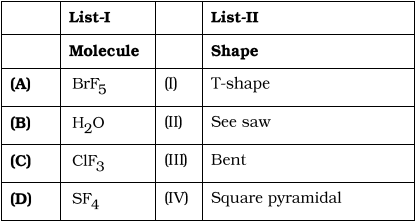
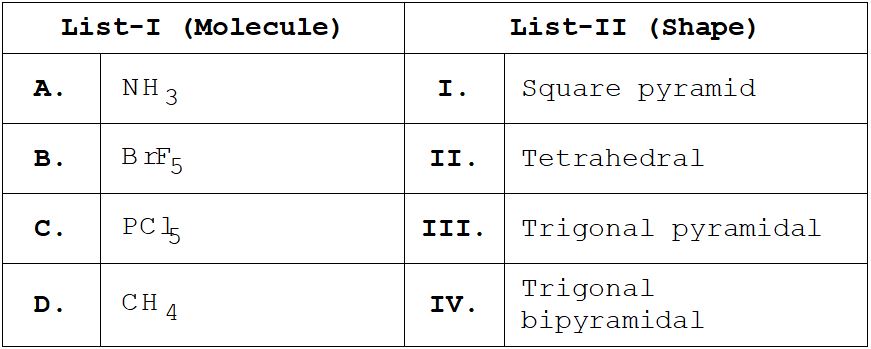
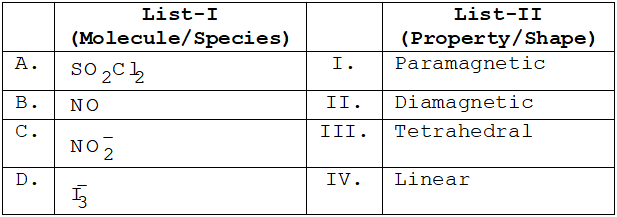
Match List-I with List-II.
Choose the correct answer from the options given below:
The total number of molecular orbitals formed from \( 2s \) and \( 2p \) atomic orbitals of a diatomic molecule is ________.
Number of molecules/ions from the following in which the central atom is involved in \( \mathrm{sp}^3 \) hybridization is \( \_\_\_\_\_\_ \).\( \mathrm{NO}_3^- , \ \mathrm{BCl}_3 , \ \mathrm{ClO}_2^- , \ \mathrm{ClO}_3 \)
Number of compounds with one lone pair of electrons on central atom amongst following is _____________. \( \mathrm{O_3} \), \( \mathrm{H_2O} \), \( \mathrm{SF_4} \), \( \mathrm{ClF_3} \), \( \mathrm{NH_3} \), \( \mathrm{BrF_5} \), \( \mathrm{XeF_4} \)
Given below are two statement:Statement-I: Since Fluorine is more electronegative than nitrogen, the net dipole moment of \( \mathrm{NF_3} \) is greater than \( \mathrm{NH_3} \).Statement-II: In \( \mathrm{NH_3} \), the orbital dipole due to lone pair and the dipole moment of NH bonds are in opposite direction, but in \( \mathrm{NF_3} \) the orbital dipole due to lone pair and dipole moment of \( \mathrm{N-F} \) bonds are in same direction.In the light of the above statements, choose the most appropriate from the options given below:
Which one of the following molecules has maximum dipole moment?
The total number of species from the following in which one unpaired electron is present, is _______. \( \text{N}_2, \text{O}_2, \text{C}_2^{-}, \text{O}_2^{-}, \text{O}_2^{2-}, \text{H}_2^{+}, \text{CN}^{-}, \text{He}_2^{+} \)
Given below are two statements:Statement (I): A \( \pi \) bonding MO has lower electron density above and below the inter-nuclear axis.Statement (II): The \( \pi^{*} \) antibonding MO has a node between the nuclei.In the light of the above statements, choose the most appropriate answer from the options given below:
Given below are two statements:Statement (I): The oxidation state of an element in a particular compound is the charge acquired by its atom on the basis of electron gain enthalpy consideration from other atoms in the molecule.Statement (II): \( p\pi - p\pi \) bond formation is more prevalent in second period elements over other periods.In the light of the above statements, choose the most appropriate answer from the options given below:
Number of molecules/species from the following having one unpaired electron is _______. \( \mathrm{O_2} \), \( \mathrm{O_2^{-1}} \), \( \mathrm{NO} \), \( \mathrm{CN^{-1}} \), \( \mathrm{O_2^{2-}} \)
Number of molecules from the following which are exceptions to octet rule is ______.\( \mathrm{CO_2} \), \( \mathrm{NO_2} \), \( \mathrm{H_2SO_4} \), \( \mathrm{BF_3} \), \( \mathrm{CH_4} \), \( \mathrm{SiF_4} \), \( \mathrm{ClO_2} \), \( \mathrm{PCl_5} \), \( \mathrm{BeF_2} \), \( \mathrm{C_2H_6} \), \( \mathrm{CHCl_3} \), \( \mathrm{CBr_4} \)
Given below are two statements: one is labelled as Assertion (A) and the other is labelled as Reason (R).Assertion (A): \( \mathrm{NH_3} \) and \( \mathrm{NF_3} \) molecule have pyramidal shape with a lone pair of electrons on nitrogen atom. The resultant dipole moment of \( \mathrm{NH_3} \) is greater than that of \( \mathrm{NF_3} \).Reason (R): In \( \mathrm{NH_3} \), the orbital dipole due to lone pair is in the same direction as the resultant dipole moment of the \( \mathrm{N-H} \) bonds. \( \mathrm{F} \) is the most electronegative element.In the light of the above statements, choose the correct answer from the options given below :
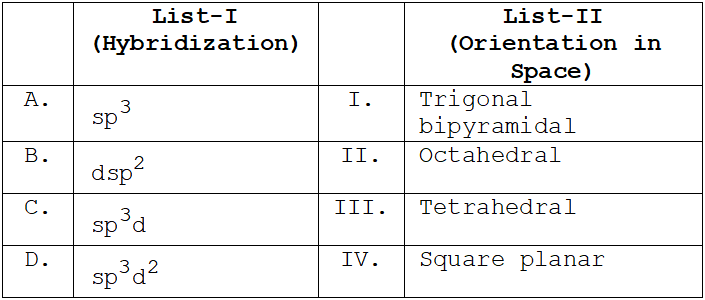
Match List-I with List-II.Choose the correct answer from the options given below:
The linear combination of atomic orbitals to form molecular orbitals takes place only when the combining atomic orbitalsA. have the same energyB. have the minimum overlapC. have same symmetry about the molecular axisD. have different symmetry about the molecular axisChoose the most appropriate from the options given below:
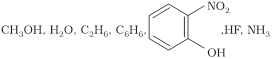
Number of molecules from the following which can exhibit hydrogen bonding is__________. (nearest integer)
The number of species from the following in which the central atom uses \( sp^3 \) hybrid orbitals in its bonding is ______. \( \text{NH}_3, \text{SO}_2, \text{SiO}_2, \text{BeCl}_2, \text{CO}_2, \text{H}_2\text{O}, \text{CH}_4, \text{BF}_3 \)
The correct increasing order for bond angles among \( \mathrm{BF_3} \), \( \mathrm{PF_3} \) and \( \mathrm{ClF_3} \) is:
Sum of bond order of \( \text{CO} \) and \( \text{NO}^+ \) is __________.
The correct statement/s about Hydrogen bonding is/are:A. Hydrogen bonding exists when H is covalently bonded to the highly electronegative atom.B. Intermolecular H bonding is present in o-nitro phenolC. Intramolecular H bonding is present in HF.D. The magnitude of H bonding depends on the physical state of the compound.E. H-bonding has powerful effect on the structure and properties of compounds.Choose the correct answer from the options given below:
The total number of molecules with zero dipole moment among \( \mathrm{CH_4} \), \( \mathrm{BF_3} \), \( \mathrm{H_2O} \), \( \mathrm{HF} \), \( \mathrm{NH_3} \), \( \mathrm{CO_2} \) and \( \mathrm{SO_2} \) is __________.
The number of species from the following which are paramagnetic and with bond order equal to one is __________.\( \mathrm{H_2, \ He_2^{+}, \ O_2^{+}, \ N_2^{2-}, \ O_2^{2-}, \ F_2, \ Ne_2^{+}, \ B_2} \)
Choose the correct answer from the options given below
Arrange the bonds in order of increasing ionic character in the molecules \( \mathrm{LiF} \), \( \mathrm{K_2O} \), \( \mathrm{N_2} \), \( \mathrm{SO_2} \) and \( \mathrm{ClF_3} \)
Total number of species from the following with central atom utilising \( \text{sp}^2 \) hybrid orbitals for bonding is __________ \( \mathrm{NH_3}, \ \mathrm{SO_2}, \ \mathrm{SiO_2}, \ \mathrm{BeCl_2}, \ \mathrm{C_2H_2}, \ \mathrm{C_2H_4}, \ \mathrm{BCl_3}, \ \mathrm{HCHO}, \ \mathrm{C_6H_6}, \ \mathrm{BF_3}, \ \mathrm{C_2H_4Cl_2} \)
In the Lewis dot structure for \( \mathrm{NO_2^-} \), total number of valence electrons around nitrogen is \( \_\_\_\_\_\_\_\_ \).
Toal number of electrons present in \( (\pi^{*}) \) molecular orbitals of \( \text{O}_2 \), \( \text{O}_2^{+} \) and \( \text{O}_2^{-} \) is
Choose the polar molecule from the following :