In which one of the following pairs the central atoms exhibit \( sp^2 \) hybridization?
\( \text{BF}_3 \) and \( \text{NO}_2^- \)
\( \text{H}_2\text{O} \) and \( \text{NO}_2 \)
\( \text{NH}_2^- \) and \( \text{H}_2\text{O} \)
\( \text{NH}_2^- \) and \( \text{BF}_3 \)
The number of lone pair of electrons on the central I atom in \( \mathrm{I_3^-} \) is ________.
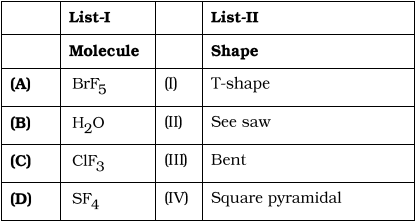
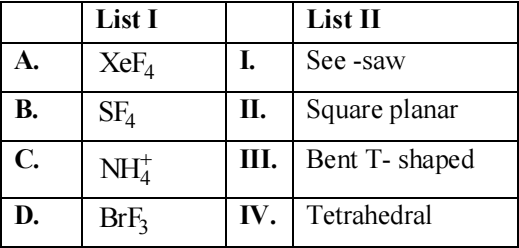
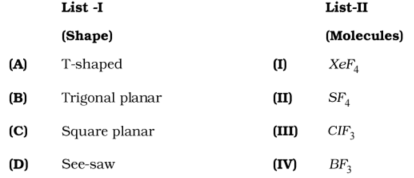
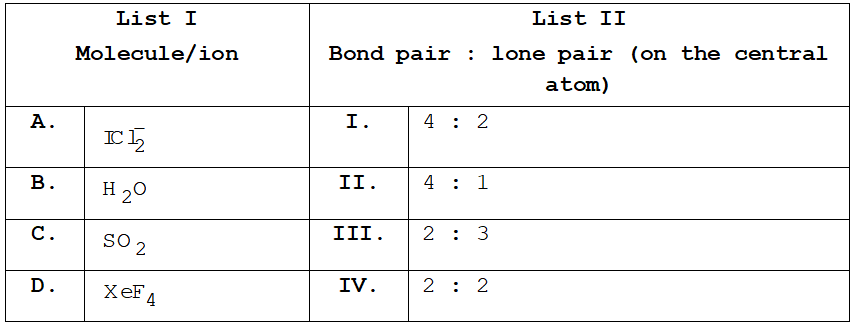
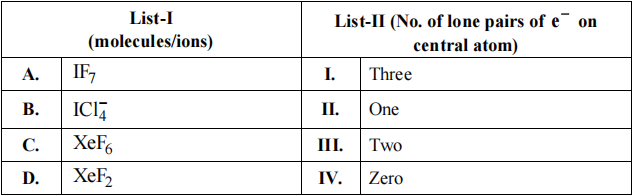
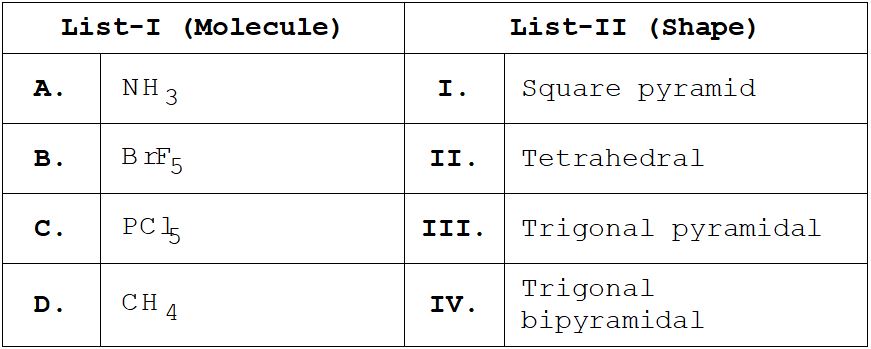
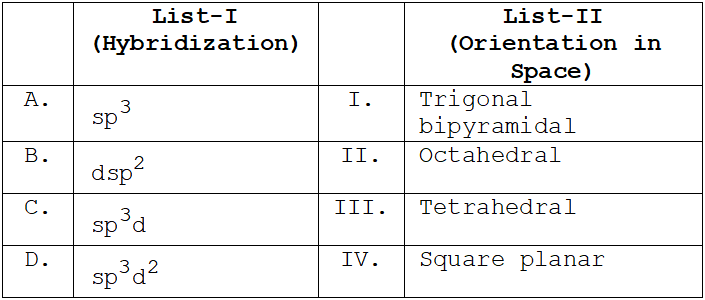
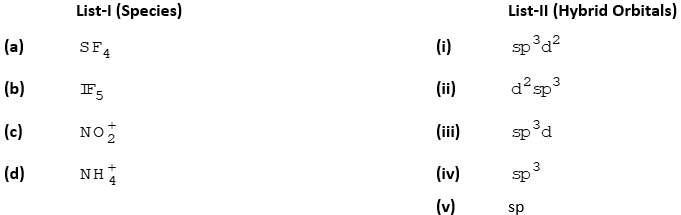
Match List -I and List-II
Choose the correct answer from the options given below:
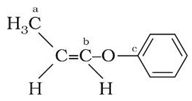
In the following molecule,Hybridisation of carbon \( a \), \( b \) and \( c \) respectively are:
Among \( \mathrm{SO_2} \), \( \mathrm{NF_3} \), \( \mathrm{NH_3} \), \( \mathrm{XeF_2} \), \( \mathrm{ClF_3} \) and \( \mathrm{SF_4} \), the hybridization of the molecule with non-zero dipole moment and highest number of lone-pairs of electrons on the central atom is:
Given below are two statements:Statement I: The number of species among \( \mathrm{BF_4^-} \), \( \mathrm{SiF_4} \), \( \mathrm{XeF_4} \) and \( \mathrm{SF_4} \), that have unequal \( \mathrm{E\!-\!F} \) bond lengths is two. Here, \( \mathrm{E} \) is the central atom.Statement II: Among \( \mathrm{O_2^-} \), \( \mathrm{O_2^{2-}} \), \( \mathrm{F_2} \) and \( \mathrm{O_2^+} \), \( \mathrm{O_2^-} \) has the highest bond order.In the light of the above statements, choose the correct answer from the options given below
The number of paramagnetic species among the following is ____________.\( \mathrm{B_2}, \mathrm{Li_2}, \mathrm{C_2}, \mathrm{C_2^-}, \mathrm{O_2^{2-}}, \mathrm{O_2^+} \) and \( \mathrm{He_2^+} \)
Consider the ions/molecule \( \mathrm{O_2^{+}} \), \( \mathrm{O_2} \), \( \mathrm{O_2^{-}} \), \( \mathrm{O_2^{2-}} \). For increasing bond order the correct option is:
What is the number of unpaired electron(s) in the highest occupied molecular orbital of the following species: \( \mathrm{N_2} \) ; \( \mathrm{N_2^+} \) ; \( \mathrm{O_2} \) ; \( \mathrm{O_2^+} \) ?
\( \mathrm{SF_4} \) is isostructural with: A. \( \mathrm{BrF_4^-} \) B. \( \mathrm{CH_4} \) C. \( \mathrm{IF_4^+} \) D. \( \mathrm{XeF_4} \) E. \( \mathrm{XeO_2F_2} \) Choose the correct answer from the options given below:
The geometry around boron in the product ‘B’ formed from the following reaction is\( \displaystyle \text{BF}_3 + \text{NaH} \;\dfrac{450\text{K}}{\text{A} + \text{NMe}_3 \rightarrow \text{B}}\; \text{A} + \text{NaF}\)
Given below are two statements: One is labelled as Assertion A and the other is labelled as Reason R.Assertion A: Lithium halides are some what covalent in natureReason R: Lithium possess high polarisation capabilityIn the light of the above statements, choose the most appropriate answer from the options given below:
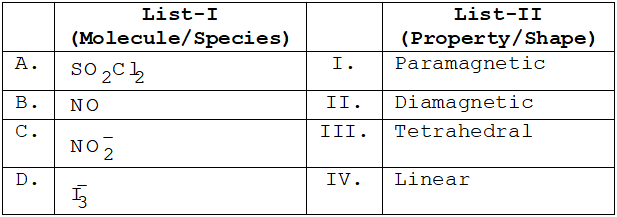
Match List-I with List-II.
The compound which does not exist is:
Consider, \(\displaystyle \mathrm{PF}_5, \, \mathrm{BrF}_5, \, \mathrm{PCl}_3, \, \mathrm{SF}_6, \, [\mathrm{ICl}_4]^-, \, \mathrm{ClF}_3 \) and \( \mathrm{IF_5} \).Amongst the above molecule(s) / ion(s), the number of molecule(s) / ion(s) having \( \mathrm{sp^{3}d^{2}} \) hybridization is ________.
The number of molecules from the following which contain only two lone pair of electrons is ______.\( \mathrm{H_2O}, \mathrm{N_2}, \mathrm{CO}, \mathrm{XeF_4}, \mathrm{NH_3}, \mathrm{NO}, \mathrm{CO_2}, \mathrm{F_2} \)
Arrange the following in the decreasing order of their covalent character:(A) \( \mathrm{LiCl} \) (B) \( \mathrm{NaCl} \) (C) \( \mathrm{KCl} \) (D) \( \mathrm{CsCl} \)Choose the most appropriate answer from the options given below:
The molecule / ion with square pyramidal shape is:
According to molecular orbital theory, the number of unpaired electron(s) \( \mathrm{O}_2^{2-} \) is _______.
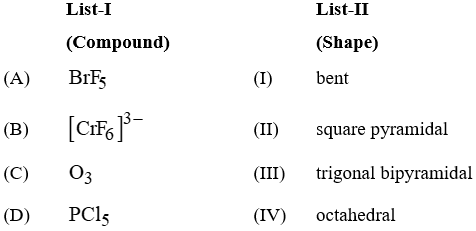
Match List – I with List–IIChoose the correct answer from the options given below:
The correct order of increasing intermolecular hydrogen bond strength is
The number of species below that have two lone pairs of electrons in their central atom is_____ \( \mathrm{SF_4} \), \( \mathrm{BF_4^-} \), \( \mathrm{ClF_3} \), \( \mathrm{AsF_3} \), \( \mathrm{PCl_5} \), \( \mathrm{BrF_5} \), \( \mathrm{XeF_4} \), \( \mathrm{SF_6} \)
Which of the following pictorial diagram most correctly represents the \( \pi^* \) (\( \pi \)-antibonding) molecular orbital between two atoms if the internuclear axis is taken to be in the z-direction ?
Number of lone pairs of electrons in the central atom of \( \mathrm{SCl_2} \), \( \mathrm{O_3} \), \( \mathrm{ClF_3} \) and \( \mathrm{SF_6} \), respectively, are:
The number of sigma bonds in is _______________ .
The number of species from the following that have pyramidal geometry around the central atom is __________\( \mathrm{S_2O_3^{2-}},\ \mathrm{SO_4^{2-}},\ \mathrm{SO_3^{2-}},\ \mathrm{S_2O_7^{2-}} \)
Select the compound from the following that will show intramolecular hydrogen bonding.
Consider the species \( \mathrm{CH_4} \), \( \mathrm{NH_4^+} \) and \( \mathrm{BH_4^-} \). Choose the correct option with respect to the there species.
The hybridization of \( \mathrm{P} \) exhibited in \( \mathrm{PF_5} \) is \( \mathrm{sp^x d^y} \). The value of \( y \) is ______.
The number of non-polar molecules from the following is __________ . \( \mathrm{HF}, \mathrm{H_2O}, \mathrm{SO_2}, \mathrm{H_2}, \mathrm{CO_2}, \mathrm{CH_4}, \mathrm{NH_3}, \mathrm{HCl}, \mathrm{CHCl_3}, \mathrm{BF_3} \)
According to Lewis theory, the total number of \( \sigma \) bond-pairs and lone pair of electrons around the central atom of \( \text{XeO}_6^{4-} \) ion is ________.
The number of molecules/ion/s having trigonal bipyramidal shape is _______. \( \mathrm{PF_5} \), \( \mathrm{BrF_5} \), \( \mathrm{PCl_5} \), \( [\mathrm{Pt\!Cl_4}]^{2-} \), \( \mathrm{BF_3} \), \( \mathrm{Fe(CO)_5} \)
A diatomic molecule has a dipole moment of \( 1.2 \, \text{D} \). If the bond distance is \( 1 \,\mathring{\text{A}} \), then fractional charge on each atom is ________ \( \times 10^{-1} \) esu. (Given \( 1 \, \text{D} = 10^{-18} \) esu cm)
The difference between bonds order of \( \mathrm{CO} \) and \( \mathrm{NO^+} \) is \( \dfrac{x}{2} \) where \( x = \) ______. (Round off to the Nearest Integer)
Number of compounds from the following with zero dipole moment is \( \_ \_ \_ \_ \_ \).\( \mathrm{HF}, \mathrm{H_2}, \mathrm{H_2S}, \mathrm{CO_2}, \mathrm{NH_3}, \mathrm{BF_3}, \mathrm{CH_4}, \mathrm{CHCl_3}, \mathrm{SiF_4}, \mathrm{H_2O}, \mathrm{BeF_2} \)
Which of the following is least ionic?
AX is a covalent diatomic molecule where A and X are second row elements of periodic table. Based on Molecular orbital theory, the bond order of AX is \( 2.5 \). The total number of electrons in AX is __________. (Round off to the Nearest Integer).
Statement I: Dipole moment is a vector quantity and by convention it is depicted by a small arrow with tail on the negative centre and head pointing towards the positive centre.Statement II: The crossed arrow of the dipole moment symbolizes the direction of the shift of charges in the molecules.In the light of the above statements, choose the most appropriate answer from the options given below:
The total number of molecular orbitals formed from \( 2s \) and \( 2p \) atomic orbitals of a diatomic molecule is ________.
Given below are two statements:Statement I : The number of pairs among \([\mathrm{SiO_2}, \mathrm{CO_2}] , [\mathrm{SnO}, \mathrm{SnO_2}] , [\mathrm{PbO}, \mathrm{PbO_2}] \) and \([\mathrm{GeO}, \mathrm{GeO_2}]\), which contain oxides that are both amphoteric is \( 2 \).Statement II : \( \mathrm{BF_3} \) is an electron deficient molecule, can act as a Lewis acid, forms adduct with \( \mathrm{NH_3} \) and has a trigonal planar geometry.In the light of the above statements, choose the correct answer from the options given below:
Given below are two statements:Statement (I): The correct sequence of bond lengths in the following species is: \( \mathrm{O_2^{+}} < \mathrm{O_2} < \mathrm{O_2^{-}} < \mathrm{O_2^{2-}} \)Statement (II): The correct sequence of number of unpaired electrons in the following species is: \( \mathrm{O_2} > \mathrm{O_2^{+}} > \mathrm{O_2^{-}} > \mathrm{O_2^{2-}} \)In the light of the above statements, choose the correct answer from the options given below:
The total number of lone pairs of electrons on oxygen atoms of ozone is __________ .
Number of molecules/ions from the following in which the central atom is involved in \( \mathrm{sp}^3 \) hybridization is \( \_\_\_\_\_\_ \).\( \mathrm{NO}_3^- , \ \mathrm{BCl}_3 , \ \mathrm{ClO}_2^- , \ \mathrm{ClO}_3 \)
The number of species from the following carrying a single lone pair on central atom Xenon is ________.\( \mathrm{XeF_5^+}, \mathrm{XeO_3}, \mathrm{XeO_2F_2}, \mathrm{XeF_5^-}, \mathrm{XeO_3F_2}, \mathrm{XeOF_4}, \mathrm{XeF_4} \)
The sum of lone pairs present on the central atom of the interhalogen \( \mathrm{IF_5} \) and \( \mathrm{IF_7} \) is ______
The bond order and magnetic behaviour of \( \mathrm{O_2^-} \) ion are, respectively:
CORRECT order of stability for the following is: \( \mathrm{CH_2 = CH^-} \), \( \mathrm{CH_3 - CH_2^-} \), \( \mathrm{CH \equiv C^-} \)
Number of compounds with one lone pair of electrons on central atom amongst following is _____________. \( \mathrm{O_3} \), \( \mathrm{H_2O} \), \( \mathrm{SF_4} \), \( \mathrm{ClF_3} \), \( \mathrm{NH_3} \), \( \mathrm{BrF_5} \), \( \mathrm{XeF_4} \)
Given below are two statement:Statement-I: Since Fluorine is more electronegative than nitrogen, the net dipole moment of \( \mathrm{NF_3} \) is greater than \( \mathrm{NH_3} \).Statement-II: In \( \mathrm{NH_3} \), the orbital dipole due to lone pair and the dipole moment of NH bonds are in opposite direction, but in \( \mathrm{NF_3} \) the orbital dipole due to lone pair and dipole moment of \( \mathrm{N-F} \) bonds are in same direction.In the light of the above statements, choose the most appropriate from the options given below:
Among the following, the CORRECT combinations are\( \text{A.}\ \mathrm{IF_3} \rightarrow \text{T-shaped}\ (sp^3d) \)\( \text{B.}\ \mathrm{IF_5} \rightarrow \text{Square pyramidal}\ (sp^3d^2) \)\( \text{C.}\ \mathrm{IF_7} \rightarrow \text{Pentagonal bipyramidal}\ (sp^3d^3) \)\( \text{D.}\ \mathrm{ClO_4^-} \rightarrow \text{Square planar}\ (sp^2d) \)Choose the correct answer from the options given below:
Given below are two statements:Statement I : \( \mathrm{SO_2} \) and \( \mathrm{H_2O} \) both possess V-shaped structure.Statement II : The bond angle of \( \mathrm{SO_2} \) is less than that of \( \mathrm{H_2O} \).In the light of the above statements, choose the most appropriate answer from the options given below:
Which one of the following molecules has maximum dipole moment?
The total number of species from the following in which one unpaired electron is present, is _______. \( \text{N}_2, \text{O}_2, \text{C}_2^{-}, \text{O}_2^{-}, \text{O}_2^{2-}, \text{H}_2^{+}, \text{CN}^{-}, \text{He}_2^{+} \)
Amongst the following, the number of species having the linear shape is __________.\( \mathrm{XeF_2, \ I_3^+, \ C_3O_2, \ I_3^-, \ CO_2, \ SO_2, \ BeCl_2} \) and \( \mathrm{BCl_2^{\Theta}} \)
Among \( \text{H}_2\text{S}, \text{H}_2\text{O}, \text{NF}_3, \text{NH}_3 \) and \( \text{CHCl}_3, \) identify the molecule (\( X \)) with lowest dipole moment value. The number of lone pairs of electrons present on the central atom of the molecule (\( X \)) is:
The correct increasing order of the ionic radii is:
Given below are two statements:Statement (I): A \( \pi \) bonding MO has lower electron density above and below the inter-nuclear axis.Statement (II): The \( \pi^{*} \) antibonding MO has a node between the nuclei.In the light of the above statements, choose the most appropriate answer from the options given below:
Given below are two statements :Statement (I) : Experimentally determined oxygen-oxygen bond lengths in the \( \mathrm{O_3} \) are found to be same and the bond length is greater than that of a \( \mathrm{O=O} \) (double bond) but less than that of a single (\( \mathrm{O-O} \)) bond.Statement (II) : The strong lone pair-lone pair repulsion between oxygen atoms is solely responsible for the fact that the bond length in ozone is smaller than that of a double bond (\( \mathrm{O=O} \)) but more than that of a single bond (\( \mathrm{O-O} \)).In the light of the above statements, choose the correct answer from the options given below:
Given below are two statements:Statement (I): The oxidation state of an element in a particular compound is the charge acquired by its atom on the basis of electron gain enthalpy consideration from other atoms in the molecule.Statement (II): \( p\pi - p\pi \) bond formation is more prevalent in second period elements over other periods.In the light of the above statements, choose the most appropriate answer from the options given below:
Pair of species among the following having same bond order as well as paramagnetic character will be:
The number of colloidal systems from the following, which will have ‘liquid’ as the dispersion medium, is ________ .Gem stones, paints, smoke, cheese, milk, hair cream, insecticide sprays, froth, soap lather
Which among the following molecules is (a) involved in \( sp^3 d \) hybridization, (b) has different bond lengths and (c) has lone pair of electrons on the central atom?
Number of \( \mathrm{Cl} = \mathrm{O} \) bonds in chlorous acid, chloric acid and perchloric acid respectively are:
In the structure of \( \mathrm{SF}_4 \), the lone pair of electrons on \( \mathrm{S} \) is in.
Match List I with List II.
Benzene on nitration gives nitrobenzene in presence of \( \mathrm{HNO_3} \) and \( \mathrm{H_2SO_4} \) mixture, where:
Number of molecules/species from the following having one unpaired electron is _______. \( \mathrm{O_2} \), \( \mathrm{O_2^{-1}} \), \( \mathrm{NO} \), \( \mathrm{CN^{-1}} \), \( \mathrm{O_2^{2-}} \)
Based upon VSEPR theory, match the shape (geometry) of the molecules in List-I with the molecules in List-II and select the most appropriate option.
Amongst \( \mathrm{SF_4} \), \( \mathrm{XeF_4} \), \( \mathrm{CF_4} \) and \( \mathrm{H_2O} \), the number of species with two lone pairs of electrons is _______.
Identify the correct statement for \( \mathrm{B_2H_6} \) , from those given below.(A) In \( \mathrm{B_2H_6} \) , all B-H bonds are equivalent.(B) In \( \mathrm{B_2H_6} \) there are four \( 3 \)-centre-\( 2 \)-electron bonds.(C) \( \mathrm{B_2H_6} \) is a Lewis acid.(D) \( \mathrm{B_2H_6} \) can be synthesized from both \( \mathrm{BF_3} \) and \( \mathrm{NaBH_4} \) .(E) \( \mathrm{B_2H_6} \) is a planar molecule.Choose the most appropriate answer from the options given below:
Number of molecules from the following which are exceptions to octet rule is ______.\( \mathrm{CO_2} \), \( \mathrm{NO_2} \), \( \mathrm{H_2SO_4} \), \( \mathrm{BF_3} \), \( \mathrm{CH_4} \), \( \mathrm{SiF_4} \), \( \mathrm{ClO_2} \), \( \mathrm{PCl_5} \), \( \mathrm{BeF_2} \), \( \mathrm{C_2H_6} \), \( \mathrm{CHCl_3} \), \( \mathrm{CBr_4} \)
Match the List-I with List-II.
$\text{O}-\text{O}$ bond length in $\text{H}_2\text{O}_2$ is $\underline{\text{X}}$ than the $\text{O}-\text{O}$ bond length in $\text{F}_2\text{O}_2$. The $\text{O}-\text{H}$ bond length in $\text{H}_2\text{O}_2$ is $\underline{\text{Y}}$ than that of the $\text{O}-\text{F}$ bond in $\text{F}_2\text{O}_2$.
Choose the correct option for $\underline{\text{X}}$ and $\underline{\text{Y}}$ from those given below:
\\( A=[\\mathrm{SO_3^{2-}},\\,\\mathrm{CO_3^{2-}}],\\; B=[\\mathrm{O_2^{2-}},\\,\\mathrm{F_2}],\\; C=[\\mathrm{CN^-},\\,\\mathrm{CO}],\\; D=[\\mathrm{NH_3},\\,\\mathrm{H_3O^+}] \\) and \\( E=[\\mathrm{MnO_4^{2-}},\\,\\mathrm{CrO_4^{2-}}] \\) that do not have similar Lewis dot structure are:
The number of molecules/ions that show linear geometry among the following is ____________.\( \mathrm{SO_2}, \mathrm{BeCl_2}, \mathrm{CO_2}, \mathrm{N_3^-}, \mathrm{NO_2}, \mathrm{F_2O}, \mathrm{XeF_2}, \mathrm{NO_2^+}, \mathrm{I_3^-}, \mathrm{O_3} \)
Given below are two statements: one is labelled as Assertion (A) and the other is labelled as Reason (R).Assertion (A): \( \mathrm{NH_3} \) and \( \mathrm{NF_3} \) molecule have pyramidal shape with a lone pair of electrons on nitrogen atom. The resultant dipole moment of \( \mathrm{NH_3} \) is greater than that of \( \mathrm{NF_3} \).Reason (R): In \( \mathrm{NH_3} \), the orbital dipole due to lone pair is in the same direction as the resultant dipole moment of the \( \mathrm{N-H} \) bonds. \( \mathrm{F} \) is the most electronegative element.In the light of the above statements, choose the correct answer from the options given below :
Match List-I with List-II.Choose the correct answer from the options given below:
Consider the following species:\( \mathrm{BrF_5} \), \( \mathrm{XeF_5^-} \), \( \mathrm{BF_4^-} \), \( \mathrm{ICl_4^-} \), \( \mathrm{XeF_4} \), \( \mathrm{SF_4} \), \( \mathrm{NH_4^+} \), \( \mathrm{ClF_3} \), \( \mathrm{XeF_2} \), \( \mathrm{ICl_2^-} \)Number of species having \( sp^3d \) hybridized central atom is ______.
The linear combination of atomic orbitals to form molecular orbitals takes place only when the combining atomic orbitalsA. have the same energyB. have the minimum overlapC. have same symmetry about the molecular axisD. have different symmetry about the molecular axisChoose the most appropriate from the options given below:
Number of lone pair(s) of electrons on central atom and the shape of \( \mathrm{BrF_3} \) molecule respectively, are:
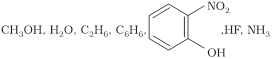
Number of molecules from the following which can exhibit hydrogen bonding is__________. (nearest integer)
Arrange the following compounds in increasing order of their dipole moment: \( \mathrm{HBr} \), \( \mathrm{H_2S} \), \( \mathrm{NF_3} \) and \( \mathrm{CHCl_3} \)
Match List-I with List-II:
The INCORRECT statement regarding the structure of \( \text{C}_{60} \) is:
Arrange the following in increasing order of their covalent character.A. \( \mathrm{CaF_2} \) B. \( \mathrm{CaCl_2} \) C. \( \mathrm{CaBr_2} \) D. \( \mathrm{CaI_2} \)Choose the correct answer from the options given below:
The correct increasing order of C–H (A), C–O (B), C=O (C) and C≡N (D) bonds in terms of covalent bond length is:
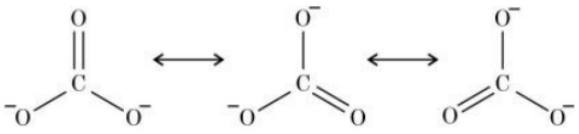
Resonance in carbonate ion \( \mathrm({CO_3^{2-}} \)) is :Which of the follwing is true?
Amongst the following, the linear species is :
The number of species from the following in which the central atom uses \( sp^3 \) hybrid orbitals in its bonding is ______. \( \text{NH}_3, \text{SO}_2, \text{SiO}_2, \text{BeCl}_2, \text{CO}_2, \text{H}_2\text{O}, \text{CH}_4, \text{BF}_3 \)
The spin-only magnetic moment value of \( \mathrm{B_2^{+}} \) species is ___ \( \times 10^{-2} \) BM . (Given : \( \sqrt{3} = 1.73 \) ]
A central atom in a molecule has two lone pair of electrons and forms three single bonds. The shape of this molecule is:
The sum of number of lone pairs of electrons present on the central atoms of \( \mathrm{XeO_3} \), \( \mathrm{XeOF_4} \) and \( \mathrm{XeF_6} \), is ________.
The correct shape and \(I–I–I\) bond angles respectively in \( \mathrm{I_3^-} \) ion are:
Which of the following pair of molecules contain odd electron molecule and an expanded octet molecule?
Which of the following statement is true with respect to \( \mathrm{H_2O} \), \( \mathrm{NH_3} \) and \( \mathrm{CH_4} \)?(A) The central atoms of all the molecules are \( sp^3 \) hybridized.(B) The H–O–H, H–N–H and H–C–H angles in the above molecules are \( 104.5^\circ \), \( 107.5^\circ \) and \( 109.5^\circ \), respectively.(C) The increasing order of dipole moment is \( \mathrm{CH_4} < \mathrm{NH_3} < \mathrm{H_2O} \).(D) Both \( \mathrm{H_2O} \) and \( \mathrm{NH_3} \) are Lewis acids and \( \mathrm{CH_4} \) is a Lewis base.(E) A solution of \( \mathrm{NH_3} \) in \( \mathrm{H_2O} \) is basic. In this solution \( \mathrm{NH_3} \) and \( \mathrm{H_2O} \) act as Lowry-Bronsted acid and base respectively.Choose the correct answer from the options given below:
Given below are two statements: One is labelled as Assertion A and the other is labelled as Reason RAssertion A: Zero orbital overlap is an out of phase overlapReason R: It results due to different orientation/direction of approach of orbitals.In the light of the above statements, choose the correct answer from the options given below
The number of molecule(s) or ion(s) from the following having non-planar structure is ______.\( \mathrm{NO_3^-}, \ \mathrm{H_2O_2}, \ \mathrm{BF_3}, \ \mathrm{PCl_3}, \ \mathrm{XeF_4}, \ \mathrm{SF_4}, \ \mathrm{XeO_3}, \ \mathrm{PH_4^+}, \ \mathrm{SO_3}, \ \left[\mathrm{Al(OH)_4}\right]^- \)
The total number of electrons in all bonding molecular orbitals of \( \mathrm{O_2^{2-}} \) is _______. (Round off to the nearest Integer).
The correct increasing order for bond angles among \( \mathrm{BF_3} \), \( \mathrm{PF_3} \) and \( \mathrm{ClF_3} \) is:
According to MO theory, number of species/ions from the following having identical bond order is _____. \( \mathrm{CN^-}, \mathrm{NO^+}, \mathrm{O_2}, \mathrm{O_2^+}, \mathrm{O_2^{2+}} \)
Identify the species having one \( \pi \) bond and maximum number of canonical forms from the following:
Bonding in which of the following diatomic molecule(s) become(s) stronger, on the basis of MO Theory, by removal of an electron?(A) \( \mathrm{NO} \) (B) \( \mathrm{N_2} \) (C) \( \mathrm{O_2} \) (D) \( \mathrm{C_2} \) (E) \( \mathrm{B_2} \)Choose the most appropriate answer from the options given below:
Sum of bond order of \( \text{CO} \) and \( \text{NO}^+ \) is __________.
The correct statement/s about Hydrogen bonding is/are:A. Hydrogen bonding exists when H is covalently bonded to the highly electronegative atom.B. Intermolecular H bonding is present in o-nitro phenolC. Intramolecular H bonding is present in HF.D. The magnitude of H bonding depends on the physical state of the compound.E. H-bonding has powerful effect on the structure and properties of compounds.Choose the correct answer from the options given below:
The total number of molecules with zero dipole moment among \( \mathrm{CH_4} \), \( \mathrm{BF_3} \), \( \mathrm{H_2O} \), \( \mathrm{HF} \), \( \mathrm{NH_3} \), \( \mathrm{CO_2} \) and \( \mathrm{SO_2} \) is __________.
The correct order of bond orders of \( \text{C}_2^{2-} \), \( \text{N}_2^{2-} \) and \( \text{O}_2^{2-} \) is, respectively:
Choose the most appropriate answer from the options given below:
Given below are two statements:Statement I: The number of species among \( \mathrm{SF_4} \), \( \mathrm{NH_4^+} \), \( [\mathrm{NiCl_4}]^{2-} \), \( \mathrm{XeF_4} \), \( [\mathrm{PtCl_4}]^{2-} \), \( \mathrm{SeF_4} \) and \( [\mathrm{Ni(CN)_4}]^{2-} \), that have tetrahedral geometry is \( 3 \).Statement II: In the set \( [\,\mathrm{NO_2}, \mathrm{BeH_2}, \mathrm{BF_3}, \mathrm{AlCl_3}\,] \), all the molecules have incomplete octet around central atom.In the light of the above statements, choose the correct answer from the options given below:
\( \mathrm{AB_3} \) is an interhalogen T-shaped molecule. The number of lone pairs of electrons on A is ______. (Integer answer)
The number of species from the following which are paramagnetic and with bond order equal to one is __________.\( \mathrm{H_2, \ He_2^{+}, \ O_2^{+}, \ N_2^{2-}, \ O_2^{2-}, \ F_2, \ Ne_2^{+}, \ B_2} \)
Match List-I with List-II:Choose the correct answer from the options given below:
Choose the correct answer from the options given below
The pair from the following pairs having both compounds with net non-zero dipole moment is:
Consider \( 'n' \) is the number of lone pair of electrons present in the equatorial position of the most stable structure of \( \mathrm{ClF_{3}} \). The ions from the following with \( 'n' \) number of unpaired electrons are:A. \( \mathrm{V}^{3+} \) B. \( \mathrm{Ti}^{3+} \) C. \( \mathrm{Cu}^{2+} \) D. \( \mathrm{Ni}^{2+} \) E. \( \mathrm{Ti}^{2+} \)Choose the correct answers from the options given below:(\( 1 \)) A and C Only (\( 2 \)) B and D Only (\( 3 \)) A, D and E Only (\( 4 \)) B and C Only
Amongst \( \mathrm{BeF_2} \), \( \mathrm{BF_3} \), \( \mathrm{H_2O} \), \( \mathrm{NH_3} \), \( \mathrm{CCl_4} \) and \( \mathrm{HCl} \), the number of molecules with non-zero net dipole moment is __________.
The maximum number of lone pairs of electrons on the central atom from the following species is ________ \( \mathrm{ClO_3^-} \), \( \mathrm{XeF_4} \), \( \mathrm{SF_4} \) and \( \mathrm{I_3^-} \).
Amongst the following, the number of oxide(s) which are paramagnetic in nature is: \(\mathrm{Na_2O},\ \mathrm{KO_2},\ \mathrm{NO_2},\ \mathrm{N_2O},\ \mathrm{ClO_2},\ \mathrm{NO},\ \mathrm{SO_2},\ \mathrm{Cl_2O}\)
Consider the following statements:(A) \( \mathrm{NF_3} \) molecule has a trigonal planar structure(B) Bond length of \( \mathrm{N_2} \) is shorter than \( \mathrm{O_2} \)(C) Isoelectronic molecules or ions have identical bond order(D) Dipole moment of \( \mathrm{H_2S} \) is higher than that of water moleculeChoose the correct answer from the options given below:
Arrange the bonds in order of increasing ionic character in the molecules \( \mathrm{LiF} \), \( \mathrm{K_2O} \), \( \mathrm{N_2} \), \( \mathrm{SO_2} \) and \( \mathrm{ClF_3} \)
Order of covalent bond:I. \( \mathrm{KF} > \mathrm{KI} ; \mathrm{LiF} > \mathrm{KF} \)II. \( \mathrm{KF} < \mathrm{KI} ; \mathrm{LiF} > \mathrm{KF} \)III. \( \mathrm{SnCl_4} > \mathrm{SnCl_2} ; \mathrm{CuCl} > \mathrm{NaCl} \)IV. \( \mathrm{LiF} > \mathrm{KF} ; \mathrm{CuCl} < \mathrm{NaCl} \)V. \( \mathrm{KF} < \mathrm{KI} ; \mathrm{CuCl} > \mathrm{NaCl} \)Choose the correct answer from the options given below:
Total number of non-bonded electrons present in \( \mathrm{NO_2^-} \) ion based on Lewis theory is ______.
Given below are statements about some molecules/ions. Identify the CORRECT statements. A. The dipole moment value of \( \mathrm{NF_3} \) is higher than that of \( \mathrm{NH_3} \). B. The dipole moment value of \( \mathrm{BeH_2} \) is \( 0 \). C. The bond order of \( \mathrm{O_2^{2-}} \) and \( \mathrm{F_2} \) is same. D. The formal charge on the central oxygen atom of ozone is \( -1 \). E. In \( \mathrm{NO_2} \), all the three atoms satisfy the octet rule, hence it is very stable. Choose the correct answer from the options given below:
The number of interhalogens from the following having square pyramidal structure is: \( \mathrm{ClF}_3 \), \( \mathrm{IF}_7 \), \( \mathrm{BrF}_5 \), \( \mathrm{BrF}_3 \), \( \mathrm{I_2Cl}_6 \), \( \mathrm{IF}_5 \), \( \mathrm{ClF} \), \( \mathrm{ClF}_5 \)
Given below are two statements :Statement I : \( \mathrm{SbCl_5} \) is more covalent than \( \mathrm{SbCl_3} \)Statement II : The higher oxides of halogens also tend to be more stable than the lower ones.In the light of the above statements, choose the most appropriate answer from the options given below
The number of following factors which affect the percent covalent character of the ionic bond is ________.(A) Polarising power of cation (B) Extent of distortion of anion(C) Polarisability of the anion (D) Polarising power of anion
The number of \( sp^{3} \) hybridized carbons in an acyclic neutral compound with molecular formula \( \mathrm{C_4H_5N} \) is ______.
\( 2.8 \times 10^{-3} \, \text{mol} \) of \( \mathrm{CO_2} \) is left after removing \( 10^{21} \) molecules from its '\( x \)' \( \text{mg} \) sample. The mass of \( \mathrm{CO_2} \) taken initially is:[Given: \( N_A = 6.02 \times 10^{23} \, \text{mol}^{-1} \)]
The number of bent-shaped molecule/s from the following is _________ \( \mathrm{N_3^-} \), \( \mathrm{NO_2^-} \), \( \mathrm{I_3^-} \), \( \mathrm{O_3} \), \( \mathrm{SO_2} \)
In the following the correct bond order sequence is:
The number of species having non-pyramidal shape among the following is _______.\( (A) \; \mathrm{SO}_3 \quad (B) \; \mathrm{NO}_3^{-} \quad (C) \; \mathrm{PCl}_3 \quad (D) \; \mathrm{CO}_3^{2-} \)
Which statements are NOT TRUE about \( \mathrm{X_e O_{2}F_{2}} \)?A. It has a see-saw shape.B. Xe has \( 5 \) electron pairs in its valence shell in \( \mathrm{XeO_{2}F_{2}} \).C. The O-Xe-O bond angle is close to \( 180^{\circ} \).D. The F-Xe-F bond angle is close to \( 180^{\circ} \).E. Xe has \( 16 \) valence electrons in \( \mathrm{X_e O_{2}F_{2}} \).Choose the correct answer from the options given below:
The interaction energy of London forces between two particles is proportional to \( r^{x} \), where \( r \) is the distance between the particles. The value of \( x \) is:
In \(SO_2\), \(NO_2^{-}\) and \(N_3^{-}\) the hybridizations at the central atom are respectively:
Bromine trifluoride autoionizes to form \( \mathrm{BrF_{2}^{\oplus}} \) and \( \mathrm{BrF_{4}^{\oplus}} \). The shapes of the cation and anion are respectively ______ and ______
Which one of the following pairs is an example of polar molecular solids?
Total number of species from the following with central atom utilising \( \text{sp}^2 \) hybrid orbitals for bonding is __________ \( \mathrm{NH_3}, \ \mathrm{SO_2}, \ \mathrm{SiO_2}, \ \mathrm{BeCl_2}, \ \mathrm{C_2H_2}, \ \mathrm{C_2H_4}, \ \mathrm{BCl_3}, \ \mathrm{HCHO}, \ \mathrm{C_6H_6}, \ \mathrm{BF_3}, \ \mathrm{C_2H_4Cl_2} \)
Which of the following linear combination of atomic orbitals will lead to formation of molecular orbitals in homonuclear diatomic molecules [internuclear axis in \( z \)-direction]?(A) \( 2p_z \) and \( 2p_x \) (B) \( 2s \) and \( 2p_x \)(C) \( 3d_{xy} \) and \( 3d_{x^2-y^2} \) (D) \( 2s \) and \( 2p_z \)(E) \( 2p_z \) and \( 3d_{x^2-y^2} \)Choose the correct answer from the options given below:
In the Lewis dot structure for \( \mathrm{NO_2^-} \), total number of valence electrons around nitrogen is \( \_\_\_\_\_\_\_\_ \).
Which one of the following given graphs represents the variation of the rate constant \( k \) with temperature \( T \) for an endothermic reaction?
The bond order and magnetic property of acetylide ion are same as that of :
As compared with chlorocyclohexane, which of the following statements correctly apply to chlorobenzene?A. The magnitude of negative charge is more on chlorine atom.B. The C—Cl bond has partial double bond character.C. C—Cl bond is less polar.D. C—Cl bond is longer due to repulsion between delocalised electrons of the aromatic ring and lone pairs of electrons of chlorine.E. The C—Cl bond is formed using \( sp^2 \) hybridised orbital of carbonChoose the correct answer from the options given below:
The magnetic behavior of \( \mathrm{Li_2O} \), \( \mathrm{Na_2O_2} \) and \( \mathrm{KO_2} \), respectively, are:
Toal number of electrons present in \( (\pi^{*}) \) molecular orbitals of \( \text{O}_2 \), \( \text{O}_2^{+} \) and \( \text{O}_2^{-} \) is
Choose the polar molecule from the following :
Number of molecules having bond order \( 2 \) from the following molecules is ______________. \( C_2, O_2, Be_2, Li_2, Ne_2, N_2, He_2 \).
Among the following species\( \mathrm{N_2, \, N_2^{+}, N_2^{-}, \, N_2^{2-}, \, O_2, \, O_2^{+}, O_2^{-}, \, O_2^{2-}} \)The number of species showing diamagnetism is ______.
The molecules having square pyramidal geometry are:
For \( \mathrm{OF_2} \) molecule consider the following:A. Number of lone pairs on oxygen is \( 2 \).B. FOF angle is less than \( 104.5^\circ \).C. Oxidation state of O is \( -2 \).D. Molecule is bent ‘V’ shaped.E. Molecular geometry is linear.Correct option are:
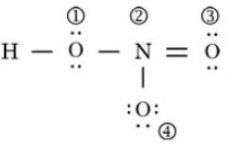
The formal charges on the atoms marked as \((1)\) to \((4)\) in the Lewis representation of \( \mathrm{HNO_3} \) molecule respectively are:
Identify the molecule \( (X) \) with maximum number of lone pairs of electrons (obtained using Lewis dot structure) among \( \mathrm{HNO_3} \), \( \mathrm{H_2SO_4} \), \( \mathrm{NF_3} \) and \( \mathrm{O_3} \). Choose the correct bond angle made by the central atom of the molecule \( (X) \).

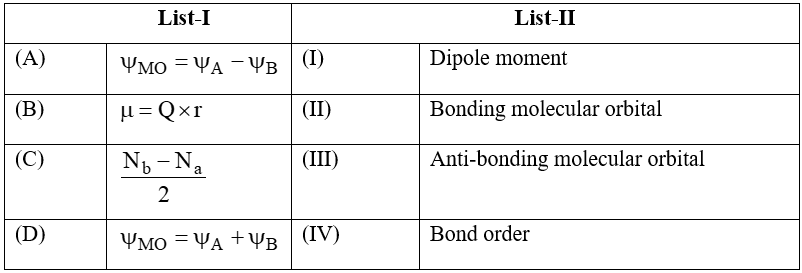
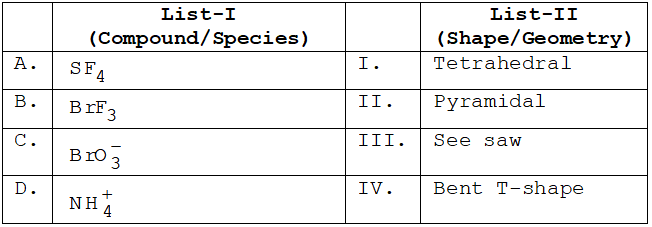
 ?
 is _______________ .