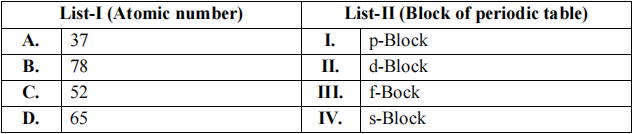
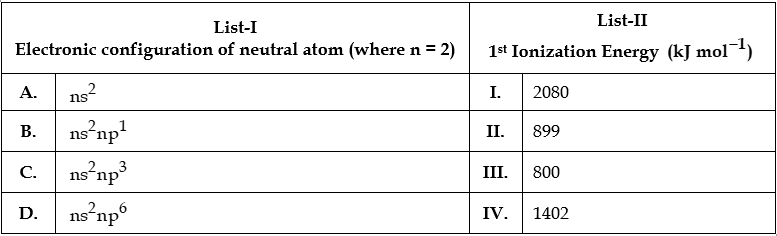
Match List-I with List-II.
Choose the correct answer from the options given below:
A-\( \text{IV} \), B-\( \text{III} \), C-\( \text{II} \), D-\( \text{I} \)
A-\( \text{IV} \), B-\( \text{II} \), C-\( \text{I} \), D-\( \text{III} \)
A-\( \text{II} \), B-\( \text{IV} \), C-\( \text{I} \), D-\( \text{III} \)
A-\( \text{I} \), B-\( \text{III} \), C-\( \text{IV} \), D-\( \text{II} \)
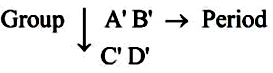
Consider the following elements.Which of the following is/are true about \( A', B', C' \) and \( D' \)?\((A)\) Order of atomic radii: \( B' < A' < D' < C' \)\((B)\) Order of metallic character: \( B' < A' < D' < C' \)
\((C)\) Size of the element: \( D' < C' < B' < A' \)
\((D)\) Order of ionic radii: \( B'^{+} < A'^{+} < D'^{+} < C'^{+} \)
Which set of quantum numbers is possible for outermost shell electron of ‘Cr’ \( (Z = 24) \)?
Element "E" belongs to the period \( 4 \) and group \( 16 \) of the periodic table. The valance shell electron configuration of the element, which is just above "E" in the group is:
The IUPAC nomenclature of an element with electronic configuration \( [\mathrm{Rn}]5f^{14}6d^{1}7s^{2} \) is :
For elements \( \mathrm{B}, \mathrm{C}, \mathrm{N}, \mathrm{Li}, \mathrm{Be}, \mathrm{O} \) and \( \mathrm{F} \), the correct order of first ionization enthalpy is:
The correct trend in the first ionization enthalpies of the elements in the \( 3^\text{rd} \) period of periodic table is:
Given below are two statements: one is labeled as Assertion (A) and the other is labeled as Reason (R).Assertion (A): \( \mathrm{Cu^{2+}} \) in water is more stable than \( \mathrm{Cu^{+}} \).Reason (R): Enthalpy of hydration for \( \mathrm{Cu^{2+}} \) is much less than that of \( \mathrm{Cu^{+}} \).In the light of the above statements, choose the correct answer from the options given below:
The elements of Group \( 13 \) with highest and lowest first ionisation enthalpies are respectively:
Given below are two statements: one is labelled as Assertion A and the other is labelled as Reason RAssertion A: \( 5f \) electrons can participate in bonding to a far greater extent than \( 4f \) electronsReasons R : \( 5f \) orbitals are not as buried as \( 4f \) orbitalsIn the light of the above statements, choose the correct answer from the options given below
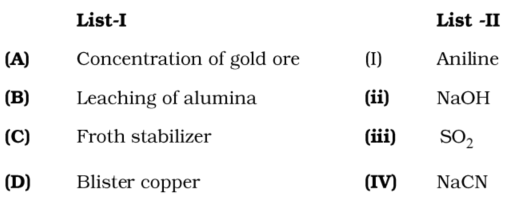
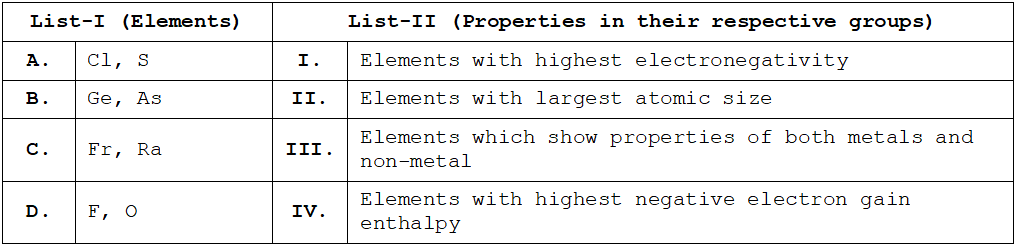
Match List-I with List-II
Choose the correct answer from the options given below.
The ionic radii of \( \mathrm{F^-} \) and \( \mathrm{O^{2-}} \) respectively are \( 1.33\, \overset{\circ}{A}\) and \( 1.4\,\overset{\circ}{A} \), while the covalent radius of \( \mathrm{N} \) is \( 0.74\,\overset{\circ}{A}\).The correct statement for the ionic radius of \( \mathrm{N^{3-}} \) from the following is:
Given below are two statements: Statement (I): According to the Law of Octaves, the elements were arranged in the increasing order of their atomic number. Statement (II): Meyer observed a periodically repeated pattern upon plotting physical properties of certain elements against their respective atomic numbers. In the light of the above statements, choose the correct answer from the options given below:
The ionic radius of \( \mathrm{Na^+} \) ion is 1.02 Å. The ionic radii (in Å) of \( \mathrm{Mg^{2+}} \) and \( \mathrm{Al^{3+}} \), respectively, are:
The characteristics of elements X, Y and Z with atomic numbers, respectively, \( 33 \), \( 53 \) and \( 83 \) are:
The bond dissociation energy is highest for:
The Correct order of first ionization enthalpy is:
Given below are two statements : one is labelled as Assertion A and the other is labelled as Reason R.Assertion A : The first ionization enthalpy decreases across a period.Reason R : The increasing nuclear charge outweighs the shielding across the period.In the light of the above statements, choose the most appropriate from the options given below:
The correct order of increasing ionic radii is
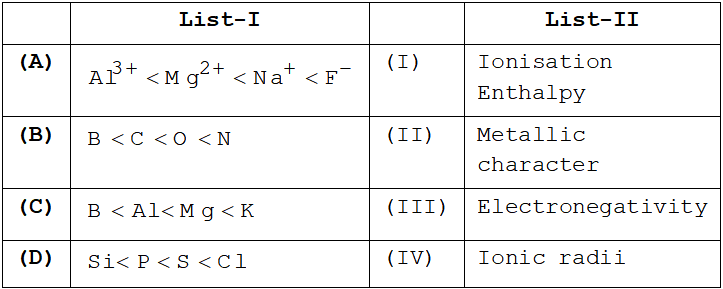
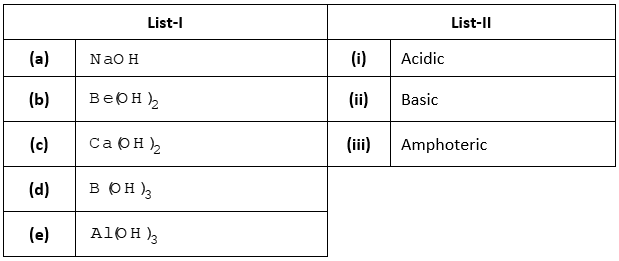
Match List-I with List-II.Choose the correct answer from the options given below:
The sum of group number and period number of the element named Unnilennium is ______.
The element having the highest first ionization enthalpy is:
Arrange the following elements in the increasing order of number of unpaired electrons in it. (A) Sc (B) Cr (C) V (D) Ti (E) Mn Choose the correct answer from the options given below:
The incorrect relationship in the following pairs in relation to ionization enthalpies is:
The absolute value of the electron gain enthalpy of halogens satisfies:
Given below are two statements:Statement I: The correct order in terms of atomic/ionic radii is \( \mathrm{Al > Mg > Mg^{2+} > Al^{3+}} \).Statement II: The correct order in terms of the magnitude of electron gain enthalpy is \( \mathrm{Cl > Br > S > O} \).In the light of the above statements, choose the correct answer from the options given below:
The correct order of C, N, O and F in terms of second ionisation potential is:
The correct statements from the following are:(A) The decreasing order of atomic radii of group \( 13 \) elements is \( \mathrm{Tl > In > Ga > Al > B} \).(B) Down the group \( 13 \) electronegativity decreases from top to bottom.(C) \( \mathrm{Al} \) dissolves in dil. \( \mathrm{HCl} \) and Liberates \( \mathrm{H_2} \) but conc. \( \mathrm{HNO_3} \) renders \( \mathrm{Al} \) passive by forming a protective oxide layer on the surface.(D) All elements of group \( 13 \) exhibits highly stable \( +1 \) oxidation state.(E) Hybridization of \( \mathrm{Al} \) in \( [\mathrm{Al(H_2O)_6}]^{3+} \) ion is \( \mathrm{sp^3 d^2} \).Choose the correct answer from the options given below:
The property/ properties that show irregularity in first four elements of group-\( 17 \) is/are:(A) Covalent radius(B) Electron affinity(C) Ionic radius(D) First ionization energyChoose the correct answer from the options given below:
The difference between electron gain enthalpies will be maximum between?
Given below are two statements: one is labelled as Assertion (A) and the other is labelled as Reason (R).Assertion (A) : Metallic character decreases and non-metallic character increases on moving from left to right in a period.Reason (R) : It is due to increase in ionization enthalpy and decrease in electron gain enthalpy, when one moves from left to right in a period.In the light of the above statements, choose the most appropriate answer from the options given below:
Henry Moseley studied characteristic X-ray spectra of elements. The graph which represents his observation correctly is:Given \( v \) = frequency of X-ray emitted\( Z \) = atomic number
Given below are two statements:Statement I: The second ionisation enthalpy of Na is larger than the corresponding ionisation enthalpy of Mg.Statement II: The ionic radius of \( \mathrm{O}^{2-} \) is larger than that of \( \mathrm{F}^{-} \).In the light of the above statements, choose the correct answer from the options given below
Given two statements below:Statement I: In \( \mathrm{Cl_2} \) molecule the covalent radius is double of the atomic radius of chlorine.Statement II: Radius of anionic species is always greater than their parent atomic radius.Choose the most appropriate answer from options given below:
Given below are two statements:Statement (I): The first ionisation enthalpy of group \( 14 \) elements is higher than the corresponding elements of group \( 13 \).Statement (II): Melting points and boiling points of group \( 13 \) elements are in general much higher than those of corresponding elements of group \( 14 \).In the light of the above statements, choose the most appropriate answer from the options given below:
Choose the incorrect trend in the atomic radii (\( r \)) of the elements.
Given below are two statements: one is labelled as Assertion (A) and the other is labelled as Reason (R).Assertion (A): The first ionization enthalpy of aluminium is lower than that of magnesium.Reason (R): Ionic radius of aluminium cation is smaller than that of magnesium cation.In the light of above statements, choose the most appropriate answer from the options given below:
The set of elements that differ in mutual relationship from those of the other sets is :
Boric acid is solid, whereas \( \mathrm{BF}_3 \) is gas at room temperature because of :
Given below are two statements:Statement I: The decrease in first ionization enthalpy from B to Al is much larger than the from Al to GaStatement II: The d orbitals in Ga are completely filledIn the light of the above statement, choose the most appropriate answer from the options given below
Outermost electronic configurations of four elements A, B, C, D are given below:(A) \( 3s^2 \) (B) \( 3s^2 3p^1 \) (C) \( 3s^2 3p^3 \) (D) \( 3s^2 3p^4 \)The correct order of first ionization enthalpy for them is:
Which of the following statements are not correct?A. The electron gain enthalpy of \( \mathrm{F} \) is more negative than that of \( \mathrm{Cl} \)B. Ionization enthalpy decreases in a group of periodic tableC. The electronegativity of an atom depends upon the atoms bonded to it.D. \( \mathrm{Al_2O_2} \) and \( \mathrm{NO} \) are examples of amphoteric oxidesChoose the most appropriate answer from the options given below:
The correct sequence of electron gain enthalpy of the elements listed below isA. ArB. BrC. FD. SChoose the most appropriate from the options given below:
Which of the following arrangement order is not correct according to the property indicated against it?
In case of isoelectronic species the size of \( \text{F}^- \), \( \text{Ne} \) and \( \text{Na}^+ \) is affected by:
Lithium aluminium hydride can be prepared from the reaction of:
The correct order of electron gain enthalpies of \( \mathrm{Cl} \), \( \mathrm{F} \), \( \mathrm{Te} \) and \( \mathrm{Po} \) is
The first ionization enthalpy of \( \mathrm{Na} \), \( \mathrm{Mg} \) an \( \mathrm{Si} \), respectively, are: \( 496 \) and \( 737 \) and \( 786 \) \( \mathrm{kJ \, mol^{-1}} \). The first ionization enthalpy (\( \mathrm{kJ \, mol^{-1}} \)) of \( \mathrm{Al} \) is:
The type of oxide formed by the element among Li, Na, Be, Mg, B and Al that has the least atomic radius is:
In a period, the first ionisation enthalpy of the element at extreme left and the negative electron gain enthalpy of the extreme right element, except noble gases, are respectively.
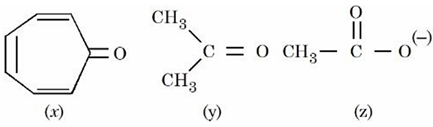
Consider the following molecules/species:The correct order of carbon - oxygen double bond length is:
If each orbital can take maximum of \( 3 \) electrons then the sum of number of orbitals and number of elements in \( 4^{\text{th}} \) period will be _______.
Given below are two statements: one is labelled as Assertion A and the other is labelled as Reason R.Assertion A: The energy required to form \( \mathrm{Mg^{2+}} \) from \( \mathrm{Mg} \) is much higher than that required to produce \( \mathrm{Mg^{+}} \).Reason R: \( \mathrm{Mg^{2+}} \) is small ion and carry more charge than \( \mathrm{Mg^{+}} \).In the light of the above statements, choose the correct answer from the options given below:
Electronic configuration of four elements \( A \), \( B \), \( C \) and \( D \) are given below:(A) \( 1s^2\,2s^2\,2p^3 \) (B) \( 1s^2\,2s^2\,2p^4 \) (C) \( 1s^2\,2s^2\,2p^5 \) (D) \( 1s^2\,2s^2\,2p^2 \)Which of the following is the correct order of increasing electronegativity (Pauling's scale) ?
The 1st ionization enthalpy for \( \mathrm{Mg} \) is \( +737 \, \text{kJ/mol} \). The most probable estimated value of the 2nd ionization enthalpy of \( \mathrm{Mg} \) is __________.
Given below are two statements:Statement I: The second ionization enthalpy of \( \mathrm{B}, \mathrm{Al} \) and \( \mathrm{Ga} \) is in the order of \( \mathrm{B} > \mathrm{Al} > \mathrm{Ga} \).Statement II: The correct order in terms of first ionization enthalpy is \( \mathrm{Si} < \mathrm{Ge} < \mathrm{Pb} < \mathrm{Sn} \).In the light of the above statements, choose the correct answer from the options given below:
The correct order of ionic radii for the ions, \( \mathrm{P^{3-}}, \ \mathrm{S^{2-}}, \ \mathrm{Ca^{2+}}, \ \mathrm{K^+}, \ \mathrm{Cl^-} \) is :
Which one of the following statements for D.I. Mendeleeff, is incorrect?
In period \( 4 \) of the periodic table, the elements with highest and lowest atomic radii are respectively.
The correct order of metallic character is equal to:
Which of the following electronegativity order is incorrect?
Match List-I with List-II :
Choose the most appropriate answer from the options given below :
Given below are two statements:Statement (I): The first ionization enthalpy of the elements Na, Mg, Cl and Ar follows the order \( \mathrm{Na > Mg > Cl > Ar} \).Statement (II): Among Ca, Al, Fe and B, the third ionization enthalpy is very high for Ca.In the light of the above statements, choose the correct answer from the options given below:
The correct decreasing order of metallic character is:
Which of the following pairs have highest electronegativity difference?
Which set lists only neutral oxides?
Given below are two statements, one is labelled as Assertion A and the other is labelled as Reason R.
Assertion A: Carbon forms two important oxides – $\text{CO}$ and $\text{CO}_2$. $\text{CO}$ is neutral whereas $\text{CO}_2$ is acidic in nature.
Reason R: $\text{CO}_2$ can combine with water in a limited way to form carbonic acid, while $\text{CO}$ is sparingly soluble in water.
In the light of the above statements, choose the most appropriate answer from the options given below:
An element ‘E’ has the ionisation enthalpy value of \( 374 \, \text{kJ mol}^{-1} \). ‘E’ reacts with elements A, B, C and D with electron gain enthalpy values of \( -328 \), \( -349 \), \( -325 \) and \( -295 \, \text{kJ mol}^{-1} \), respectively. The correct order of the products EA, EB, EC and ED in terms of ionic character is:
In the ground state of atomic \( \mathrm{Fe} \) \( (Z = 26) \), The spin only magnetic moment is _______ \( \times 10^{-1} \) \( \mathrm{BM} \). (Round off to the Nearest Integer) [Given: \( \sqrt{3} = 1.73 \), \( \sqrt{2} = 1.41 \)]
Which of the following statements are correct? (A) The process of adding an electron to a neutral gaseous atom is always exothermic (B) The process of removing an electron from an isolated gaseous atom is always endothermic (C) The \( 1^{\text{st}} \) ionization energy of boron is less than that of beryllium (D) The electronegativity of C is \( 2.5 \) in \( \mathrm{CH_4} \) and \( \mathrm{CCl_4} \) (E) \( \mathrm{Li} \) is the most electropositive among elements of group I Choose the correct answer from the options given below:
Given below are two statements:
Statement (I): The radii of isoelectronic species increase in the order:$\text{Mg}^{2+} < \text{Na}^{+} < \text{F}^{-} < \text{O}^{2-}$
Statement (II):The magnitude of electron gain enthalpy of halogen decreases in the order:$\text{Cl} > \text{F} > \text{Br} > \text{I}$
In the light of the above statement, choose the most appropriate answer from the options given below:
The element that does not belong to the same period of the remaining elements (modern periodic table) is:
Which one of the following sets of ions represented a collection of isoelectronic species? (Given: Atomic number: \( \mathrm{F: \, 9} \), \( \mathrm{Cl: \, 17} \), \( \mathrm{Na = 11} \), \( \mathrm{Mg = 12} \), \( \mathrm{Al = 13} \), \( \mathrm{K = 19} \), \( \mathrm{Ca = 20} \), \( \mathrm{Sc = 21} \).)
If IUPAC name of an element is "Unununnium" then the element belongs to \( n \)th group of Periodic table. The value of \( n \) is ___________.
The incorrect statement is:
Given below are two statements:Statement I: The metallic radius of \( \mathrm{Na} \) is \( 1.86 \, A^\circ \) and the ionic radius of \( \mathrm{Na^+} \) is lesser than \( 1.86 \, A^\circ \).Statement II: Ions are always smaller in size than the corresponding elements.In the light of the above statements, choose the correct answer from the options given below:
Given below are two statements:Statement I: \( \mathrm{K > Mg > Al > B} \) is the correct order in terms of metallic character.Statement II: Atomic radius is always greater than the ionic radius for any element.In the light of the above statements, choose the correct answer from the options given below:
Given below are two statements:Statement (I): Both metals and non-metals exist in p and d-block elements.Statement (II): Non-metals have higher ionization enthalpy and higher electronegativity than the metals.In the light of the above statements, choose the most appropriate answer from the options given below:
The electronic configuration of Pt (atomic number \( 78 \)) is:
The first ionization energy of magnesium is smaller as compared to that of elements \( X \) and \( Y \), but higher than that of \( Z \). The elements \( X \), \( Y \) and \( Z \), respectively, are:
The metal that has very low melting point and its periodic position is closer to a metalloid is:
The first ionization enthalpies of \( \mathrm{Be} \), \( \mathrm{B} \), \( \mathrm{N} \) and \( \mathrm{O} \) follow the order.
Given below are two statements : Statement (I) : An element in the extreme left of the periodic table forms acidic oxides. Statement (II) : Acid is formed during the reaction between water and oxide of a reactive element present in the extreme right of the periodic table, In the light of the above statements, choose the correct answer from the options given below :
Chalcogen group elements are:
Match the LIST -I with LIST -II.
Element not showing variable oxidation state is :
Given below are two statements :Statement (I) : The \( 4f \) and \( 5f \) - series of elements are placed separately in the Periodic table to preserve the principle of classification.Statement (II) : \( s \)-block elements can be found in pure form in nature.In the light of the above statements, choose the most appropriate answer from the options given below :
The correct order of first ionization enthalpy values of the following elements is: \( (A) \) \( \mathrm{O} \) \( (B) \) \( \mathrm{N} \) \( (C) \) \( \mathrm{Be} \) \( (D) \) \( \mathrm{F} \) \( (E) \) \( \mathrm{B} \) Choose the correct answer from the options given below:
Given below are two statements:Statement I: In group \( 13 \), the stability of \( +1 \) oxidation state increases down the group.Statement II: The atomic size of gallium is greater than that of aluminium.In the light of the above statement, choose the most appropriate answer from the options given below:
The atomic number of the element from the following with lowest \( 1^{\text{st}} \) ionisation enthalpy is:
Given below are two statements. One is labelled as Assertion A and the other is labelled as Reason R.Assertion A: The first ionization enthalpy for oxygen is lower than that of nitrogen.Reason R: The four electrons in \( 2p \) orbitals of oxygen experience more electron-electron repulsion.In the light of the above statements, choose the correct answer from the options given below:
Inert gases have positive electron gain enthalpy. Its correct order is:
Given below are two statements:Statement-I: Along the period, the chemical reactivity of the element gradually increases from group \( 1 \) to group \( 18 \).Statement-II: The nature of oxides formed by group \( 1 \) elements is basic while that of group \( 17 \) elements is acidic.In the light of the above statements, choose the most appropriate from the options given below:
Match List I with List II
The ionic radii of \( \mathrm{K^+} \), \( \mathrm{Na^+} \), \( \mathrm{Al^{3+}} \) and \( \mathrm{Mg^{2+}} \) are in the order:
Given below are the oxides:\( \mathrm{Na}_{2}\mathrm{O}, \ \mathrm{As}_{2}\mathrm{O}_{3}, \ \mathrm{N}_{2}\mathrm{O}, \ \mathrm{NO} \) and \( \mathrm{Cl}_{2}\mathrm{O}_{7} \)Number of amphoteric oxides is:
The statement(s) that are correct about the species \( \mathrm{O}^{2-} \), \( \mathrm{F}^{-} \), \( \mathrm{Na}^{+} \) and \( \mathrm{Mg}^{2+} \).(A) All are isoelectronic(B) All have the same nuclear charge(C) \( \mathrm{O}^{2-} \) has the largest ionic radii(D) \( \mathrm{Mg}^{2+} \) has the smallest ionic radiiChoose the most appropriate answer from the options given below:
In which of the following options, Hund’s rule and Aufbau rule are not followed?
The successive \( 5 \) ionisation energies of an element are \( 800 \), \( 2427 \), \( 3658 \), \( 25024 \) and \( 32824 \, \mathrm{kJ\, /mol} \), respectively. By using the above values predict the group in which the above element is present:
The correct order of electronegativity for given elements is:
Given below are two statements: Statement-I: The overall enthalpy change for \( \mathrm{O(g)} + 2e^{-} \rightarrow \mathrm{O^{2-}(g)} \) is negative. Statement-II: The first electron gain enthalpy of oxygen is negative while its second electron gain enthalpy is positive.
The electron affinity value are negative for:A. \( \mathrm{Be \to Be^-} \)B. \( \mathrm{N \to N^-} \)C. \( \mathrm{O \to O^{2-}} \)D. \( \mathrm{Na \to Na^-} \)E. \( \mathrm{Al \to Al^-} \)Choose the most appropriate answer from the options given below:
Given below are two statements:Statement I: The correct order of first ionization enthalpy values of Li, Na, F and Cl is \( \mathrm{Na} < \mathrm{Li} < \mathrm{Cl} < \mathrm{F} \).Statement II: The correct order of negative electron gain enthalpy values of Li, Na, F and Cl is \( \mathrm{Na} < \mathrm{Li} < \mathrm{F} < \mathrm{Cl} \).In the light of the above statements, choose the correct answer from the options given below:
Given below are two statements:Statement I: The covalency of oxygen is generally two but it can exceed upto four. The oxidation state of oxygen in \( \mathrm{SO_2} \) is \( -2 \) and in \( \mathrm{OF_2} \), it is \( +2 \).Statement II: The anomalous behaviour of oxygen when compared to the other elements of group \( 16 \) is due to its small size and high electronegativity.In the light of the above statements, choose the correct answer from the options given below