The correct order of C, N, O and F in terms of second ionisation potential is:
\( \mathrm{F < N < C < O} \)
\( \mathrm{C < F < N < O} \)
\( \mathrm{C < O < N < F} \)
\( \mathrm{C < N < F < O} \)
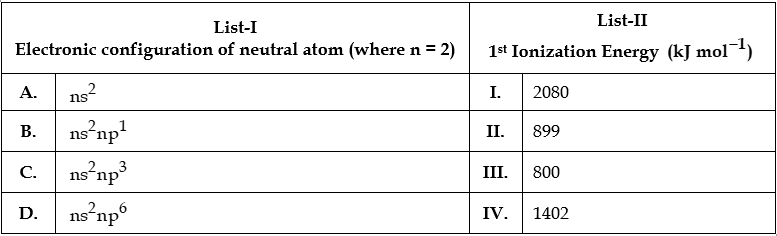
Match List-I with List-II.Choose the correct answer from the options given below:
Given below are two statements:Statement I: The second ionisation enthalpy of Na is larger than the corresponding ionisation enthalpy of Mg.Statement II: The ionic radius of \( \mathrm{O}^{2-} \) is larger than that of \( \mathrm{F}^{-} \).In the light of the above statements, choose the correct answer from the options given below
Given below are two statements: one is labelled as Assertion (A) and the other is labelled as Reason (R).Assertion (A): The first ionization enthalpy of aluminium is lower than that of magnesium.Reason (R): Ionic radius of aluminium cation is smaller than that of magnesium cation.In the light of above statements, choose the most appropriate answer from the options given below:
Which of the following arrangement order is not correct according to the property indicated against it?
In a period, the first ionisation enthalpy of the element at extreme left and the negative electron gain enthalpy of the extreme right element, except noble gases, are respectively.
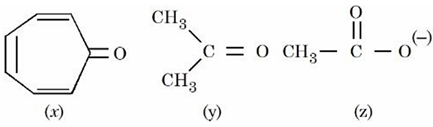
Consider the following molecules/species:The correct order of carbon - oxygen double bond length is:
If each orbital can take maximum of \( 3 \) electrons then the sum of number of orbitals and number of elements in \( 4^{\text{th}} \) period will be _______.
The 1st ionization enthalpy for \( \mathrm{Mg} \) is \( +737 \, \text{kJ/mol} \). The most probable estimated value of the 2nd ionization enthalpy of \( \mathrm{Mg} \) is __________.
Given below are two statements:Statement I: The second ionization enthalpy of \( \mathrm{B}, \mathrm{Al} \) and \( \mathrm{Ga} \) is in the order of \( \mathrm{B} > \mathrm{Al} > \mathrm{Ga} \).Statement II: The correct order in terms of first ionization enthalpy is \( \mathrm{Si} < \mathrm{Ge} < \mathrm{Pb} < \mathrm{Sn} \).In the light of the above statements, choose the correct answer from the options given below:
In period \( 4 \) of the periodic table, the elements with highest and lowest atomic radii are respectively.
Given below are two statements:Statement (I): The first ionization enthalpy of the elements Na, Mg, Cl and Ar follows the order \( \mathrm{Na > Mg > Cl > Ar} \).Statement (II): Among Ca, Al, Fe and B, the third ionization enthalpy is very high for Ca.In the light of the above statements, choose the correct answer from the options given below:
Which of the following pairs have highest electronegativity difference?
Which set lists only neutral oxides?
Given below are two statements:Statement I: \( \mathrm{K > Mg > Al > B} \) is the correct order in terms of metallic character.Statement II: Atomic radius is always greater than the ionic radius for any element.In the light of the above statements, choose the correct answer from the options given below:
In which of the following options, Hund’s rule and Aufbau rule are not followed?
Given below are two statements: Statement-I: The overall enthalpy change for \( \mathrm{O(g)} + 2e^{-} \rightarrow \mathrm{O^{2-}(g)} \) is negative. Statement-II: The first electron gain enthalpy of oxygen is negative while its second electron gain enthalpy is positive.
Given below are two statements:Statement I: The covalency of oxygen is generally two but it can exceed upto four. The oxidation state of oxygen in \( \mathrm{SO_2} \) is \( -2 \) and in \( \mathrm{OF_2} \), it is \( +2 \).Statement II: The anomalous behaviour of oxygen when compared to the other elements of group \( 16 \) is due to its small size and high electronegativity.In the light of the above statements, choose the correct answer from the options given below