24 questions from 2024
The density of ' \( x \) ' M solution (' \( x \) ' molar) of NaOH is \( 1.12 \, \text{g mL}^{-1} \), while in molality, the concentration of the solution is \( 3 \, \text{m} \) (\( 3 \) molal). Then \( x \) is (Given: Molar mass of NaOH is \( 40 \, \text{g /mol}^{} \))
Number of moles of \( \mathrm{H^+} \) ions required by \( 1 \) mole of \( \mathrm{MnO_4^-} \) to oxidise oxalate ion to \( \mathrm{CO_2} \) is ________.
Molarity \( (\text{M}) \) of an aqueous solution containing \( x \,\text{g} \) of anhyd. \( \text{CuSO}_4 \) in \( 500 \,\text{mL} \) solution at \( 32\,^{\circ}\text{C} \) is \( 2 \times 10^{-1} \,\text{M} \). Its molality will be ________ \( \times 10^{-3} \) m. (Nearest integer).[Given density of the solution \( = 1.25 \,\text{g/mL} \)]
The quantity which changes with temperature is:
\( 0.05 \, \text{cm} \) thick coating of silver is deposited on a plate of \( 0.05 \, \text{m}^{2} \) area. The number of silver atoms deposited on plate are __________ \( \times 10^{23} \). (At mass Ag \( = 108 \), \( d = 7.9 \, \text{g} \, \text{cm}^{-3} \) )
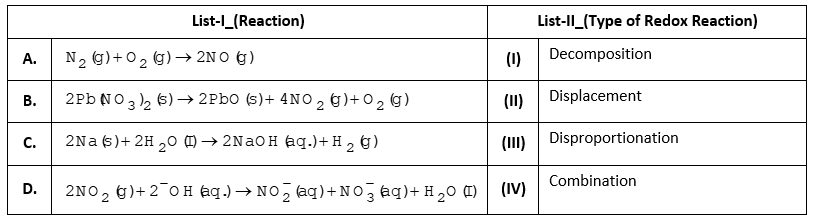
Match List-I with List-II.
Choose the correct answer from the options given below:
Molality of \( 0.8 \, \text{M} \, \mathrm{H_2SO_4} \) solution (density \( 1.06 \, \text{g cm}^{-3} \)) is ______ \( \times 10^{-3} \, \text{m} \).
\( 10 \, \text{mL} \) of gaseous hydrocarbon on combustion gives \( 40 \, \text{mL} \) of \( \text{CO}_2 (g) \) and \( 50 \, \text{mL} \) of water vapour. Total number of carbon and hydrogen atoms in the hydrocarbon is __________.
Given below are two statements:Statement I: \( \mathrm{S}_8 \) solid undergoes disproportionation reaction under alkaline conditions to form \( \mathrm{S}^{2-} \) and \( \mathrm{S}_2\mathrm{O}_3^{2-} \).Statement II: \( \mathrm{ClO}_4^{-} \) can undergo disproportionation reaction under acidic condition.In the light of the above statements, choose the most appropriate answer from the options given below:
A solution of \( \mathrm{H_2SO_4} \) is \( 31.4\% \) \( \mathrm{H_2SO_4} \) by mass and has a density of \( 1.25 \, \mathrm{g/mL} \). The molarity of the \( \mathrm{H_2SO_4} \) solution is __________ \( \mathrm{M} \) (nearest integer) [Given molar mass of \( \mathrm{H_2SO_4} = 98 \, \mathrm{g \, mol^{-1}} \) ]
The number of moles of methane required to produce \( 11 \, \text{g} \) \( \mathrm{CO_2(g)} \) after complete combustion is:(Given molar mass of methane in \( \mathrm{g \, mol^{-1}} : 16 \))
The mass of sodium acetate \( \mathrm{(CH_3COONa)} \) required to prepare \( 250 \, \text{mL} \) of \( 0.35 \, \text{M} \) aqueous solution is _______ \( \text{g} \). (Molar mass of \( \mathrm{CH_3COONa} \) is \( 82.02 \, \text{g} \, \text{mol}^{-1} \) )
A sample of \( \mathrm{CaCO_3} \) and \( \mathrm{MgCO_3} \) weighed \( 2.21 \, \text{g} \) is ignited to constant weight of \( 1.152 \, \text{g} \). The composition of mixture is:(Given molar mass in \( \text{g mol}^{-1} \) \( \mathrm{CaCO_3} : 100, \; \mathrm{MgCO_3} : 84 \))
Mass of methane required to produce \( 22 \, \text{g} \) of \( \mathrm{CO_2} \) after complete combustion is ________ \( \text{g} \). (Given Molar mass in \( \text{g mol}^{-1} \), \( \mathrm{C} = 12.0 \), \( \mathrm{H} = 1.0 \), \( \mathrm{O} = 16.0 \))
An organic compound has \( 42.1\% \) carbon, \( 6.4\% \) hydrogen and remainder is oxygen. If its molecular weight is \( 342 \), then its molecular formula is:
Molality \( (m) \) of \( 3 \, \mathrm{M} \) aqueous solution of \( \mathrm{NaCl} \) is:(Given: Density of solution \( = 1.25 \, \mathrm{g \, mL^{-1}} \), Molar mass in \( \mathrm{g \, mol^{-1}} \): \( \mathrm{Na\!-\!23, \, Cl\!-\!35.5} \))
The incorrect postulates of the Dalton’s atomic theory are:(A) Atoms of different elements differ in mass(B) Matter consists of divisible atoms(C) Compounds are formed when atoms of different element combine in a fixed ratio(D) All the atoms of given element have different properties including mass(E) Chemical reaction involve reorganisation of atomsChoose the correct answer from the options given below:
Volume of \( 3 \, \text{M} \) NaOH (formula weight \( 40 \, \text{g mol}^{-1} \)) which can be prepared from \( 84 \, \text{g} \) of NaOH is __________ × \( 10^{-1} \, \text{dm}^3 \).
The molarity of \( 1 \, \text{L} \) orthophosphoric acid \( (\mathrm{H_3PO_4}) \) having \( 70\% \) purity by weight (specific gravity \( 1.54 \, \text{g cm}^{-3} \)) is _______ \( \text{M} \).(Molar mass of \( \mathrm{H_3PO_4} = 98 \, \text{g mol}^{-1} \))
If a substance ‘A’ dissolves in solution of a mixture of ‘B’ and ‘C’ with their respective number of moles as \( n_A \), \( n_B \) and \( n_C \), Mole fraction of C in the solution is:
The Molarity \( (M) \) of an aqueous solution containing \( 5.85 \, \mathrm{g} \) of \( \mathrm{NaCl} \) in \( 500 \, \mathrm{mL} \) water is: (Given: Molar Mass Na : \( 23 \) and Cl : \( 35.5 \, \mathrm{g \, mol^{-1}} \) )
Molality of an aqueous solution of urea is \( 4.44 \, \text{m} \). Mole fraction of urea in solution is \( x \times 10^{-3} \). Value of \( x \) is _____________. (Integer answer)
Combustion of glucose \( (\mathrm{C_6H_{12}O_6}) \) produces \( \mathrm{CO_2} \) and water. The amount of oxygen (in \( \mathrm{g} \)) required for the complete combustion of \( 900 \) \( \mathrm{g} \) of glucose is: [Molar mass of glucose in \( \mathrm{g\,mol^{-1}} \) = \( 180 \)]
Consider the following reaction: \( 3\mathrm{PbCl_2} + 2(\mathrm{NH_4})_3\mathrm{PO_4} \rightarrow \mathrm{Pb_3(PO_4)_2} + 6\mathrm{NH_4Cl} \) If \( 72 \) mmol of \( \mathrm{PbCl_2} \) is mixed with \( 50 \) mmol of \( (\mathrm{NH_4})_3\mathrm{PO_4} \), then the amount of \( \mathrm{Pb_3(PO_4)_2} \) formed is ______ mmol. (Nearest integer)