17 questions from 2021
The compound statement \( (p \lor Q) \land (\sim p) \Rightarrow Q \) is equivalent to:
The statement \( (p \land (p \to q) \land (q \to r)) \to r \) is:
The negation of the statement \( \sim p \land (p \lor q) \) is:
If the Boolean expression \( (p \Rightarrow q) \Leftrightarrow \big(q^* (\sim p)\big) \) is a tautology, then the Boolean expression \( p^* (\sim q) \) is equivalent to:
For the statements \( p \) and \( q \), consider the following compound statements: (a) \( (\sim q \land (p \to q)) \to \sim p \) (b) \( ((p \lor q) \land \sim p) \to q \) Then which of the following statements is correct?
Which of the following is the negation of the statement “for all \( M>0 \), there exists \( x\in S \) such that \( x\ge M \)”?
Consider the statement "The match will he played only if the weather is good and ground is not wet". Select the correct negation from the following:
Consider the two statements:\( \text{(S1)}: (p \to q) \vee (\sim q \to p) \) is a tautology.\( \text{(S2)}: (p \wedge \sim q) \wedge (\sim p \vee q) \) is a fallacy.Then:
If \( P \) and \( Q \) are two statements, then which of the following compound statement is a tautology?
If the truth value of the Boolean expression $((p \vee q) \wedge (q \rightarrow r) \wedge (\sim r)) \rightarrow (p \wedge q)$ is false, then the truth values of the statements $p, q, r$ respectively can be:
Consider the following three statements:(A) If \( 3+3=7 \) then \( 4+3=8 \).(B) If \( 5+3=8 \) then earth is flat.(C) If both (A) and (B) are true then \( 5+6=17 \).Then, which of the following statements is correct?
The Boolean expression \( (p \land q) \Rightarrow \big((r \land q) \land p\big) \) is equivalent to:
The Boolean expression \( (p \land \sim q) \Rightarrow (q \lor \sim p) \) is equivalent to:
Which of the following Boolean expressions is not a tautology?
Which of the following is equivalent to the Boolean expression \( p \land \sim q \)?
Negation of the statement \( (p \lor r) \Rightarrow (q \lor r) \) is:
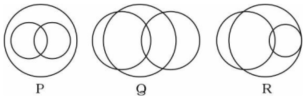
In a school, there are three types of games to be played. Some of the students play two types of games, but none play all the three games. Which Venn diagrams can justify the above statement?