Let the sum of two positive integers be \( 24 \). If the probability, that their product is not less than \( \frac{3}{4} \) times their greatest possible product, is \( \frac{m}{n} \), where \( \gcd(m,n) = 1 \), then \( n - m \) equals:
\( 8 \)
\( 9 \)
\( 10 \)
\( 11 \)
Three balls are drawn at random from a bag containing \( 5 \) blue and \( 4 \) yellow balls. Let the random variables \( X \) and \( Y \) respectively denote the number of blue and yellow balls. If \( \overline{X} \) and \( \overline{Y} \) are the means of \( X \) and \( Y \) respectively, then \( 7\overline{X} + 4\overline{Y} \) is equal to _______.
A company has two plants \( A \) and \( B \) to manufacture motorcycles. 60% motorcycles are manufactured at plant \( A \) and the remaining are manufactured at plant \( B \). 80% of the motorcycle manufactured at plant \( A \) are rated of the standard quality, while 90% of the motorcycles manufactured at plant \( B \) are rated of the standard quality. A motorcycle picked up randomly from the total production is found to be of the standard quality. If \( p \) is the probability that it was manufactured at plant \( B \), then \( 126p \) is:
Three rotten apples are accidently mixed with fifteen good apples. Assuming the random variable \( x \) to be the number of rotten apples in a draw of two apples, the variance of \( x \) is:
In a tournament, a team plays \( 10 \) matches with probabilities of winning and losing each match as \( \tfrac{1}{3} \) and \( \tfrac{2}{3} \) respectively. Let \( x \) be the number of matches that the team wins, and \( y \) be the number of matches that team loses. If the probability \( P(|x-y|\le 2) \) is p , then \( 3^{9}p \) equals __________.
There are three bags \( X \), \( Y \) and \( Z \). Bag \( X \) contains \( 5 \) one–rupee coins and \( 4 \) five-rupee coins; Bag \( Y \) contains \( 4 \) one-rupee coins and \( 5 \) five-rupee coins and Bag \( Z \) contains \( 3 \) one-rupee coins and \( 6 \) five-rupee coins. A bag is selected at random and a coin drawn from it at random is found to be a one-rupee coin. Then the probability, that it came from bag \( Y \), is:
If three letters can be posted to any one of the \( 5 \) different addresses, then the probability that the three letters are posted to exactly two addresses is:
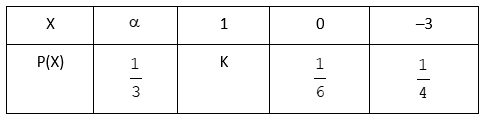
Let the mean and the standard deviation of the probability distribution
be \( \mu \) and \( \sigma \), respectively. If \( \sigma - \mu = 2 \), then \( \sigma + \mu \) is equal to \( \_\_\_\_\_\_\_ \).
An urn contains \( 6 \) white and \( 9 \) black balls. Two successive draws of \( 4 \) balls are made without replacement. The probability, that the first draw gives all white balls and the second draw gives all black balls, is:
A bag contains \( 8 \) balls, whose colours are either white or black. \( 4 \) balls are drawn at random without replacement and it was found that \( 2 \) balls are white and other \( 2 \) balls are black. The probability that the bag contains equal number of white and black balls is:
Three urns \( A \), \( B \) and \( C \) contain \( 7 \) red, \( 5 \) black; \( 5 \) red, \( 7 \) black and \( 6 \) red, \( 6 \) black balls, respectively. One of the urn is selected at random and a ball is drawn from it. If the ball drawn is black, then the probability that it is drawn from urn \( A \) is:
The coefficients \( a,b,c \) in the quadratic equation \( ax^2 + bx + c = 0 \) are chosen from the set \( \{1,2,3,4,5,6,7,8\} \). The probability of this equation having repeated roots is:
Two integers \( x \) and \( y \) are chosen with replacement from the set \( \{ 0, 1, 2, 3, \ldots, 10 \} \). Then the probability that \( |x - y| > 5 \), is:
Let \( a \), \( b \) and \( c \) denote the outcome of three independent rolls of a fair tetrahedral die, whose four faces are marked \( 1 \), \( 2 \), \( 3 \), \( 4 \). If the probability that \( ax^2 + bx + c = 0 \) has all real roots is \( \frac{m}{n} \), \( \gcd(m,n) = 1 \), then \( m + n \) is equal to ________.
A fair die is tossed repeatedly until a six is obtained. Let \( X \) denote the number of tosses required and let \( a = P(X = 3) \), \( b = P(X \ge 3) \) and \( c = P(X \ge 6 \mid X > 3) \). Then \( \frac{b + c}{a} \) is equal to __________.
A coin is biased so that a head is twice as likely to occur as a tail. If the coin is tossed \( 3 \) times, then the probability of getting two tails and one head is:
Let Ajay will not appear in JEE exam with probability \( p = \dfrac{2}{7} \), while both Ajay and Vijay will appear in the exam with probability \( q = \dfrac{1}{5} \). Then the probability, that Ajay will appear in the exam and Vijay will appear is: