The lowest integer which is greater than \( \left( 1 + \dfrac{1}{10^{100}} \right)^{10^{100}} \) is ______.
\( 2 \)
\( 1 \)
\( 3 \)
\( 4 \)
Let \( (1 + x + 2x^2)^{20} = a_0 + a_1 x + a_2 x^2 + \ldots + a_{40}x^{40} \). Then, \( a_1 + a_3 + a_5 + \ldots + a_{37} \) is equal to:
$\displaystyle \sum_{k=0}^{20} ({}^{20}C_k)^2$ is equal to:
Let \( n \in \mathbb{N} \) and \( [ x ] \) denote the greatest integer less than or equal to \( x \). If the sum of \( (n+1) \) terms \( \, {^{n}C_{0}},\, 3\cdot {^{n}C_{1}},\, 5\cdot {^{n}C_{2}},\, 7\cdot {^{n}C_{3}}, \ldots \\, \) is equal to \( 2^{100}\cdot 101 \), then \( 2\left[ \dfrac{n-1}{2} \right] \) is equal to _______.
\( 3 \times 7^{22} + 2 \times 10^{22} - 44 \) when divided by \( 18 \) leaves the remainder ________.
If the sum of the coefficients in the expansion of \( (x + y)^n \) is \( 4096 \), then the greatest coefficient in the expansion is:
A possible value of '\(x\)' for which the ninth term in the expansion of in the increasing powers of \( 3^{\left(-\dfrac{1}{8}\right)\log_{3}\!\left(5^{x-1}+1\right)} \) is equal to \( 180 \), is:
If the greatest value of the term independent of ‘\( x \)’ in the expansion of \( \left(x{\sin \alpha + a}+\dfrac{\cos \alpha}{x}\right)^{10} \) is \( \dfrac{10!}{(5!)^2} \), then the value of ‘\( a \)’ is equal to:
The number of rational terms in the binomial expansion of \( \displaystyle \left( 4^{\dfrac{1}{4}} + 5^{\dfrac{1}{6}} \right)^{120} \) is ________.
The ratio of the coefficient of the middle term in the expansion of \( (1+x)^{20} \) and the sum of the coefficients of two middle terms in expansion of \( (1+x)^{19} \) is:
For the natural numbers \( m,n \), if \( (1-y)^{m}(1+y)^{n}=1+a_{1}y+a_{2}y^{2}+\ldots +a_{m+n}y^{\,m+n} \) and \( a_{1}=a_{2}=10 \), then the value of \( m+n \) is equal to:
If the fourth term in the expansion of \( (x + x^{\log_{2} x})^{7} \) is \( 4480 \), then the value of \( x \) where \( x \in \mathbb{N} \) is equal to:
Let \( n \) be a positive integer. Let \( A=\displaystyle\sum_{k=0}^{n}(-1)^k \,{{}^n C_ k}\left[\left(\dfrac{1}{2}\right)^k+\left(\dfrac{3}{4}\right)^k+\left(\dfrac{7}{8}\right)^k+\left(\dfrac{15}{16}\right)^k+\left(\dfrac{31}{32}\right)^k\right] \). If \( 63A=1-\dfrac{1}{2^{30}} \), then \( n \) is equal to ____________.
The coefficient of \( x^{256} \) in the expansion of \( (1-x)^{101}\left(x^{2}+x+1\right)^{100} \) is:
If the coefficient of \( x^7 \) in \( \left(x^2 + \dfrac{1}{bx}\right)^{11} \) and \( x^{-7} \) in \( \left(x - \dfrac{1}{bx^2}\right)^{11} \), \( b \neq 0 \), are equal, then the value of \( b \) is equal to:
The term independent of ' \( x \) ' in the expansion of \( \left( \dfrac{x+1}{x^{2/3}-x^{1/3}+1}-\dfrac{x-1}{x-x^{1/2}} \right)^{10} \), where \( x \neq 0,1 \) is equal to __________ .
The sum of all those terms which are rational numbers in the expansion of \( \left(2^{1/3} + 3^{1/4}\right)^{12} \) is:
If \( b \) is very small as compared to the value of \( a \), so that the cube and other higher powers of \( \dfrac{b}{a} \) can be neglected in the identify\( \dfrac{1}{a-b} + \dfrac{1}{a-2b} + \dfrac{1}{a-3b} + \ldots + \dfrac{1}{a-nb} = \alpha n + \beta n^2 + \gamma n^3 \), then the value of \( \gamma \) is:
If \( n \ge 2 \) is a positive integer, then the sum of the series \( {}^{n+1}C_{2}+2({}^{2}C_{2}+{}^{3}C_{2}+{}^{4}C_{2}+\cdots+{}^{n}C_{2}) \) is:
If \( (2021)^{3762} \) is divided by \( 17 \), then the remainder is______________.
and $A_4 - A_3 = 190p$, then $p$ is equal to ________.

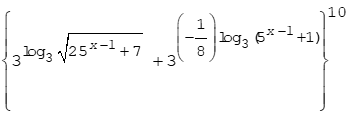 in the increasing powers of \( 3^{\left(-\dfrac{1}{8}\right)\log_{3}\!\left(5^{x-1}+1\right)} \) is equal to \( 180 \), is:

