Let $S = \{z : 3 \le |2z - 3(1 + i)| \le 7\}$ be a set of complex numbers. Then $\min_{z \in S} \left| (z + \frac{1}{2}(5 + 3i)) \right|$ is equal to:
Let \( \alpha \) and \( \beta \) respectively be the maximum and the minimum values of the function \( f(\theta) = 4\left[\sin^{4}\!\left(\frac{7\pi}{2}-\theta\right) + \sin^{4}(11\pi+\theta)\right] - 2\left[\sin^{6}\!\left(\frac{3\pi}{2}-\theta\right) + \sin^{6}(9\pi-\theta)\right],\ \theta \in \mathbb{R}. \) Then \( \alpha + 2\beta \) is equal to:
Let \( \vec{a} = -\vec{i} + \vec{j} + 2\vec{k},\ \vec{b} = \vec{i} - \vec{j} - 3\vec{k},\ \vec{c} = \vec{a} \times \vec{b} \) and \( \vec{d} = \vec{c} \times \vec{a}. \) Then \( (\vec{a} - \vec{b}) \cdot \vec{d} \) is equal to:
Let the mean and variance of \( 8 \) numbers \( -10, -7, -1, x, y, 9, 2, 16 \) be \( \frac{7}{2} \) and \( \frac{293}{4} \), respectively. Then the mean of \( 4 \) numbers \( x, y, x + y + 1, |x - y| \) is:
Let the domain of the function \( f(x) = \log_{3}\!\big(\log_{5}\!\big(\log_{7}(9x - x^{2} - 13)\big)\big) \) be the interval \( (m, n) \). Let the hyperbola \( \frac{x^{2}}{a^{2}} - \frac{y^{2}}{b^{2}} = 1 \) have eccentricity \( \frac{n}{3} \) and the length of the latus rectum \( \frac{8m}{3} \). Then \( b^{2} - a^{2} \) is equal to:
Among the statements:then \( \cos^{2}\alpha + \cos^{2}\beta + \cos^{2}\gamma = \frac{3}{2} \) and then \( p^{2} = 196q^{2} \).
The value of \( \frac{{}^{100}C_{50}}{51} + \frac{{}^{100}C_{51}}{52} + \ldots + \frac{{}^{100}C_{100}}{101} \) is:
Let the line \( y - x = 1 \) intersect the ellipse \( \frac{x^{2}}{2} + \frac{y^{2}}{1} = 1 \) at the points \( A \) and \( B \). Then the angle made by the line segment \( AB \) at the center of the ellipse is:
Let \( A = \{-2,\ -1,\ 0,\ 1,\ 2,\ 3,\ 4\} \). Let \( R \) be a relation on \( A \) defined by \( xRy \) if and only if \( 2x + y \leq 2 \). Let \( l \) be the number of elements in \( R \). Let \( m \) and \( n \) be the minimum number of elements required to be added in \( R \) to make it reflexive and symmetric relations respectively. Then \( l + m + n \) is equal to:
If \( \alpha \) and \( \beta (\alpha < \beta) \) are the roots of the equation \( (-2 + \sqrt{3})\lvert \sqrt{x} - 3 \rvert + (x - 6\sqrt{x}) + (9 - 2\sqrt{3}) = 0, \ \ x \ge 0 \), then \( \sqrt{\frac{\beta}{\alpha}} + \sqrt{\alpha \beta} \) is equal to:
Number of solutions of \( \sqrt{3}\cos 2\theta + 8\cos \theta + 3\sqrt{3} = 0, \ \theta \in [-3\pi, 2\pi] \) is:
Let \( y = y(x) \) be the solution of the differential equation \( x^4 \, dy + \left(4x^3 y + 2 \sin x\right) \, dx = 0 \), \( x > 0 \), \( y\!\left(\frac{\pi}{2}\right) = 0 \). Then \( \pi^4 \, y\!\left(\frac{\pi}{3}\right) \) is equal to:
The vertices \( B \) and \( C \) of a triangle \( ABC \) lie on the line \( \dfrac{x}{1} = \dfrac{1 - y}{-2} = \dfrac{z - 2}{3} \). The coordinates of \( A \) and \( B \) are \( (1, 6, 3) \) and \( (4, 9, \alpha) \) respectively and \( C \) is at a distance of \( 10 \) units from \( B \). The area (in sq. units) of \( \triangle ABC \) is:
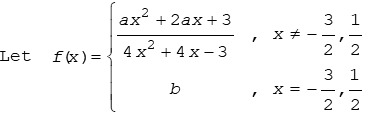
be continuous at \( x = -\dfrac{3}{2} \). If \( f of (x) = \dfrac{7}{5} \), then \( x \) is equal to:
The value of the integral \( \displaystyle \int_{\frac{\pi}{24}}^{\frac{5\pi}{24}} \frac{dx}{1 + \sqrt[3]{\tan 2x}} \) is:
A building construction work can be completed by two masons \( A \) and \( B \) together in \( 22.5 \, \text{days} \). Mason \( A \) alone can complete the construction work in \( 24 \, \text{days} \) less than mason \( B \) alone. Then mason \( A \) alone will complete the construction work in:
The sum of all possible values of \( n \in \mathbb{N} \), so that the coefficients of \( x \), \( x^{2} \) and \( x^{3} \) in the expansion of \( (1 + x^{2})(1 + x)^{n} \), are in arithmetic progression is:
Let \( f(x) = \int \frac{(2 - x^2)e^x}{\sqrt{1 + x}(1 - x)^{3/2}} \, dx \). If \( f(0) = 0 \), then \( f\!\left(\frac{1}{2}\right) \) is equal to:
Let the direction cosines of two lines satisfy the equations: \( 4l + m - n = 0 \) and \( 2mn + 10nl + 3lm = 0 \). Then the cosine of the acute angle between these lines is:
A rectangle is formed by the lines \( x = 0 \), \( y = 0 \), \( x = 3 \) and \( y = 4 \). Let the line \( L \) be perpendicular to \( 3x + y + 6 = 0 \) and divide the area of the rectangle into two equal parts. Then the distance of the point \( \left(\frac{1}{2}, -5\right) \) from the line \( L \) is equal to:
From the first \( 100 \) natural numbers, two numbers first \( a \) and then \( b \) are selected randomly without replacement. If the probability that \( a - b \ge 10 \) is \( \frac{m}{n} \), \( \gcd(m, n) = 1 \), then \( m + n \) is equal to \( \_\_\_\_\_ \).
Let the area of the region bounded by the curve \( y = \max\{\sin x , \cos x\} \), lines \( x = 0 \), \( x = \frac{3\pi}{2} \), and the x-axis be \( A \). Then, \( A + A^2 \) is equal to \( \_\_\_\_\_ \).
Let \( |A| = 6 \), where \( A \) is a \( 3 \times 3 \) matrix. If \( \left|\operatorname{adj}\!\left(3\,\operatorname{adj}\!\left(A^{2}\cdot \operatorname{adj}(2A)\right)\right)\right| = 2^{m}\cdot 3^{n} \), \( m, n \in N \), then \( m+n \) is equal to ______.
Let \( f \) be a twice differentiable non-negative function such that \( (f(x))^{2} = 25 + \int_{0}^{x}\left((f(t))^{2} + (f'(t))^{2}\right)\,dt \). Then the mean of \( f(\log_{e}(1)),\ f(\log_{e}(2)),\ \ldots,\ f(\log_{e}(625)) \) is equal to ______.
The number of \( 4 \)-letter words, with or without meaning, which can be formed using the letters PQRPQRSTUVP, is ______.