Let \( A = \{ z \in C : 1 \le |z - (1 + i)| \le 2 \} \) and \( B = \{ z \in A : |z - (1 - i)| = 1 \} \). Then, \( B \) :
The remainder when \( 3^{2022} \) is divided by \( 5 \) is :
The surface area of a balloon of spherical shape being inflated, increases at a constant rate. If initially, the radius of balloon is \( 3 \) units and after \( 5 \) seconds, it becomes \( 7 \) units, then its radius after \( 9 \) seconds is :
Bag A contains \( 2 \) white, \( 1 \) black and \( 3 \) red balls and bag B contains \( 3 \) black, \( 2 \) red and \( n \) white balls. One bag is chosen at random and \( 2 \) balls drawn from it at random, are found to be \( 1 \) red and \( 1 \) black. If the probability that both balls come from Bag A is \( \frac{6}{11} \), then \( n \) is equal to ________.
Let \( x^{2} + y^{2} + Ax + By + C = 0 \) be a circle passing through \( (0, 6) \) and touching the parabola \( y = x^{2} \) at \( (2, 4) \). Then \( A + C \) is equal to :
The number of values of \( \alpha \) for which the system of equations:\( x + y + z = \alpha \)\( \alpha x + 2\alpha y + 3z = -1 \)\( x + 3\alpha y + 5z = 4 \)is inconsistent, is
If the sum of the squares of the reciprocals of the roots \( \alpha \) and \( \beta \) of the equation \( 3x^{2} + \lambda x - 1 = 0 \) is \( 15 \), then \( 6(\alpha^{3} + \beta^{3})^{2} \) is equal to:
The set of all values of \( k \) for which \( (\tan^{-1}x)^{3} + (\cot^{-1}x)^{3} = k\pi^{3},\ x \in \mathbb{R} \), is the interval:
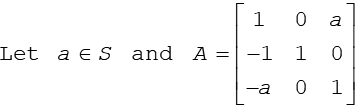
Let \( S = \{ \sqrt{n} : 1 \leq n \leq 50 \text{ and } n \text{ is odd} \} \). If \( \sum\limits_{a \in S} \det(\operatorname{adj} A) = 100\,\lambda \), then \( \lambda \) is equal to:
For the function \( f(x) = 4\log_e(x-1) - 2x^{2} + 4x + 5, \ x > 1 \), which one of the following is NOT correct?
If the tangent at the point \( (x_{1}, y_{1}) \) on the curve \( y = x^{3} + 3x^{2} + 5 \) passes through the origin, then \( (x_{1}, y_{1}) \) does NOT lie on the curve:
The sum of absolute maximum and absolute minimum values of the function \( f(x) = |2x^{2} + 3x - 2| + \sin x \cos x \) in the interval \( [0, 1] \) is:
If \( \{a_i\}_{i=1}^{n} \), where \( n \) is an even integer, is an arithmetic progression with common difference \( 1 \), and \(\displaystyle \sum_{i=1}^{n} a_i = 192 \), \(\displaystyle \sum_{i=1}^{n/2} a_{2i} = 120 \), then \( n \) is equal to:
If \( x = x(y) \) is the solution of the differential equation \( y\,\frac{dx}{dy} = 2x + y^3 (y+1) e^{y} \), \( x(1) = 0 \); then \( x(e) \) is equal to:
Let \( \lambda x - 2y = \mu \) be a tangent to the hyperbola \( a^{2}x^{2} - y^{2} = b^{2} \). Then \( \left( \frac{\lambda}{a} \right)^{2} - \left( \frac{\mu}{b} \right)^{2} \) is equal to:
Let \( \hat{a},\ \hat{b} \) be unit vectors. If \( \vec{c} \) be a vector such that the angle between \( \hat{a} \) and \( \vec{c} \) is \( \frac{\pi}{12} \), and \( \hat{b} = \vec{c} + 2(\vec{c} \times \hat{a}) \), then \( \lvert 6\,\vec{c} \rvert^{2} \) is equal to:
If a random variable \( X \) follows the Binomial distribution \( B(33,\ p) \) such that \( 3P(X=0) = P(X=1) \), then the value of \( \dfrac{P(X=15)}{P(X=18)} - \dfrac{P(X=16)}{P(X=17)} \) is equal to:
The domain of the function \( f(x) := \dfrac{\cos^{-1}\!\left( \dfrac{x^{2} - 5x + 6}{x^{2} - 9} \right)}{\log_{e}(x^{2} - 3x + 2)} \) is:
Let \( S = \left\{ \theta \in [-\pi, \pi] - \left\{ \pm \frac{\pi}{2} \right\} : \sin \theta \tan \theta + \tan \theta = \sin 2\theta \right\} \). If \( T = \ \displaystyle \sum_{\theta \in S} \cos 2\theta \), then \( T + n(S) \) is equal to:
The number of choices for $\Delta \in \{\wedge, \vee, \Rightarrow, \Leftrightarrow\}$, such that $(p \Delta q) \Rightarrow ((p \Delta \sim q) \vee ((\sim p) \Delta q))$ is a tautology, is:
The number of one-one functions \( f : \{a, b, c, d\} \to \{0, 1, 2, \ldots, 10\} \) such that \( 2f(a) - f(b) + 3f(c) + f(d) = 0 \) is ________.
In an examination, there are \( 5 \) multiple choice questions with \( 3 \) choices, out of which exactly one is correct. There are \( 3 \) marks for each correct answer, \( -2 \) marks for each wrong answer and \( 0 \) mark if the question is not attempted. Then, the number of ways a student appearing in the examination gets \( 5 \) marks is _________.
Let \( A\!\left(\dfrac{3}{\sqrt{a}}, \sqrt{a}\right) \), \( a>0 \), be a fixed point in the \( xy \)-plane. The image of \( A \) in \( y \)-axis be \( B \) and the image of \( B \) in \( x \)-axis be \( C \). If \( D(3\cos \theta, a \sin \theta) \) is a point in the fourth quadrant such that the maximum area of \( \triangle ACD \) is \( 12 \) square units, then \( a \) is equal to _________.
Let a line having direction ratios \( 1, -4, 2 \) intersect the lines \( \dfrac{x-7}{3} = \dfrac{y-1}{-1} = \dfrac{z+2}{1} \) and \( \dfrac{x}{2} = \dfrac{y-7}{3} = \dfrac{z}{1} \) at the point A and B. Then \( (AB)^2 \) is equal to ______________.
The number of points where the function\([t]\) denotes the greatest integer \( \le t \), is discontinuous is ____________.
Let \( f(\theta) = \sin \theta + \displaystyle \int_{-\pi/2}^{\pi/2} (\sin \theta + t \cos \theta)\, f(t)\, dt \). Then the value of \( \left| \displaystyle \int_{0}^{\pi/2} f(\theta)\, d\theta \right| \) is ____________.
Let $\displaystyle \max_{0 \le x \le 2} \left\{ \frac{9-x^2}{5-x} \right\} = \alpha$ and $\displaystyle \min_{0 \le x \le 2} \left\{ \frac{9-x^2}{5-x} \right\} = \beta$.If $\int_{\beta - \frac{8}{3}}^{2\alpha - 1} max \left\{ \frac{9-x^2}{5-x}, x \right\} dx = \alpha_1 + \alpha_2 \log_e \left( \frac{8}{15} \right)$ then $\alpha_1 + \alpha_2$ is equal to __________.
If two tangents drawn from a point \( (\alpha, \beta) \) lying on the ellipse \( 25x^{2} + 4y^{2} = 1 \) to the parabola \( y^{2} = 4x \) are such that the slope of one tangent is four times the other, then the value of \( (10\alpha + 5)^{2} + (16\beta^{2} + 50)^{2} \) equals ________________.
Let \( S \) be the region bounded by the curves \( y = x^{3} \) and \( y^{2} = x \). The curve \( y = 2|x| \) divides \( S \) into two regions of areas \( R_{1} \) and \( R_{2} \). If \( \max\{R_{1}, R_{2}\} = R_{2} \), then \( \dfrac{R_{2}}{R_{1}} \) is equal to ______________.
If the shortest distance between the lines $\vec{r} = (-\hat{i} + 3\hat{k}) + \lambda(\hat{i} - a\hat{j})$ and $\vec{r} = (-\hat{j} + 2\hat{k}) + \mu(\hat{i} - \hat{j} + \hat{k})$ is $\sqrt{\frac{2}{3}}$, then the integral value of $a$ is equal to __________.