Let \( R \) be a relation from the set \( \{1,2,3,\ldots,60\} \) to itself such that \( R=\{(a,b): b=pq \text{ , where } p,q\ge 3 \text{ are prime numbers}\} \). Then, the number of elements in \( R \) is:
If \( z=2+3i \), then \( z^{5}+(\overline{z})^{5} \) is equal to:
Let \( A \) and \( B \) be two \( 3\times 3 \) non-zero real matrices such that \( AB \) is a zero matrix. Then.
If \( \dfrac{1}{(20-a)(40-a)}+\dfrac{1}{(40-a)(60-a)}+\ldots+\dfrac{1}{(180-a)(200-a)}=\dfrac{1}{256} \), then the maximum value of \( a \) is:
If \( \displaystyle \lim_{x\to 0}\dfrac{\alpha e^{x}+\beta e^{-x}+\gamma \sin x}{x\sin^{2}x}=\dfrac{2}{3} \), where \( \alpha,\beta,\gamma\in \mathbb{R} \), then which of the following is NOT correct?
The integral \(\displaystyle \int\limits_{0}^{\dfrac{\pi}{2}} \frac{1}{3 + 2\sin x + \cos x} \, dx \) is equal to:
Let the solution curve \( y=y(x) \) of the differential equation \( (1+e^{2x})\!\left(\dfrac{dy}{dx}+y\right)=1 \) pass through the point \( \left(0,\dfrac{\pi}{2}\right) \). Then, \( \displaystyle\lim_{x\to \infty} e^{x}y(x) \) is equal to:
Let a line \( L \) pass through the point of intersection of the lines \( bx+10y-8=0 \) and \( 2x-3y=0, \, b\in \mathbb{R}-\left\{ \dfrac{4}{3} \right\} \). If the line \( L \) also passes through the point \( (1,1) \) and touches the circle \( 17(x^{2}+y^{2})=16 \), then the eccentricity of the ellipse \( \dfrac{x^{2}}{5}+\dfrac{y^{2}}{b^{2}}=1 \) is:
If the foot of the perpendicular from the point \( A(-1,4,3) \) on the plane \( P: 2x+my+nz=4 \) is \( \left(-2,\dfrac{7}{2},\dfrac{3}{2}\right) \), then the distance of the point \( A \) from the plane \( P \), measured parallel to a line with direction ratios \( 3,-1,-4 \), is equal to:
Let \( \vec{a}=3\hat{i}+\hat{j} \) and \( \vec{b}=\hat{i}+2\hat{j}+\hat{k} \). Let \( \vec{c} \) be a vector satisfying \( \vec{a}\times (\vec{b}\times \vec{c})=\vec{b}+\lambda \vec{c} \). If \( \vec{b} \) and \( \vec{c} \) are non-parallel, then the value of \( \lambda \) is:
The angle of elevation of the top of a tower from a point \( A \) due north of it is \( \alpha \) and from a point \( B \) at a distance of \( 9 \) units due west of \( A \) is \( \cos^{-1}\!\left(\dfrac{3}{\sqrt{13}}\right) \). If the distance of the point \( B \) from the tower is \( 15 \) units, then \( \cot \alpha \) is equal to:
The statement \( (p \land q) \Rightarrow (p \land r) \) is equivalent to:
Let the circumcentre of a triangle with vertices \( A(a,3) \), \( B(b,5) \) and \( C(a,b) \), \( ab > 0 \) be \( P(1,1) \). If the line \( AP \) intersects the line \( BC \) at the point \( Q(k_1,k_2) \), then \( k_1 + k_2 \) is equal to:
Let \( \hat{a} \) and \( \hat{b} \) be two unit vectors such that the angle between them is \( \dfrac{\pi}{4} \). If \( \theta \) is the angel between the vectors \( (\hat{a}+\hat{b}) \) and \( (\hat{a}+2\hat{b}+2(\hat{a}\times\hat{b})) \), then the value of \( 164\cos^{2}\theta \) is equal to:
\( f(\alpha)=\displaystyle\int\limits_{1}^{\alpha}\frac{\log_{10} t}{1+t}\,dt, \ \alpha>0 \) If , then \( f(e^{3})+f(e^{-3}) \) is equal to:
The area of the region \( \{(x,y): |x-1| \le y \le \sqrt{5-x^2}\} \) is equal to:
Let the focal chord of the parabola \(P: y^{2}=4x\) along the line \(L: y=mx+c,\, m>0\) meet the parabola at the points \(M\) and \(N\). Let the line \(L\) be a tangent to the hyperbola \(H: x^{2}-y^{2}=4\). If \(O\) is the vertex of \(P\) and \(F\) is the focus of \(H\) on the positive \(x\)-axis, then the area of the quadrilateral \(OMFN\) is:
The number of points, where the function \(f:\mathbb{R}\to\mathbb{R}\), \( f(x)=|x-1|\cos|x-2|\sin|x-1|+(x-3)|x^{2}-5x+4| \), is NOT differentiable, is:
Let \( S=\{1,2,3,\ldots,2022\} \). Then the probability, that a randomly chosen number \(n\) from the set \(S\) such that \(\mathrm{HCF}(n,2022)=1\), is:
Let \( f(x)=3^{(x^2-2)^3+4}, \; x \in R \). Then which of the following statements are true?\( P:\; x=0 \) is a point of local minima of \( f \)\( Q:\; x=\sqrt{2} \) is a point of inflection of \( f \)\( R:\; f' \) is increasing for \( x>\sqrt{2} \)
Let \( S=\{ \theta \in (0,2\pi): 7\cos^2\theta-3\sin^2\theta-2\cos^2 2\theta=2 \} \). Then, the sum of roots of all the equations \( x^2-2(\tan^2\theta+\cot^2\theta)x+6\sin^2\theta=0,\;\theta\in S \), is _________.
Let the mean and the variance of \( 20 \) observations \( x_1,x_2,\ldots,x_{20} \) be \( 15 \) and \( 9 \), respectively. For \( \alpha \in R \), if the mean of \( (x_1+\alpha)^2,(x_2+\alpha)^2,\ldots,(x_{20}+\alpha)^2 \) is \( 178 \), then the square of maximum value of \( \alpha \) is equal to _________.
Let a line with direction ratios \( a,-4a,-7 \) be perpendicular to the lines with direction ratios \( 3,-1,2b \) and \( b,a,-2 \). If the point of intersection of the line \(\displaystyle \frac{x+1}{a^2+b^2}=\frac{y-2}{a^2-b^2}=\frac{z}{1} \) and the plane \( x-y+z=0 \) is \( (\alpha,\beta,\gamma) \), then \( \alpha+\beta+\gamma \) is equal to __________.
Let \( a_1,a_2,a_3,\ldots \) be an A.P. If \(\displaystyle \sum_{r=1}^{\infty}\frac{a_r}{2^r}=4 \), then \( 4a_2 \) is equal to __________.
Let the ratio of the fifth term from the beginning to the fifth term from the end in the binomial expansion of \( \left(\sqrt[4]{2}+\dfrac{1}{\sqrt[4]{3}}\right)^n \), in the increasing powers of \( \dfrac{1}{\sqrt[4]{3}} \) be \( \sqrt[4]{6}:1 \). If the sixth term from the beginning is \( \dfrac{\alpha}{\sqrt[4]{3}} \), then \( \alpha \) is equal to __________.
The number of matrices of order \( 3 \times 3 \), whose entries are either \( 0 \) or \( 1 \) and the sum of all the entries is a prime number, is__________.
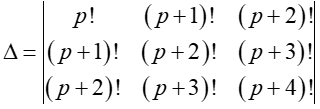
Let \( p \) and \( p+2 \) be prime number and letThen the sum of the maximum values of \( \alpha \) and \( \beta \), such that \( p^{\alpha} \) and \( (p+2)^{\beta} \) divide \( \Delta \), is__________.
If \(\displaystyle \frac{1}{2 \times 3 \times 4} + \frac{1}{3 \times 4 \times 5} + \frac{1}{4 \times 5 \times 6} + \ldots + \frac{1}{100 \times 101 \times 102} = \frac{k}{101} \), then \( 34k \) is equal to__________.
Let \( S=\{4,6,9\} \) and \( T=\{9,10,11,\ldots,1000\} \). If \( A=\{ a_1+a_2+\ldots+a_k : k\in \mathbb{N}, a_1,a_2,a_3,\ldots,a_k\in S \} \), then the sum of all the elements in the set \( T-A \) is equal to__________.
Let the mirror image of a circle \( c_1:x^2+y^2-2x-6y+\alpha=0 \) in line \( y=x+1 \) be \( c_2:5x^2+5y^2+10gx+10fy+38=0 \). If \( r \) is the radius of circle \( c_2 \), then \( \alpha+6r^2 \) is equal to__________.