If \( z \neq 0 \) be a complex number such that \( \left| z - \dfrac{1}{z} \right| = 2 \), then the maximum value of \( |z| \) is
Which of the following matrices can NOT be obtained from the matrix \(\displaystyle \begin{bmatrix} -1 & 2 \\ 1 & -1 \end{bmatrix} \)by a single elementary row operation?
If the system of equations\( x+y+z = 6 \) \( 2x+5y+a z = \beta \) \( x+2y+3z = 14 \) has infinitely many solutions, then \( \alpha + \beta \) is equal to
Let the function be continuous at \( x=0 \). Then \( \alpha \) is equal to
If \( [t] \) denotes the greatest integer \( \le t \), then the value of \( \displaystyle \int_{0}^{1}\!\Big[\,2x-\big|3x^2-5x+2\big|+1\,\Big]\,dx \) is:
Let \( \displaystyle \{a_n\}_{n=0}^\infty \) be a sequence such that \( a_0=a_1=0 \) and \( a_{n+2}=3a_{n+1}-2a_n+1, \; \forall\, n\ge 0 \). Then \( a_{25}a_{23}-2a_{25}a_{22}-2a_{23}a_{24}+4a_{22}a_{24} \) is equal to
\(\displaystyle \sum_{r=1}^{20} (r^2 + 1)(r!) \) is equal to
For \( I(x)=\displaystyle \int \frac{\sec^2 x-2022}{\sin^{2022}x}\,dx \), if \( I\!\left(\dfrac{\pi}{4}\right)=2^{1011} \), then
If the solution curve of the differential equation \( \dfrac{dy}{dx}=\dfrac{x+y-2}{x-y} \) passes through the points \( (2,1) \) and \( (k+1,2) \), \( k>0 \), then
Let \( y=y(x) \) be the solution curve of the differential equation \( \dfrac{dy}{dx}+\left(\dfrac{2x^2+11x+13}{x^3+6x^2+11x+6}\right)y=\dfrac{(x+3)}{x+1},\, x>-1, \) which passes through the point \( (0,1) \). The \( y(1) \) is equal to
Let \( m_1,m_2 \) be the slopes of two adjacent sides of a square of side \( a \) such that \( a^2+11a+3\!\left(m_1^2+m_2^2\right)=220 \). If one vertex of the square is \( \left(10(\cos\alpha-\sin\alpha),\,10(\sin\alpha+\cos\alpha)\right) \), where \( \alpha\in\!\left(0,\dfrac{\pi}{2}\right) \) and the equation of one diagonal is \( (\cos\alpha-\sin\alpha)x+(\sin\alpha+\cos\alpha)y=10 \), then \( 72(\sin^4\alpha+\cos^4\alpha)+a^2-3a+13 \) is equal to:
The number of elements in the set \( S = \left\{ x \in \mathbb{R} : 2\cos\!\left(\dfrac{x^2 + x}{6}\right) = 4^{x} + 4^{-x} \right\} \) is:
Let \( A(\alpha,-2), B(\alpha,6) \) and \( C\!\left(\dfrac{\alpha}{4},-2\right) \) be vertices of a \( \triangle ABC \). If \( \left(5,\dfrac{\alpha}{4}\right) \) is the circumcentre of \( \triangle ABC \), then which of the following is NOT correct about \( \triangle ABC \)?
Let \( Q \) be the foot of perpendicular drawn from the point \( P(1,2,3) \) to the plane \( x + 2y + z = 14 \). If \( R \) is a point on the plane such that \( \angle PRQ = 60^\circ \), then the area of \( \triangle PQR \) is equal to:
If \( (2,3,9), (5,2,1), (1,\lambda,8) \) and \( (\lambda,2,3) \) are coplanar, then the product of all possible values of \( \lambda \) is:
Bag \( I \) contains \( 3 \) red, \( 4 \) black and \( 3 \) white balls and Bag \( II \) contains \( 2 \) red, \( 5 \) black and \( 2 \) white balls. One ball is transferred from Bag \( I \) to Bag \( II \) and then a ball is drawn from Bag \( II \). The ball so drawn is found to be black in colour. Then the probability, that the transferred ball is red, is:
Let \( S = \{ z = x + iy : |z - 1 + i| \ge |z|, \; |z| < 2, \; |z + i| = |z - 1| \}\). Then the set of all values of \( x \), for which \( w = 2x + iy \in S \) for some \( y \in \mathbb{R} \), is
Let \( \vec{a}, \vec{b}, \vec{c} \) be three coplanar concurrent vectors such that angles between any two of them is same. If the product of their magnitudes is \( 14 \) and \( (\vec{a} \times \vec{b}) \cdot (\vec{b} \times \vec{c}) + (\vec{b} \times \vec{c}) \cdot (\vec{c} \times \vec{a}) + (\vec{c} \times \vec{a}) \cdot (\vec{a} \times \vec{b}) = 168 \), then \( |\vec{a}|+|\vec{b}|+|\vec{c}| \) is equal
The domain of the function \( f(x) = \sin^{-1}\!\left(\dfrac{x^{2}-3x+2}{x^{2}+2x+7}\right) \) is :
The statement \( (p \Rightarrow q) \vee (p \Rightarrow r) \) is NOT equivalent to
The sum and product of the mean and variance of a binomial distribution are \( 82\cdot 5 \) and \( 1350 \) respectively. Then the number of trials in the binomial distribution is __________.
Let \( \alpha, \beta (\alpha > \beta) \) be the roots of the quadratic equation \( x^{2}-x-4=0 \). If \( P_{n}=\alpha^{n}-\beta^{n}, \ n \in \mathbb{N} \), then \( \dfrac{P_{15}P_{16}-P_{14}P_{16}-P_{15}^{2}+P_{14}P_{15}}{P_{13}P_{14}} \) is equal to __________.
\(\displaystyle \text{Let } x = \begin{bmatrix} 1 \\ 1 \\ 1 \end{bmatrix} \text{ and } A = \begin{bmatrix} -1 & 2 & 3 \\ 0 & 1 & 6 \\ 0 & 0 & -1 \end{bmatrix}\). For \( k \in \mathbb{N} \), if \( X' A^{k} X = 33 \), then \( k \) is equal to __________.
The number of natural numbers lying between \( 1012 \) and \( 23421 \) that can be formed using the digits \( 2, 3, 4, 5, 6 \) (repetition of digits is not allowed) and divisible by \( 55 \) is ________.
If \( \displaystyle \sum_{k=1}^{10} K^{2}\left({10}_{C_{K}}\right)^{2}=22000L \), then \( L \) is equal to ________.
If \( [t] \) denotes the greatest integer \( \le t \), then the number of points, at which the function \( f(x)=4|2x+3|+9\left[x+\dfrac{1}{2}\right]-12[x+20] \) is not differentiable in the open interval \( (-20,20) \), is ________.
If the tangent to the curve \( y=x^{3}-x^{2}+x \) at the point \( (a,b) \) is also tangent to the curve \( y=5x^{2}+2x-25 \) at the point \( (2,-1) \), then \( |2a+9b| \) is equal to ________.
Let \( AB \) be a chord of length \( 12 \) of the circle \( (x-2)^{2}+(y+1)^{2}=\dfrac{169}{4} \). If tangents drawn to the circle at point \( A \) and \( B \) intersect at the point \( P \), then five times the distance of point \( P \) from chord \( AB \) is equal to ________.
Let \( \vec{a} \) and \( \vec{b} \) be two vectors such that \(|\vec{a}+\vec{b}|^{2}=|\vec{a}|^{2}+2|\vec{b}|^{2}\), \( \vec{a}\cdot\vec{b}=3 \) and \( |\vec{a}\times\vec{b}|^{2}=75 \). Then \( |\vec{a}|^{2} \) is equal to __________.
Let \( S=\{(x,y)\in \mathbb{N}\times \mathbb{N}:9(x-3)^2+16(y-4)^2\leq 144\} \) and \(\displaystyle T = \{(x, y) \in \mathbb{R} \times \mathbb{R} : (x - 7)^2 + (y - 4)^2 \le 36\}\). Then \(n(S\cap T)\) is equal to __________.

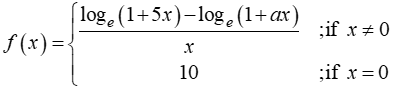 be continuous at \( x=0 \). Then \( \alpha \) is equal to