If the functions \( f(x)=\frac{x^{3}}{3}+2bx+\frac{ax^{2}}{2} \) and \( g(x)=\frac{x^{3}}{3}+ax+bx^{2} \), \( a \neq 2b \) have a common extreme point, then \( a+2b+7 \) is equal to:
The solution of the differential equation \( \frac{dy}{dx}=\left(\frac{x^{2}+3y^{2}}{3x^{2}+y^{2}}\right) \), \( y(1)=0 \) is:
A vector \( \vec{v} \) in the first octant is inclined to the x-axis at \( 60^\circ \), to the y-axis at \( 45^\circ \) and to the z-axis at an acute angle. If a plane passing through the points \( (\sqrt{2},-1,1) \) and \( (a,b,c) \), is normal to \( \vec{v} \), then:
Let \( \vec{a} \) and \( \vec{b} \) be two vectors, let \( \lvert \vec{a} \rvert =1 \), \( \lvert \vec{b} \rvert =4 \) and \( \vec{a}\cdot \vec{b}=2 \). If \( \vec{c}=(2\vec{a}\times \vec{b})-3\vec{b} \), then the value of \( \vec{b}\cdot \vec{c} \) is:
If \( P \) is a \( 3\times 3 \) real matrix such that \( P^{T}=\alpha P+(\alpha -1)I \), where \( \alpha>1 \), then:
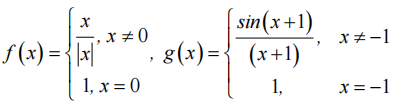
Let \( f \), \( g \) and \( h \) be the real valued functions defined on \( \mathbb{R} \) as:and \( h(x)=2[x]-f(x) \), where \( [x] \) is the greatest integer \( \leq x \).Then the value of \( \lim\limits_{x\to 1} g\!\left(h(x-1)\right) \) is:
The parabolas: \( ax^{2}+2bx+cy=0 \) and \( dx^{2}+2ex+fy=0 \) intersect on the line \( y=1 \). If \( a,b,c,d,e,f \) are positive real numbers and \( a,b,c \) are in G.P., then:
Let \( a_{1}=1,\, a_{2}, a_{3}, a_{4}, \ldots \) be consecutive natural numbers. Then \( \tan^{-1}\!\left(\dfrac{1}{1+a_{1}a_{2}}\right)+\tan^{-1}\!\left(\dfrac{1}{1+a_{2}a_{3}}\right)+\ldots+\tan^{-1}\!\left(\dfrac{1}{1+a_{2021}a_{2022}}\right) \) is equal to:
Let \( a, b, c>1 \), \( a^{3}, b^{3} \) and \( c^{3} \) be in A.P., and \( \log_{a} b, \log_{c} a \) and \( \log_{b} c \) be in G.P. If the sum of first \( 20 \) terms of an A.P., whose first term is \( \dfrac{a+4b+c}{3} \) and the common difference is \( \dfrac{a-8b+c}{10} \) is \( -444 \), then \( abc \) is equal to:
The number of ways of selecting two numbers \( a \) and \( b \), \( a\in\{2,4,6,\ldots,100\} \) and \( b\in\{1,3,5,\ldots,99\} \) such that \( 2 \) is the remainder when \( a+b \) is divided by \( 23 \) is:
The range of the function \( f(x) = \sqrt{3 - x} + \sqrt{2 + x} \) is :
Let \( A \) be a point on the \( x \)-axis. Common tangents are drawn from \( A \) to the curves \( x^{2}+y^{2}=8 \) and \( y^{2}=16x \). If one of these tangents touches the two curves at \( Q \) and \( R \), then \( (QR)^{2} \) is equal to :
Let \( \lambda \in \mathbb{R},\ \vec{a}=\lambda \hat{i}+2\hat{j}-3\hat{k},\ \vec{b}=\hat{i}-\lambda \hat{j}+2\hat{k} \). If \( \big((\vec{a}+\vec{b})\times(\vec{a}\times\vec{b})\big)\times(\vec{a}-\vec{b})=8\hat{i}-40\hat{j}-24\hat{k} \), then \( \left|\lambda\big(\vec{a}+\vec{b})\times(\vec{a}-\vec{b}\big)\right|^{2} \) is equal to :
If a plane passes through the points \(( -1, k, 0)\), \(( 2, k, -1)\), \(( 1, 1, 2)\) and is parallel to the line \( \dfrac{x-1}{1}=\dfrac{2y+1}{2}=\dfrac{z+1}{-1} \), then the value of \( \dfrac{k^{2}+1}{(k-1)(k-2)} \) is :
Consider the following statements :\( P:\) I have fever \( \\ \\ Q:\) I will not take medicine \( \\ \\ R:\) I will take restThe statement “If I have fever, then I will take medicine and I will take rest” is equivalent to :
Let \( q \) be the maximum integral value of \( p \) in \([0,10]\) for which the roots of the equation \( x^{2}-px+\dfrac{5}{4}p=0 \) are rational. Then the area of the region \( \{(x,y): 0\le y \le (x-q)^{2},\ 0\le x \le q\} \) is :
Let \( x = (8\sqrt{3} + 13)^{13} \) and \( y = (7\sqrt{2} + 9)^{9} \). If \( [t] \) denotes the greatest integer \( \le t \), then:
For \( \alpha, \beta \in \mathbb{R} \), suppose the system of linear equations\( x - y + z = 5 \)\( 2x + 2y + \alpha z = 8 \)\( 3x - y + 4z = \beta \)has infinitely many solutions. Then \( \alpha \) and \( \beta \) are the roots of:
Let \( S \) be the set of all values of \( a_{1} \) for which the mean deviation about the mean of \( 100 \) consecutive positive integers \( a_{1}, a_{2}, a_{3}, \ldots, a_{100} \) is \( 25 \). Then \( S \) is:
The number of seven digits odd numbers, that can be formed using all the seven digits \( 1, 2, 2,2, 3, 3, 5 \) is ________.
A bag contains six balls of different colours. Two balls are drawn in succession with replacement. The probability that both the balls are of the same colour is \( p \). Next four balls are drawn in succession with replacement and the probability that exactly three balls are of the same colour is \( q \). If \( p : q = m : n \), where \( m \) and \( n \) are coprime, then \( m + n \) is equal to ________.
Let \( A \) be the area of the region \( \left\{ (x,y) : y \ge x^{2},\ y \ge (1-x)^{2},\ y \le 2x(1-x) \right\} \). Then \( 540A \) is equal to ________.
\( 50^{\text{th}} \) root of a number \( x \) is \( 12 \) and \( 50^{\text{th}} \) root of another number \( y \) is \( 18 \). Then the remainder obtained on dividing \( (x + y) \) by \( 25 \) is __________.
If $\int \sqrt{\sec 2x - 1} \, dx = \alpha \log_e \left| \cos 2x + \beta + \sqrt{\cos 2x \left( 1 + \cos \frac{1}{\beta}x \right)} \right| + \text{constant}$, then $\beta - \alpha$ is equal to ________.
Let a line \( L \) pass through the point \( P(2,3,1) \) and be parallel to the line \( x + 3y - 2z - 2 = 0 = x - y + 2z \). If the distance of \( L \) from the point \( (5,3,8) \) is \( \alpha \), then \( 3\alpha^{2} \) is equal to __________.
If the value of real number \( a>0 \) for which \( x^{2}-5ax+1=0 \) and \( x^{2}-ax-5=0 \) have a common real root is \( \dfrac{3}{\sqrt{2\beta}} \) then \( \beta \) is equal to __________.
The \( 8^{\text{th}} \) common term of the series \(S_{1}=3+7+11+15+19+\ldots \), \( S_{2}=1+6+11+16+21+\ldots \) is __________.
Let \( P(a_{1},b_{1}) \) and \( Q(a_{2},b_{2}) \) be two distinct points on a circle with center \( C(\sqrt{2},\sqrt{3}) \). Let \( O \) be the origin and \( OC \) be perpendicular to both \( CP \) and \( CQ \). If the area of the triangle \( OCP \) is \( \dfrac{\sqrt{35}}{2} \), then \( a_{1}^{2}+a_{2}^{2}+b_{1}^{2}+b_{2}^{2} \) is equal to __________.
Let \( A = \{1, 2, 3, 5, 8, 9\} \). Then the number of possible functions \( f : A \to A \) such that \( f(m \cdot n) = f(m) \cdot f(n) \) for every \( m, n \in A \) with \( m \cdot n \in A \) is equal to _________.