Let \( S = \left\{ z = x + iy : \dfrac{2z - 3i}{4z + 2i} \text{ is a real numbers} \right\} \). Then which of the following is NOT correct?
Let the line \( \dfrac{x}{1}=\dfrac{6-y}{2}=\dfrac{z+8}{5} \) intersect the line \( \dfrac{x-5}{4}=\dfrac{y-7}{3}=\dfrac{z+2}{1} \) and \( \dfrac{x+3}{6}=\dfrac{3-y}{3}=\dfrac{z-6}{1} \) at the point \( A \) and \( B \) respectively. Then the distance of the mid-point of the line segment \( AB \) from the plane \( 2x-2y+z=14 \) is:
Let the number \( (22)^{2022}+(2022)^{22} \) leave the remainder \( \alpha \) when divided by \( 3 \) and \( \beta \) when divided by \( 7 \). Then \( (\alpha^2+\beta^2) \) is equal to:
If the points \( P \) and \( Q \) are respectively the circumcenter and the orthocenter of a \( \triangle ABC \), then \( \overrightarrow{PA}+\overrightarrow{PB}+\overrightarrow{PC} \) is:
Let a circle of radius \( 4 \) be concentric to the ellipse \( 15x^2+19y^2=285 \). Then the common tangents are inclined to the minor axis of the ellipse at the angle.
For \( \alpha, \beta, \gamma, \delta \in \mathbb{N} \), if \( \displaystyle \int \left( \left( \dfrac{x}{e} \right)^{2x} + \left( \dfrac{e}{x} \right)^{2x} \right) \log_e x \, dx = \dfrac{1}{\alpha} \left( \dfrac{e}{x} \right)^{\beta x} - \dfrac{1}{\gamma} \left( \dfrac{e}{x} \right)^{\delta x} + C \), where \( e=\displaystyle \sum_{n=0}^{\infty}\dfrac{1}{n!} \) and \( C \) is constant of integration, then \( \alpha+2\beta+3\gamma-4\delta \) is equal to:
Let a die be rolled \( n \) times. Let the probability of getting odd numbers seven times be equal to the probability of getting even numbers twice is \( \dfrac{k}{2^{15}} \), then \( k \) is equal to:
Let \( f \) be a continuous function satisfying \(\displaystyle \int_{0}^{t^{2}} \left( f(x)+x^{2} \right) \, dx = \frac{4}{3} t^{3}, \, \forall \, t>0 \). Then \(\displaystyle f\!\left( \frac{\pi^{2}}{4} \right) \) is equal to:
Let the image of the point \( P(1, 2, 6) \) in the plane passing through the points \( A(1, 2, 0) \), \( B(1, 4, 1) \) and \( C(0, 5, 1) \) be \( Q(\alpha, \beta, \gamma) \). Then \( \left( \alpha^{2} + \beta^{2} + \gamma^{2} \right) \) is equal to:
Let \(\displaystyle S=\left\{ x \in \left( -\frac{\pi}{2},\, \frac{\pi}{2} \right) : 9^{\,1-\tan^{2}x} + 9^{\,\tan^{2}x} = 10 \right\} \) and \( \beta =\displaystyle \sum\limits_{x\in S} \tan^{2}\!\left( \frac{x}{3} \right) \), then \( \dfrac{1}{6} (\beta - 14)^{2} \) is equal to:
If \( A = \dfrac{1}{5! \; 6! \; 7!} \) , then \( \left| \operatorname{adj}(\operatorname{adj}(2A)) \right| \) is equal to:
Let \( \mu \) be the mean and \( \sigma \) be the standard deviation of the distribution,
Where \( \sum f_{i} = 62 \). If \( [x] \) denotes the greatest integer \( \le x \), then \( \left[ \mu^{2} + \sigma^{2} \right] \) is equal to:
Let \( A \) be the point \( (1, 2) \) and \( B \) be any point on the curve \( x^2 + y^2 = 16 \). If the centre of the locus of the point \( P \), which divides the line segment \( AB \) in the ratio \( 3 : 2 \) is the point \( C(\alpha, \beta) \), then the length of the line segment \( AC \) is:
The statement \( \sim[p \lor (\sim(p \land q))] \) is equivalent to:
Eight persons are to be transported from city \( A \) to city \( B \) in three cars of different makes. If each car can accommodate at most three persons, then the number of ways, in which they can be transported, is:
Let \( g(x) = f(x) + f(1-x) \) and \( f''(x) > 0, \; x \in (0,1) \). If \( g \) is decreasing in the interval \( (0, \alpha) \) and increasing in the interval \( (\alpha, 1) \), then \( \tan^{-1}(2\alpha) + \tan^{-1}\!\left(\dfrac{1}{\alpha}\right) + \tan^{-1}\!\left(\dfrac{\alpha + 1}{\alpha}\right) \) is equal to:
If the coefficients of \( x \) and \( x^2 \) in \( (1+x)^p(1-x)^q \) are \( 4 \) and \( -5 \) respectively, then \( 2p + 3q \) is equal to:
Let \( A = \{2, 3, 4\} \) and \( B = \{8, 9, 12\} \). Then the number of elements in the relation \( R = \{((a_1, b_1), (a_2, b_2)) \in (A \times B, A \times B) : a_1 \text{ divides } b_2 \text{ and } a_2 \text{ divides } b_1\} \) is:
Let \( \vec{a} = 2\hat{i} + 7\hat{j} - \hat{k} \), \( \vec{b} = 3\hat{i} + 5\hat{k} \) and \( \vec{c} = \hat{i} - \hat{j} + 2\hat{k} \). Let \( \vec{d} \) be a vector which is perpendicular to both \( \vec{a} \) and \( \vec{b} \), and \( \vec{c} \cdot \vec{d} = 12 \). Then \( (-\hat{i} + \hat{j} - \hat{k}) \cdot (\vec{c} \times \vec{d}) \) is equal to:
If \( S_n = 4 + 11 + 21 + 34 + 50 + \dots \) to \( n \) terms, then \( \dfrac{1}{60}\,(S_{29} - S_{9}) \) is equal to:
Let the equation of two adjacent sides of a parallelogram \( ABCD \) be \( 2x - 3y = -23 \) and \( 5x + 4y = 23 \). If the equation of its one diagonal \( AC \) is \( 3x + 7y = 23 \) and the distance of \( A \) from the other diagonal is \( d \), then \( 50\,d^2 \) is equal to \( \_\_\_\_\_ \).
Let \( S \) be the set of values of \( \lambda \), for which the system of equations \( 6\lambda x - 3y + 3z = 4\lambda^{2} \),\( 2x + 6\lambda y + 4z = 1 \),\( 3x + 2y + 3\lambda z = \lambda \) has no solution. Then \( 12 \displaystyle\sum_{\lambda \in S} \lvert \lambda \rvert \) is equal to \( \_\_\_\_\_ \).
The sum of all the four-digit numbers that can be formed using all the digits \( 2 \), \( 1 \), \( 2 \), \( 3 \) is equal to ______.
If the area of the region \( \{(x,y): |x^{2}-2| \le y \le x\} \) is \( A \), then \( 6A + 16\sqrt{2} \) is equal to ______
Let the quadratic curve passing through the point \( (-1, 0) \) and touching the line \( y = x \) at \( (1, 1) \) be \( y = f(x) \). Then the x-intercept of the normal to the curve at the point \( (\alpha, \alpha + 1) \) in the first quadrant is ______.
Suppose \( a_{1}, a_{2}, 2, a_{3}, a_{4} \) be in an arithmetico-geometric progression. If the common ratio of the corresponding geometric progression is \( 2 \) and the sum of all \( 5 \) terms of the arithmetico-geometric progression is \( {49}/{2} \), then \( a_{4} \) is equal to ______.
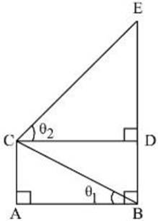
In the figure,\( \theta_{1} + \theta_{2} = \dfrac{\pi}{2} \) and \( \sqrt{3}(BE) = 4(AB) \). If the area of \( \triangle CAB \) is \( 2\sqrt{3} - 3 \) unit\( ^{2} \), when \( \theta_{2}/\theta_{1} \) is the largest, then the perimeter (in unit) of \( \triangle CED \) is equal to ______.
Let the foot of perpendicular from the point \( A(4, 3, 1) \) on the plane \( P : x - y + 2z + 3 = 0 \) be \( N \). If \( B(5, \alpha, \beta), \ \alpha, \beta \in \mathbb{Z} \) is a point on plane \( P \) such that the area of the triangle \( ABN \) is \( 3\sqrt{2} \), then \( \alpha^{2} + \beta^{2} + \alpha\beta \) is equal to ________.
Let the tangent at any point \( P \) on a curve passing through the points \( (1, 1) \) and \( \left(\dfrac{1}{10}, 100\right) \), intersect positive \( x \)-axis and \( y \)-axis at the points \( A \) and \( B \) respectively. If \( PA : PB = 1 : k \) and \( y(x) \) is the solution of the differential equation \( e^{\dfrac{dy}{dx}} = kx + \dfrac{k}{2},\ y(0) = k, \) then \( 4y(1) - 4\log_{e} 3 \) is equal to ______.
If the domain of the function \( f(x)=\sec^{-1}\!\left(\dfrac{2x}{5x+3}\right) \) is \( [\alpha,\beta)\cup(\gamma,\delta] \), then \( \left|3\alpha+10(\beta+\gamma)+21\delta\right| \) is equal to ______.

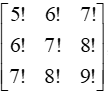 , then \( \left| \operatorname{adj}(\operatorname{adj}(2A)) \right| \) is equal to: