Let \( A = \{(x,y) \in \mathbb{R} \times \mathbb{R} \mid 2x^2 + 2y^2 - 2x - 2y = 1\} \), \( B = \{(x,y) \in \mathbb{R} \times \mathbb{R} \mid 4x^2 + 4y^2 - 16y + 7 = 0\} \) and \( C = \{(x,y) \in \mathbb{R} \times \mathbb{R} \mid x^2 + y^2 - 4x - 2y + 5 \le r^2\} \}\).Then the minimum value of \( |r| \) such that \( A \cup B \subseteq C \) is equal to:
Two tangents are drawn from the point \( P(-1,1) \) to the circle \( x^2 + y^2 - 2x - 6y + 6 = 0 \). If these tangents touch the circle at points \( A \) and \( B \), and if \( D \) is a point on the circle such that length of the segments \( AB \) and \( AD \) are equal, then the area of triangle \( ABD \) is equal to:
Let \( P \) and \( Q \) be two distinct points on a circle which has centre at \( C(2,3) \) and which passes through origin \( O \). If \( OC \) is perpendicular to both the line segments \( CP \) and \( CQ \), then the set \( \{P, Q\} \) is equal to:
The probability that a randomly selected \( 2 \)-digit number belongs to the set \( \{ n \in \mathbb{N} : (2^n - 2) \text{ is a multiple of } 3 \} \) is equal to:
Let \( \mathbb{C} \) be the set of all complex numbers. Let \( S_1 = \{ z \in \mathbb{C} \mid |z - 3 - 2i|^2 = 8 \} \), \( S_2 = \{ z \in \mathbb{C} \mid \operatorname{Re}(z) \ge 5 \} \) and \( S_3 = \{ z \in \mathbb{C} \mid |z - \overline{z}| \ge 8 \} \). Then the number of elements in \( S_1 \cap S_2 \cap S_3 \) is equal to:
The value of \( \displaystyle\lim_{n \to \infty} \dfrac{1}{n} \sum\limits_{j=1}^{n} \dfrac{(2{\,j-1)} + 8n}{(2{\,j-1)} + 4n} \) is equal to:
Let \( \vec{a} = \hat{i} + \hat{j} + 2\hat{k} \) and \( \vec{b} = -\hat{i} + 2\hat{j} + 3\hat{k} \). Then the vector product \( (\vec{a} + \vec{b}) \times \big((\vec{a} \times ((\vec{a} - \vec{b}) \times \vec{b})\times\vec b\big) \) is equal to:
Let \( \alpha, \beta \) be two roots of the equation \( x^{2} + (20)^{1/4}x + (5)^{1/2} = 0 \). Then \( \alpha^{8} + \beta^{8} \) is equal to:
The compound statement \( (p \lor Q) \land (\sim p) \Rightarrow Q \) is equivalent to:
Let \(\displaystyle A = \begin{bmatrix} 1 & 2 \\ -1 & 4 \end{bmatrix}\). If \( A^{-1}=\alpha I+\beta A \), \( \alpha,\beta \in \mathbb{R} \), \( I \) is a \( 2\times2 \) identity matrix, then \( 4(\alpha-\beta) \) is equal to:
Let \( y=y(x) \) be solution of the differential equation \( \log_{e}\!\left(\frac{dy}{dx}\right)=3x+4y \), with \( y(0)=0 \). If \( y\!\left(-\frac{2}{3}\log_{e}2\right)=\alpha \log_{e}2 \), then the value of \( \alpha \) is equal to:
Let \( f:\left[-\frac{\pi}{4},\frac{\pi}{4}\right]\to \mathbb{R} \) be defined as If \( f \) is continuous at \( x=0 \), then the value of \( 6a+b^{2} \) is equal to:
If the coefficient of \( x^7 \) in \( \left(x^2 + \dfrac{1}{bx}\right)^{11} \) and \( x^{-7} \) in \( \left(x - \dfrac{1}{bx^2}\right)^{11} \), \( b \neq 0 \), are equal, then the value of \( b \) is equal to:
If \( \sin \theta + \cos \theta = \frac{1}{2} \), then \( 16(\sin (2\theta) + \cos (4\theta) + \sin (6\theta)) \) is equal to:
A ray of light through \( (2, 1) \) is reflected to a point \( P \) on the \( y \)-axis and then passes through the point \( (5, 3) \). If this reflected ray is the directrix of an ellipse with eccentricity \( \frac{1}{3} \) and the distance of the nearer focus from this directrix is \( \frac{8}{\sqrt{53}} \) then the equation of the other directrix can be:
Let \( f:\mathbb{R} \to \mathbb{R} \) be a function such that \( f(2) = 4 \) and \( f'(2) = 1 \). Then, the value of \( \displaystyle \lim_{x \to 2} \frac{x^2 f(2) - 4 f(x)}{x - 2} \) is equal to:
If the area of the bounded region \( R = \left\{ (x,y) : \max \{0, \log_e x \}\le y \le 2^x, \ \dfrac{1}{2} \le x \le 2 \right\} \) is, \( \alpha (\log_e 2)^{-1} + \beta \log_e 2 + \gamma \), then the value of \( (\alpha + \beta - 2\gamma)^2 \) is equal to:
The value of the definite integral \( \displaystyle \int\limits_{-\pi/4}^{\pi/4} \frac{{d x}}{(1 + e^{x \cos x})(\sin^4 x + \cos^4 x)} \, dx \) is equal to:
If the mean and variance of the following data: \( 6, 10, 7, 13, a, 12, b, 12 \) are \( 9 \) and \( \dfrac{37}{4} \) respectively, then \( (a-b)^2 \) is equal to:
Let the plane passing through the point \( (-1,0,-2) \) and perpendicular to each of the planes \( 2x+y-z=2 \) and \( x-y-z=3 \) be \( ax+by+cz+8=0 \). Then the value of \( a+b+c \) is equal to:
Let \( S=\{1,2,3,4,5,6,7\} \). Then the number of possible functions \( f:S\to S \) such that \( f(m\cdot n)=f(m)\cdot f(n) \) for every \( m,n\in S \) and \( m\cdot n\in S \) is equal to \( \underline{\quad} \).
Let a plane \( P \) pass through the point \( (3,7,-7) \) and contain the line, \( \dfrac{x-2}{-3}=\dfrac{y-3}{2}=\dfrac{z+2}{1} \). If distance of the plane \( P \) from the origin is \( d \), then \( d^2 \) is equal to \( \underline{\quad} \).
If \( \log_3 2, \ \log_3(2^x-5), \ \log_3\!\left(2^x-\dfrac{7}{2}\right) \) are in an arithmetic progression, then the value of \( x \) is equal to \( \underline{\quad} \).
Let the domain of the function \( f(x)=\log_4\!\Big(\log_5\!\big(\log_3(18x-x^2-77)\big)\Big) \) be \( (a,b) \). Then the value of the integral \( \displaystyle \int_a^b \frac{\sin^3 x}{(\sin^3 x+\sin^3(a+b-x))}\,dx \) is equal to \( \underline{\quad} \).
Let \( f : [0,3] \to \mathbb{R} \) be defined by \( f(x) = \min\{x-[x],\, 1+[x]-x\} \) where \( [x] \) is the greater integer less than or equal to \( x \). Let \( P \) denote the set containing all \( x \in [0,3] \) where \( f \) is discontinuous, and \( Q \) denote the set containing all \( x \in (0,3) \) where \( f \) is not differentiable. Then the sum of number of elements in \( P \) and \( Q \) is equal to ________.
Let \( F:(3,5)\to \mathbb{R} \) be a twice differentiable function on \( (3,5) \) such that \( F(x)=e^{-x}\displaystyle \int_{3}^{x}\big(3t^{2}+2t+4F'(t)\big)\,dt \). If \( F'(4)=\dfrac{\alpha e^{\beta}-224}{\left(e^{\beta}-4\right)^{2}} \), then \( \alpha+\beta \) is equal to _________.
If \( y=y(x),\ y\in\left[0,\dfrac{\pi}{2}\right] \) is the solution of the differential equation \( \sec y\,\dfrac{dy}{dx}-\sin(x+y)-\sin(x-y)=0 \), with \( y(0)=0 \), then \( 5y'\!\left(\dfrac{\pi}{2}\right) \) is equal to ________.
Let \( \vec{a}=\hat{i}+\hat{j}-\hat{k},\ \vec{b} \) and \( \vec{c}=\hat{j}-\hat{k} \) be three vectors such that \( \vec{a}\times\vec{b}=\vec{c} \) and \( \vec{a}\cdot\vec{b}=1 \). If the length of projection vector of the vector \( \vec{b} \) on the vector \( \vec{a}\times\vec{c} \) is \( l \) then the value of \( 3l^{2} \) is equal to ________.
For real numbers \( \alpha \) and \( \beta \), consider the following system of linear equations: \( x+y-z=2, \quad x+2y+\alpha z=1, \quad 2x-y+z=\beta \). If the system has infinite solutions, then \( \alpha+\beta \) is equal to ________.
,\( x\in[0,\pi]. \) Then the maximum value of \( f(x) \) is equal to ______.

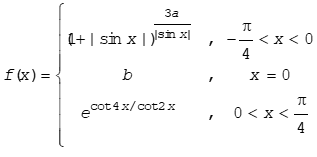 If \( f \) is continuous at \( x=0 \), then the value of \( 6a+b^{2} \) is equal to:
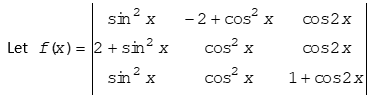 ,\( x\in[0,\pi]. \) Then the maximum value of \( f(x) \) is equal to ______.