Let \( \vec{a} = 2\hat{i} + \hat{j} + \hat{k} \), and \( \vec{b} \) and \( \vec{c} \) be two nonzero vectors such that \( |\vec{a}+\vec{b}+\vec{c}| = |\vec{a}+\vec{b}-\vec{c}| \) and \( \vec{b}\cdot\vec{c} = 0 \). Consider the following two statements:(A) \( |\vec{a}+\lambda \vec{c}| \ge |\vec{a}| \) for all \( \lambda \in \mathbb{R} \)(B) \( \vec{a} \) and \( \vec{c} \) are always parallel.
Let \( \alpha \in (0,1) \) and \( \beta = \log_{e}(1-\alpha) \). Let \( P_{n}(x) = x + \frac{x^{2}}{2} + \frac{x^{3}}{3} + \ldots + \frac{x^{n}}{n},\; x\in(0,1) \).Then the integral \( \displaystyle \int_{0}^{\alpha} \frac{t^{50}}{1-t}\,dt \) is equal to:
For all \( z \in \mathbb{C} \) on the curve \( C_{1}: |z| = 4 \), let the locus of the point \( z + \frac{1}{z} \) be the curve \( C_{2} \). then:
If \( \sin^{-1}\frac{\alpha}{17}\ + \cos^{-1}\frac{4}{5}\ - \tan^{-1}\frac{77}{36}\ = 0 ,\; 0<\alpha<13 \), then \( \sin^{-1}(\sin \alpha) + \cos^{-1}(\cos \alpha) \) is equal to:
(S1) $(p \Rightarrow q) \vee (p \wedge (\sim q))$ is a tautology
(S2) $((\sim p) \Rightarrow (\sim q)) \wedge ((\sim p) \vee q)$ is a contradiction.
Then.
A bag contains \( 6 \) balls. Two balls are drawn from it at random and both are found to be black. The probability that the bag contains at least \( 5 \) black balls is:
. Then the sum of the diagonal elements of the matrix \( (A + I)^{11} \) is equal to:
A wire of length \( 20\,\text{m} \) is to the cut into two pieces. A piece of length \( l_{1} \) is bent to make a square of area \( A_{1} \) and the other piece of length \( l_{2} \) is made into a circle of area \( A_{2} \). If \( 2A_{1}+3A_{2} \) is minimum then \( (\pi l_{1}):l_{2} \) is equal to:
Let the shortest distance between the lines \( L:\; \dfrac{x-5}{-2}=\dfrac{y-\lambda}{0}=\dfrac{z+\lambda}{1},\; \lambda \ge 0 \) and \( L_{1}:\; x+1=y-1=4-z \) be \( 2\sqrt{6} \). If \( (\alpha,\beta,\gamma) \) lies on \( L \), then which of the following is NOT possible?
If the sum and product of four positive consecutive terms of a G.P., are \( 126 \) and \( 1296 \), respectively, then the sum of common ratios of all such GPs is:
Let a circle \( C_{1} \) be obtained on rolling the circle \( x^{2}+y^{2}-4x-6y+11=0 \) upwards \( 4 \) units on the tangent \( T \) to it at the point \( (3,2) \). Let \( C_{2} \) be the image of \( C_{1} \) in \( T \). Let \( A \) and \( B \) be the center of circles \( C_{1} \) and \( C_{2} \) respectively, and \( M \) and \( N \) be respectively the feet of perpendiculars drawn from \( A \) and \( B \) on the \( x \)-axis. Then the area of trapezium \( AMNB \) is:
If the domain of the function $f(x) = \frac{[x]}{1+x^2}$, where $[x]$ is greatest integer $\leq x$, is $[2,6)$, then its range is:
If the maximum distance of normal to the ellipse \( \frac{x^2}{4} + \frac{y^2}{b^2} = 1, \; b < 2 \), from the origin is \( 1 \), then the eccentricity of the ellipse is:
Let $y = f(x) = \sin^3 \left( \frac{\pi}{3} \left( \cos \left( \frac{\pi}{3\sqrt{2}} \left( -4x^3 + 5x^2 + 1 \right)^{\frac{3}{2}} \right) \right) \right)$. Then, at $x = 1$.
The value of \( \displaystyle \int_{\pi/3}^{\pi/2} \frac{2 + 3\sin x}{\sin x (1 + \cos x)} \, dx \) is equal to:
Let \( R \) be a relation on \( \mathbb{N} \times \mathbb{N} \) defined by \( (a,b) R (c,d) \) if and only if \( ad\,(b-c) = bc\,(a-d) \). Then \( R \) is:
The number of real roots of the equation \( \sqrt{x^2 - 4x + 3} + \sqrt{x^2 - 9} = \sqrt{4x^2 - 14x + 6} \), is:
For the system of linear equations\( x + y + z = 6 \)\( \alpha x + \beta y + 7z = 3 \)\( x + 2y + 3x = 14 \),Which of the following is not true?
Let $y=f(x)$ represent a parabola with focus $\left(-\frac{1}{2},0\right)$ and directrix $y=-\frac{1}{2}$. Then $S=\left\{x \in R: \tan^{-1}\left(\sqrt{f(x)}\right)+\sin^{-1}\left(\sqrt{f(x)+1}\right)=\frac{\pi}{2}\right\}$:
Let a differentiable function \( f \) satisfy \( f(x)+\int_{3}^{x}\frac{f(t)}{t}\,dt=\sqrt{x+1}, \, x\geq 3 \). Then \( 12f(8) \) is equal to:
The remainder on dividing \( 5^{99} \) by \( 11 \) is ______.
Let $\alpha > 0$, be the smallest number such that the expansion of $\left( x^{\frac{2}{3}} + \frac{2}{x^3} \right)^{30}$ has a term $\beta x^{-\alpha}, \beta \in N$.
Then $\alpha$ is equal to _____.
Let \( 5 \) digit numbers be constructed using the digits \( 0,2,3,4,7,9 \) with repetition allowed, and are arranged in ascending order with serial numbers. Then the serial number of the number \( 42923 \) is_______.
Number of \( 4 \)-digit numbers that are less than or equal to \( 2800 \) and either divisible by \( 3 \) or by \( 11 \), is equal to ____.
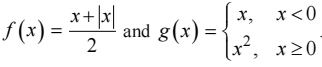
Let for \( x \in \mathbb{R} \),Then area bounded by the curve \( y = (fog)(x) \) and the lines \( y = 0 \), \( 2y - x = 15 \) is equal to _____.
Let \( \vec{a} \) and \( \vec{b} \) be two vectors such that \( |\vec{a}| = \sqrt{14} \), \( |\vec{b}| = \sqrt{6} \) and \( |\vec{a} \times \vec{b}| = \sqrt{48} \). Then \( (\vec{a} \cdot \vec{b})^{2} \) is equal to _____.
Let \( a_{1}, a_{2}, \ldots, a_{n} \) be in A.P. If \( a_{5} = 2a_{7} \) and \( a_{11} = 18 \), then \( 12\!\left(\dfrac{1}{\sqrt{a_{10}}+\sqrt{a_{11}}} + \dfrac{1}{\sqrt{a_{11}}+\sqrt{a_{12}}} + \ldots + \dfrac{1}{\sqrt{a_{17}}+\sqrt{a_{18}}}\right) \) is equal to _____.
If the variance of the frequency distribution
is \( 3 \), then \( \alpha \) is equal to _____.
Let $\theta$ be the angle between the planes $P_1 : \vec{r} \cdot (\hat{i} + \hat{j} + 2\hat{k}) = 9$ and $P_2 : \vec{r} \cdot (2\hat{i} - \hat{j} + \hat{k}) = 15$. Let $L$ be the line that meets $P_2$ at the point $(4,-2,5)$ and makes an angle $\theta$ with the normal of $P_2$. If $\alpha$ is the angle between $L$ and $P_2$, then $(\tan^2 \theta)(\cot^2 \alpha)$ is equal to _____.
Let the line \( L : \dfrac{x-1}{2} = \dfrac{y+1}{-1} = \dfrac{z-3}{1} \) intersect the plane \( 2x + y + 3z = 16 \) at the point \( P \). Let the point \( Q \) be the foot of perpendicular from the point \( R(1,-1,-3) \) on the line \( L \). If \( \alpha \) is the area of triangle \( PQR \), then \( \alpha^{2} \) is equal to _____.

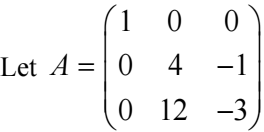 . Then the sum of the diagonal elements of the matrix \( (A + I)^{11} \) is equal to: