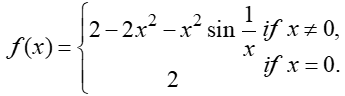
Let \( \mathbb{R} \) denote the set of all real numbers. Let \( f : \mathbb{R} \to \mathbb{R} \) be an arbitrary function and let \( g : \mathbb{R} \to \mathbb{R} \) be the function defined by \( g(x) = x f(x) \), for all \( x \in \mathbb{R} \).
Then which of the following statements is (are) TRUE?
Let \( S \) be the set of all \( (\alpha,\beta) \in \mathbb{R} \times \mathbb{R} \) such that
\( \displaystyle \lim_{x \to \infty} \frac{\sin(x^2)(\log_e x)^{\alpha} \sin\!\left(\frac{1}{x^2}\right)}{x^{\alpha\beta}\,(\log_e(1+x))^{\beta}} = 0 \)
The which of the following is (are) correct?