List-I contains various reaction sequences and List-II contains different phenolic compounds. Match each entry in List-I with the appropriate entry in List-II and choose the correct option.
P-\( 2 \), Q-\( 3 \), R-\( 4 \), S-\( 5 \)
P-\( 2 \), Q-\( 3 \), R-\( 5 \), S-\( 1 \)
P-\( 3 \), Q-\( 5 \), R-\( 4 \), S-\( 1 \)
P-\( 3 \), Q-\( 2 \), R-\( 5 \), S-\( 4 \)
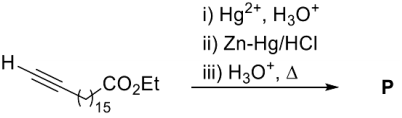
In the following reaction sequence, the major product P is formed. Glycerol reacts completely with excess P in the presence of an acid catalyst to form Q. Reaction of Q with excess \( \text{NaOH} \) followed by the treatment with \( \text{CaCl}_{2} \) yields Ca-soap R, quantitatively. Starting with one mole of Q, the amount of R produced in gram is ______.[Given, atomic weight: \( \text{H} = 1 \), \( \text{C} = 12 \), \( \text{N} = 14 \), \( \text{O} = 16 \), \( \text{Na} = 23 \), \( \text{Cl} = 35 \), \( \text{Ca} = 40 \)]
Reaction of iso-propylbenzene with \( \mathrm{O_2} \) followed by the treatment with \( \mathrm{H_3O^+} \) forms phenol and a by-product \( P \). Reaction of \( P \) with \( 3 \) equivalents of \( \mathrm{Cl_2} \) gives compound \( Q \). Treatment of \( Q \) with \( \mathrm{Ca(OH)_2} \) produces compound \( R \) and calcium salt \( S \).The correct statement(s) regarding \( P \), \( Q \), \( R \) and \( S \) is(are):