The figure shows a circuit having eight resistances of \(1\,\Omega\) each, labelled \(R_1\) to \(R_8\), and two ideal batteries with voltages \( \varepsilon_1 = 12\,\text{V} \) and \( \varepsilon_2 = 6\,\text{V} \).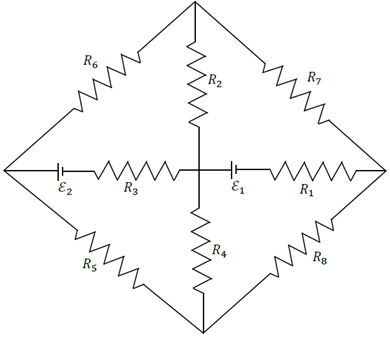
Which of the following statement(s) is(are) correct?
A metal wire of cross-sectional area \(0.5 \, \text{mm}^2\) and length \(100 \, \text{m}\) is connected across a battery of e.m.f. \(2 \, \text{V}\) and internal resistance \(1 \, \Omega\). The density, atomic mass and electrical conductivity of the metal are \(6.35 \times 10^{3} \, \text{kg}/\text{m}^{3}\), \(63.5 \, \text{gm}/\text{mole}\) and \(2 \times 10^{8} \, \text{mho m}^{-1}\) respectively. Assuming one conduction electron per atom of the metal, the drift velocity (in \(\text{mm s}^{-1}\)) of the electrons in the wire is:
[Take Avogadro’s number as \(6 \times 10^{23}\) and charge of the electron as \(1.6 \times 10^{-19} \, \text{C}\).]