The total number of possible isomers for \( [\text{Pt}(\text{NH}_3)_4\text{Cl}_2]\text{Br}_2 \) is \( \_\_\_\_\_ \).
Among the following complexes, the total number of diamagnetic species is ____________.\( [\text{Mn(NH}_{3})_{6}]^{3+} \), \( [\text{MnCl}_{6}]^{3-} \), \( [\text{FeF}_{6}]^{3-} \), \( [\text{CoF}_{6}]^{3-} \), \( [\text{Fe(NH}_{3})_{6}]^{3+} \), and \( [\text{Co(en)}_{3}]^{3+} \)[Given, atomic number: \( \text{Mn} = 25 \), \( \text{Fe} = 26 \), \( \text{Co} = 27 \); en \( = \text{H}_{2}\text{NCH}_{2}\text{CH}_{2}\text{NH}_{2} \)]
LIST-I contains metal species and LIST-II contains their properties.
[Given: Atomic number of \( \mathrm{Cr} = 24 \), \( \mathrm{Ru} = 44 \), \( \mathrm{Fe} = 26 \)]Match each metal species in LIST-I with their properties in LIST-II, and choose the correct option:
PARAGRAPH – 2When potassium iodide is added to an aqueous solution of potassium ferricyanide, a reversible reaction is observed in which a complex P is formed. In a strong acidic medium, the equilibrium shifts completely towards P. Addition of zinc chloride to P in a slightly acidic medium results in a sparingly soluble complex Q.The number of zinc ions present in the molecular formula of Q is _____.
The correct option(s) about entropy \( (S) \) is(are)
Among \( \text{V(CO)}_{6} \), \( \text{Cr(CO)}_{5} \), \( \text{Cu(CO)}_{3} \), \( \text{Mn(CO)}_{5} \), \( \text{Fe(CO)}_{5} \), \( [\text{Co(CO)}_{3}]^{3-} \), \( [\text{Cr(CO)}_{4}]^{+} \) and \( \text{Ir(CO)}_{3} \), the total number of species isoelectronic with \( \text{Ni(CO)}_{4} \) is ______.[Given, atomic number: \( \text{V} = 23 \), \( \text{Cr} = 24 \), \( \text{Mn} = 25 \), \( \text{Fe} = 26 \), \( \text{Co} = 27 \), \( \text{Ni} = 28 \), \( \text{Cu} = 29 \), \( \text{Ir} = 77 \)]
Consider that the coordinating atoms of the ligands in \( \text{cis-}[ \mathrm{Co(NH_3)_4Cl_2}] \mathrm{Cl} \) and \( \text{mer-}[ \mathrm{Co(NH_3)_3Cl_3}] \) octahedral complexes are at the vertices of an octahedron. The sum of total number of the triangular faces in both the complexes having one \( \mathrm{N} \) atom and two \( \mathrm{Cl} \) atoms at their corners is ________.
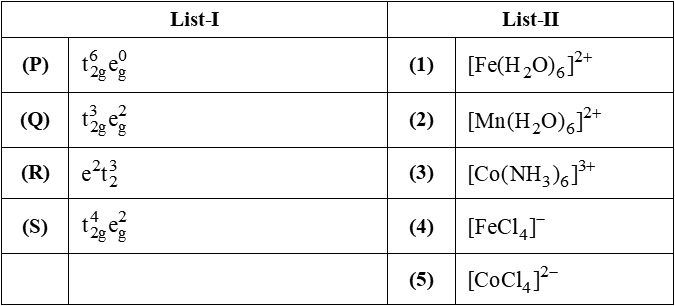
Match the electronic configurations in List-I with appropriate metal complex ions in List-II and choose the correct option. [Atomic Number : Fe= 26, Mn = 25, Co= 27]
The correct order of the wavelength maxima of the absorption band in the ultraviolet-visible region for the given complexes is:
The calculated spin only magnetic moments of \( [\mathrm{Cr(NH_3)_6}]^{3+} \) and \( [\mathrm{CuF_6}]^{3-} \) in \( \text{BM} \), respectively, are: (Atomic numbers of \( \mathrm{Cr} \) and \( \mathrm{Cu} \) are \( 24 \) and \( 29 \), respectively)
Among \( [\mathrm{Co(CN)}_{4}]^{4-}, [\mathrm{Co(CO)}_{3}(\mathrm{NO})], \mathrm{XeF}_{4}, [\mathrm{PCl}_{4}]^{+}, [\mathrm{PdCl}_{4}]^{2-}, [\mathrm{ICl}_{4}]^{-}, [\mathrm{Cu(CN)}_{4}]^{3-} \) and \( \mathrm{P}_{4} \) the total number of species with tetrahedral geometry is ________.
The complex(es), which can exhibit the type of isomerism show by \( \left[ \mathrm{Pt}\left(\mathrm{NH_3}\right)_2 \mathrm{Br_2} \right] \), is (are) \([ \mathrm{en} = \mathrm{H_2NCH_2CH_2NH_2} ]\):