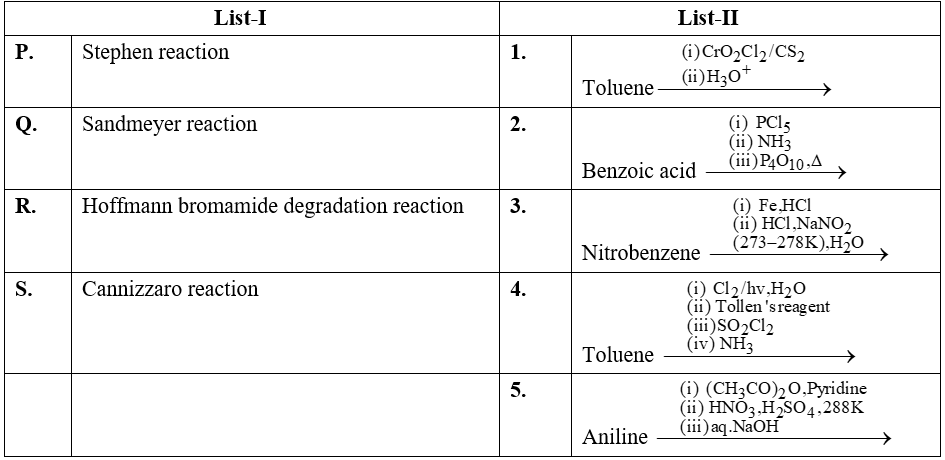
The major products obtained from the reactions in List-II are the reactants for the named reactions mentioned in List-I. Match each entry in List-I with the appropriate entry in List-II choose the correct option.
\( P \to 2; \ Q \to 4; \ R \to 1; \ S \to 3 \)
\( P \to 2; \ Q \to 3; \ R \to 4; \ S \to 1 \)
\( P \to 5; \ Q \to 3; \ R \to 4; \ S \to 2 \)
\( P \to 5; \ Q \to 4; \ R \to 2; \ S \to 1 \)
Paragraphs-2A trinitro compound, \( 1,3,5 \)-tris-\( (4\text{-nitrophenyl}) \) benzene, on complete reaction with an excess of \( \text{Sn/HCl} \) gives a major product, which on treatment with an excess of \( \text{NaNO}_2 / \text{HCl} \) at \( 0^\circ \text{C} \) provides \( P \) as the product. \( P \), upon treatment with excess of \( \text{H}_2\text{O} \) at room temperature, gives the product \( Q \). Bromination of \( Q \) in aqueous medium furnishes the product \( R \). The compound \( P \) upon treatment with an excess of phenol under basic conditions gives the product \( S \).The molar mass difference between compounds \( Q \) and \( R \) is \( 474 \, \text{g mol}^{-1} \) and between compounds \( P \) and \( S \) is \( 172.5 \, \text{g mol}^{-1} \).The total number of carbon atoms and heteroatoms present in one molecule of \( S \) is ______.[Use: Molar mass \( (\text{in } \text{g mol}^{-1}) \): \( \text{H} = 1 \), \( \text{C} = 12 \), \( \text{N} = 14 \), \( \text{O} = 16 \), \( \text{Br} = 80 \), \( \text{Cl} = 35.5 \) Atoms other than \( \text{C} \) and \( \text{H} \) are considered as heteroatoms]
For the reaction sequence given below, the correct statement(s) is (are):
The total number of \( \text{sp}^2 \) hybridised carbon atoms in the major product \( P \) (a non-heterocyclic compound) of the following reaction is _______.