For a reversible reaction \( R \rightleftharpoons P \), at constant temperature, both the forward and the backward reactions are first order elementary reactions with rate constants \( k_f \) and \( k_b \), respectively. At time zero, the concentration of \( R \) is \( [R]_0 \) and the concentration of \( P \) is zero. At any given time, \( [R] \) and \( [P] \) are the concentrations of \( R \) and \( P \), respectively. If \( k_b = 4k_f \), the correct graphical representation of the reaction is:
For the reaction, $X\text{ (s)} \rightleftharpoons Y\text{ (s)} + Z\text{ (g)}$, the plot of $\ln \frac{p_Z}{p^{\phi}}$ versus $\frac{10^4}{T}$ is given below (in solid line), where $p_Z$ is the pressure (in bar) of the gas $Z$ at temperature $T$ and $p^{\phi} = 1\text{ bar}$.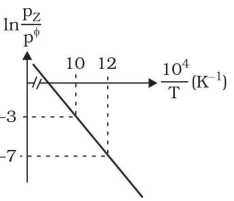
(Given, $\frac{\text{d}(\ln K)}{\text{d}\left(\frac{1}{T}\right)} = -\frac{\Delta H^{\phi}}{R}$, where the equilibrium constant, $K = \frac{p_Z}{p^{\phi}}$ and gas constant, $R = 8.314\text{ J K}^{-1}\text{ mol}^{-1}$)
The value of $\Delta S^{\phi}$ (in $\text{J K}^{-1}\text{ mol}^{-1}$) for the given reaction, at $1000\text{K}$ is _______.
