, where \( |A| \) denotes the determinant of \( A \). Then the number of elements in \( S \) is ________.
Let \(\displaystyle I = \begin{pmatrix} 1 & 0 \\ 0 & 1 \end{pmatrix} \text{ and } P = \begin{pmatrix} 2 & 0 \\ 0 & 3 \end{pmatrix}. \text{ Let } Q = \begin{pmatrix} x & y \\ z & 4 \end{pmatrix}\)for some non-zero real numbers \( x, y \) and \( z \), for which there is a \( 2 \times 2 \) matrix \( R \) with all entries being non-zero real numbers, such that \( Q R = R P \). Then which of the following statements is (are) TRUE?
Let \( M=(a_{ij}),\, i,j\in\{1,2,3\} \), be the \( 3\times3 \) matrix such that \( a_{ij}=1 \) if \( j+1 \) is divisible by \( i \), otherwise \( a_{ij}=0 \). Then which of the following statements is(are) true?
For any \( 3 \times 3 \) matrix \( M \), let \( |M| \) denote the determinant of \( M \). Let If \( Q \) is a nonsingular matrix of order \( 3 \times 3 \), then which of the following statements is (are) TRUE?
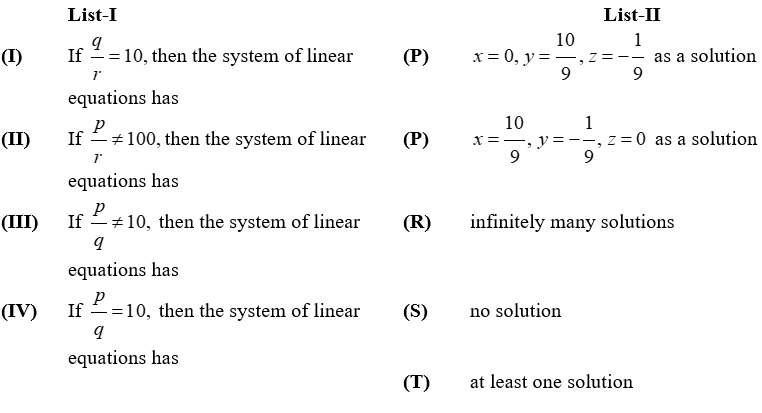
Let \( p, q, r \) be nonzero real numbers that are, respectively, the \( 10^{\text{th}} \), \( 100^{\text{th}} \) and \( 1000^{\text{th}} \) terms of a harmonic progression. Consider the system of linear equations\( x + y + z = 1 \Rightarrow 10x + 100y + 1000z = 0 \Rightarrow q r x + p r y + p q z = 0 \)The correct option is:
Let \( R \) denote the set of all real numbers and let \( i = \sqrt{-1} \), Consider the matrices . Let \( a, b, c, d \) be real numbers such that .Let $H = \{x + iy : \quad x,y \in \mathbb{R} \text{ and } y > 0\}$Then which of the following statements is (are) TRUE?
Let \( \beta \) be a real number. Consider the matrix \(\displaystyle A = \begin{pmatrix} \beta & 0 & 1 \\ 2 & 1 & -2 \\ 3 & 1 & -2 \end{pmatrix}\)If \( A^{7} - (\beta - 1)A^{6} - \beta A^{5} \) is a singular matrix, then the value of \( 9\beta \) is ________________.
Then the number of invertible matrices in \( R \) is:
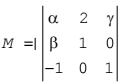
Let \( \alpha, \beta \) and \( \gamma \) be real numbers such that the system of linear equations\( x + 2y + 3z = \alpha \)\( 4x + 5y + 6z = \beta \)\( 7x + 8y + 9z = \gamma - 1 \)is consistent. Let \( |M| \) represent the determinant of the matrix Let \( P \) be the plane containing all those \( (\alpha, \beta, \gamma) \) for which the above system of linear equations is consistent, and \( D \) be the square of the distance of the point \( (0, 1, 0) \) from the plane \( P \).The value of \( D \) is _______.
For \( 3 \times 3 \) matrix \( M \), let \( |M| \) denote the determinant of \( M \). Let \( I \) be the \( 3 \times 3 \) identity matrix. Let \( E \) and \( F \) be two \( 3 \times 3 \) matrices such that \( (I - EF) \) is invertible. If \( G = (I - EF)^{-1} \), then which of the following statements is(are) TRUE?
Which one of the following matrices can be obtained by performing elementary row transformations on the \( 3\times 3 \) identity matrix?
Consider the matrix . Let \( p, q, r, s, a, b, c \) and \( d \) be integers such that .Then which of the following statements is (are) TRUE?
Let \( \alpha, \beta \) and \( \gamma \) be real numbers such that the system of linear equations\( x + 2y + 3z = \alpha \)\( 4x + 5y + 6z = \beta \)\( 7x + 8y + 9z = \gamma - 1 \)is consistent. Let \( |M| \) represent the determinant of the matrix Let \( P \) be the plane containing all those \( (\alpha, \beta, \gamma) \) for which the above system of linear equations is consistent, and \( D \) be the square of the distance of the point \( (0, 1, 0) \) from the plane \( P \).The value of \( |M| \) is _______.
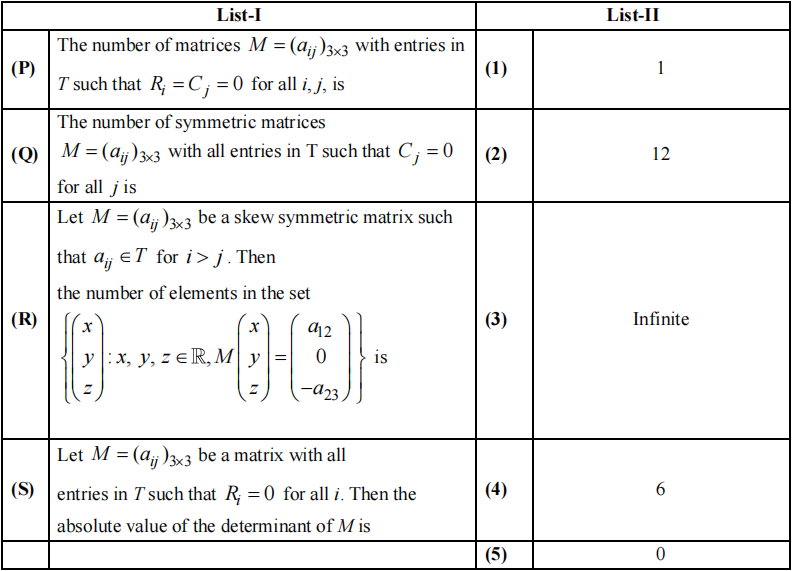
Let \( \alpha \) and \( \beta \) be the distinct roots of the equation \( x^2 + x - 1 = 0 \). Consider the set \( T = \{1, \alpha, \beta\} \). For a \( 3 \times 3 \) matrix \( M = (a_{ij})_{3 \times 3} \), define \( R_i = a_{i1} + a_{i2} + a_{i3} \) and \( C_j = a_{1j} + a_{2j} + a_{3j} \) for \( i = 1, 2, 3 \) and \( j = 1, 2, 3 \).Match each entry in List-I to the correct entry in List-II.
The correct option is:
Consider the matrix \(\displaystyle P = \begin{pmatrix} 2 & 0 & 0 \\ 0 & 2 & 0 \\ 0 & 0 & 3 \end{pmatrix}\).Let the transpose of a matrix \( X \) be denoted by \( X^T \). Then the number of \( 3\times 3 \) invertible matrices \( Q \) with integer entries, such that \( Q^{-1}=Q^T \) and \( PQ=QP \) is:



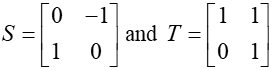 . Let \( a, b, c, d \) be real numbers such that
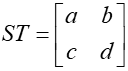 .

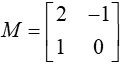 . Let \( p, q, r, s, a, b, c \) and \( d \) be integers such that
 .