The greatest integer less than or equal to \( \displaystyle \int_{1}^{2}\log_{2}(x^{3}+1)\,dx+\int_{1}^{\log_{2}9}(2^{x}-1)^{1/3}\,dx \) is ________.
Let \( \psi_1 : [0,\infty) \to \mathbb{R},\; \psi_2 : [0,\infty) \to \mathbb{R},\; f : [0,\infty) \to \mathbb{R} \) and \( g : [0,\infty) \to \mathbb{R} \) be functions such that \( f(0)=g(0)=0 \),\( \psi_1(x)=e^{-x}+x,\; \quad x\ge 0, \)\( \psi_2(x)=x^2-2x-2e^{-x}+2,\; \quad x\ge 0, \)\( f(x)=\displaystyle \int_{-x}^{x} (|t|-t^2)e^{-t^2}\,dt,\;\quad x>0 \)and\( g(x)=\displaystyle \int_{0}^{x^2} \sqrt{t}\,e^{-t}\,dt,\; \quad x>0 \)Which of the following statements is TRUE?
Let \( f:\left[-\dfrac{\pi}{2}, \dfrac{\pi}{2}\right] \to \mathbb{R} \) be a continuous function such that \( f(0)=1 \) and \( \displaystyle \int_{0}^\dfrac{\pi}{3} f(t)\,dt = 0 \). Then which of the following statements is (are) TRUE?
Consider the curve \( C_{1} \) given by \( y=e^{-x} \) for \( x\in[0,10\pi] \), and the curve \( C_{2} \) given by \( y=e^{-x}(\sin x+\cos x) \) for \( x\in[0,10\pi] \).Let \( n \) be the total number of points of intersection of the curves \( C_{1} \) and \( C_{2} \).Suppose that \( \alpha_{1},\alpha_{2},\ldots,\alpha_{n}\in[0,10\pi] \) are the \( x \)-coordinates of the points of intersection of the curves \( C_{1} \) and \( C_{2} \) such that \( \alpha_{1}<\alpha_{2}<\ldots<\alpha_{n} \). Let \( \beta \) be the area of the region enclosed between the curves \( C_{1}, C_{2} \), and the lines \( x=\alpha_{1} \) and \( x=\alpha_{4} \). Then the value of \( -\frac{1}{\pi}\log_{e}\!\left(\beta-2e^{-\pi/2}\right) \) is __________.
Let \( \mathbb{R} \) denote the set of all real numbers. Then the area of the region \( \left\{ (x,y) \in \mathbb{R} \times \mathbb{R} : x > 0, \, y > \dfrac{1}{x}, \, 5x - 4y - 1 > 0, \, 4x + 4y - 17 < 0 \right\} \)
The area of the region \( \{(x,y): 0 \le x \le \frac{9}{4},\, 0 \le y \le 1,\, x \ge 3y,\, x + y \ge 2\} \) is:
PARAGRAPH – 2Let \( f : \left[0, \frac{\pi}{2}\right] \to [0,1] \) be the function defined by \( f(x) = \sin^{2} x \) and let \( g : \left[0, \frac{\pi}{2}\right] \to [0, \infty) \) be the function defined by \( g(x) = \sqrt{\frac{\pi x}{2} - x^{2}} \).The value of \( \dfrac{16}{\pi^{3}} \int_{0}^{\pi/2} f(x) g(x) \, dx \) is ____________.
Let \( f : [0,1] \to [0,1] \) be the function defined by \( f(x) = \frac{x^3}{3} - x^2 + \frac{5}{9}x + \frac{17}{36} \). Consider the square region \( S = [0,1] \times [0,1] \). Let \( G = \{(x,y) \in S : y > f(x)\} \) be called the green region and \( R = \{(x,y) \in S : y < f(x)\} \) be called the red region. Let \( L_h = \{(x,h) \in S : x \in [0,1]\} \) be the horizontal line drawn at a height \( h \in [0,1] \). Then which of the following statements is(are) true?
Let \( g_i : \left[\frac{\pi}{8}, \frac{3\pi}{8}\right] \to \mathbb{R}, \, i=1,2, \) and \( f : \left[\frac{\pi}{8}, \frac{3\pi}{8}\right] \to \mathbb{R} \) be functions such that \( g_1(x) = 1, \, g_2(x) = |4x - \pi| \) and \( f(x) = \sin^2 x \), for all \( x \in \left[\frac{\pi}{8}, \frac{3\pi}{8}\right] \).Define \( S_i = \int\limits_\dfrac{\pi}{8}^\dfrac{3\pi}{8} f(x) \cdot g_i(x) \, dx, \quad i=1,2 \).The value of \( \frac{16 S_1}{\pi} \) is ________.
Consider the curve \( C_{1} \) given by \( y=e^{-x} \) for \( x\in[0,10\pi] \), and the curve \( C_{2} \) given by \( y=e^{-x}(\sin x+\cos x) \) for \( x\in[0,10\pi] \).Let \( n \) be the total number of points of intersection of the curves \( C_{1} \) and \( C_{2} \). Suppose that \( \alpha_{1},\alpha_{2},\ldots,\alpha_{n}\in[0,10\pi] \) are the \( x \)-coordinates of the points of intersection of the curves \( C_{1} \) and \( C_{2} \) such that \( \alpha_{1}<\alpha_{2}<\ldots<\alpha_{n} \).The value of \( n \) is ____.
Let \( S=\{(x,y)\in \mathbb{R}\times \mathbb{R}: \ge 0,\, y\ge 0,\, y^{2}\le 4x,\, y^{2}\le 12-2x \text{ and } 3y+\sqrt{8}\,x\le 5\sqrt{8}\} \). If the are of the region \( S \) is \( \alpha \sqrt{2} \), then \( \alpha \) is equal to:
For positive integer \( n \), define \( f(n) = n +\displaystyle \frac{16 + 5n - 3n^2}{4n + 3n^2} + \frac{32 + n - 3n^2}{8n + 3n^2} + \ldots + \frac{25n - 7n^2}{7n^2} \). Then, the value of \( \displaystyle\lim_{n \to \infty} f(n) \) is equal to:
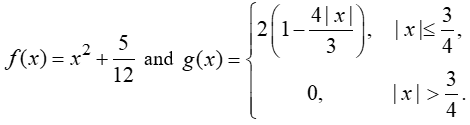
Consider the functions \( f,g:\mathbb{R}\to\mathbb{R} \) defined byIf \( \alpha \) is the area of the region \( \Big\{(x,y)\in\mathbb{R}\times\mathbb{R}:|x|\le \dfrac{3}{4},\,0\le y\le \min\{f(x),g(x)\}\Big\} \), then the value of \( 9\alpha \) is ________________.
Let \( g_i : \left[\frac{\pi}{8}, \frac{3\pi}{8}\right] \to \mathbb{R}, \, i=1,2, \) and \( f : \left[\frac{\pi}{8}, \frac{3\pi}{8}\right] \to \mathbb{R} \) be functions such that \( g_1(x) = 1, \, g_2(x) = |4x - \pi| \) and \( f(x) = \sin^2 x \), for all \( x \in \left[\frac{\pi}{8}, \frac{3\pi}{8}\right] \).Define \( S_i = \displaystyle\int\limits_{\pi/8}^{3\pi/8} f(x) \cdot g_i(x) \, dx, \quad i=1,2 \).The value of \( \frac{48 S_2}{\pi^2} \) is ______.
The value of the definite integral \( \int_{0}^{2}\dfrac{1}{3^{x}+3}\,dx \) is:
Let the function \( f : [1, \infty) \to \mathbb{R} \) be defined byDefine \( g(x) = \int_{1}^{x} f(t) dt, \ x \in (1, \infty) \). Let \( \alpha \) denote the number of solutions of the equation \( g(x) = 0 \) in the interval \( (1, 8] \) and \( \beta = \displaystyle \lim_{x \to 1^{+}} \dfrac{g(x)}{x - 1} \). Then the value of \( \alpha + \beta \) is equal to __________.