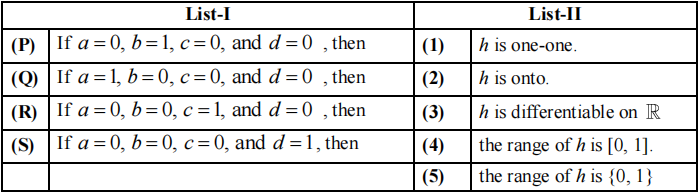
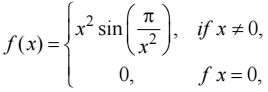
Let \( \mathbb{R} \) denote the set of all real numbers. Consider the polynomial function \( f:\mathbb{R}\to\mathbb{R} \) defined by
\( f(x)=\dfrac{d^{10}}{dx^{10}}\!\left((x^{2}-1)^{10}\right) \), for all \( x\in\mathbb{R} \).
Here \( \dfrac{d^{10}}{dx^{10}}\!\left((x^{2}-1)^{10}\right) \) is the \( 10^{\text{th}} \) order derivative of the function \( (x^{2}-1)^{10} \).
Then which of the following statements is (are) TRUE?
Let \( \mathbb{R} \) denote the set of all real numbers. Let \( f:\mathbb{R}\to\mathbb{R} \) and \( g:\mathbb{R}\to(0,4) \) be functions defined by \( f(x)=\log_e\!\left(x^2+2x+4\right) \), and \( g(x)=\dfrac{4}{1+e^{-2x}} \). Define the composite function \( f\circ g^{-1} \) by \( (f\circ g^{-1})(x)=f\!\left(g^{-1}(x)\right) \), where \( g^{-1} \) is the inverse of the function \( g \).
Then the value of the derivative of the composite function \( f\circ g^{-1} \) at \( x=2 \) is ___________.