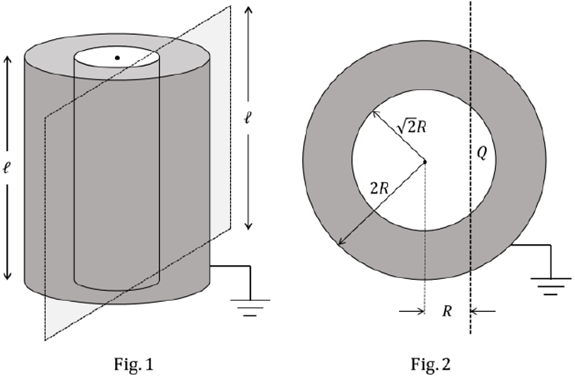
Two co-axial conducting cylinders of same length \( \ell \) with radii \( \sqrt{2}\,R \) and \( 2R \) are kept, as shown in Figure \( 1 \). The charge on the inner cylinder is \( Q \) and the outer cylinder is grounded. The annular region between the cylinders is filled with a material of dielectric constant \( K = 5 \). Consider an imaginary plane of the same length \( \ell \) at a distance \( R \) from the common axis of the cylinders. This plane is parallel to the axis of the cylinders. The cross-sectional view of this arrangement is shown in Figure \( 2 \). Ignoring edge effects, the flux of the electric field through the plane is (\( \in_{0} \) is the permittivity of free space):
![]()
![]()
